
What Is Evolution? Natural Selection Explained Simply
- 0 views
- 0 likes
- 0 comments
- All languages combined
 +99
Sign in and earn +99 points by reading this
Read to the end, wait a few seconds, then tap the claim button below.
In short
Evolution is descent with inherited modification: populations of living things change over generations as the genetic make-up of each generation shifts [1][3]. Natural selection is one of its main mechanisms, alongside mutation, migration and genetic drift [2]. Fossils, anatomy, DNA and experiments that track change in real time all support it [4][6][10].
Key takeaways
- In biology, evolution means descent with inherited modification, from small shifts in gene versions in one population to the origin of new species from shared ancestors [1].
- Natural selection needs three things: variation in a trait, differences in how many offspring individuals leave, and heredity of that trait [2].
- Mutation creates new genetic variation; selection, genetic drift and migration change how common each variant becomes [2][3].
- Individuals do not evolve during their lifetime; populations evolve across generations [1][2].
- Independent lines of evidence agree: the order of fossils in rock, transitional fossils such as Tiktaalik, shared anatomy, and DNA comparisons [6][9][10].
- Evolution can be observed directly, for example in a laboratory experiment with E. coli running for more than 60,000 generations and in bacteria that become resistant to antibiotics [6][7][12].
- In science, a theory is a comprehensive explanation supported by a vast body of evidence, not a guess [4].
On this page 12 sections
- What is evolution in biology?
- What is natural selection and how does it work?
- What are the main mechanisms of evolution besides natural selection?
- What is the evidence for evolution?
- Can we see evolution happen?
- What is the difference between evolution and natural selection?
- Did humans evolve from monkeys?
- Is evolution just a theory?
- Common mistakes
- Frequently asked questions
- Glossary
- Sources
What is evolution in biology?
Evolution in biology is descent with inherited modification: living things pass genes to their offspring, those genes change slowly over many generations, and over long periods this produces new forms of life from shared ancestors [1].
The University of California Museum of Paleontology, which runs the widely used teaching site Understanding Evolution, says the definition covers two scales [1]. Small-scale evolution is a change in how common different versions of a gene are in a population from one generation to the next. Large-scale evolution is the descent of different species from a shared ancestor over many generations [1].
Not every change counts. A caterpillar turning into a moth, a tree losing its leaves in autumn or a mountain range wearing down all change over time, but none of them involves inherited modification passed down a family line, so none is biological evolution [1].
The US National Human Genome Research Institute describes evolution in terms of the genome: mutations create genetic variation, individuals best suited to their surroundings leave more offspring, and over successive generations, sometimes spanning millions of years, a species may change its traits or split into new species [3].
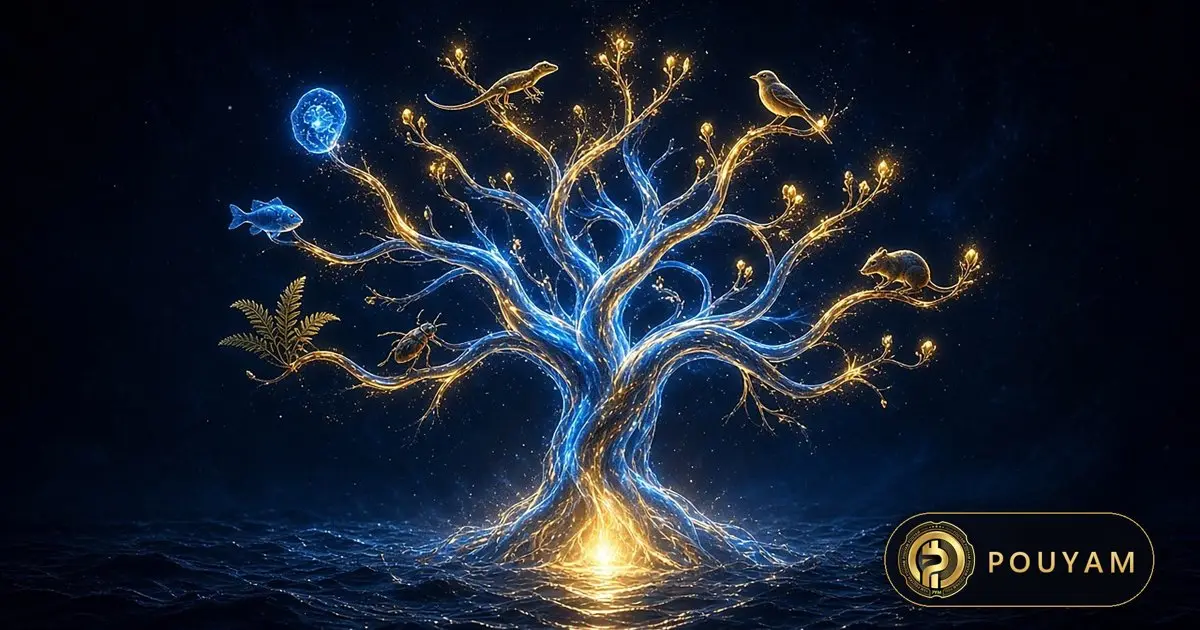
A useful picture is a family tree. Understanding Evolution puts it this way: all life on Earth shares a common ancestor, just as you and your cousins share a grandmother, which makes humans and oak trees, hummingbirds and whales distant cousins [1].
What is natural selection and how does it work?
Natural selection is the process in which inherited traits that help individuals survive and reproduce in a particular environment become more common over generations, simply because their carriers leave more offspring [2].
Understanding Evolution explains it with a population of beetles in three steps [2]:
- Variation: some beetles are green and some are brown.
- Differential reproduction: the environment cannot support unlimited growth, and birds spot and eat green beetles more often, so brown beetles leave more offspring.
- Heredity: colour has a genetic basis, so the survivors pass it on.
The result is that brown becomes more common, and if the pressure continues, the whole population may end up brown. As the museum puts it, if you have variation, differential reproduction and heredity, evolution by natural selection follows [2].
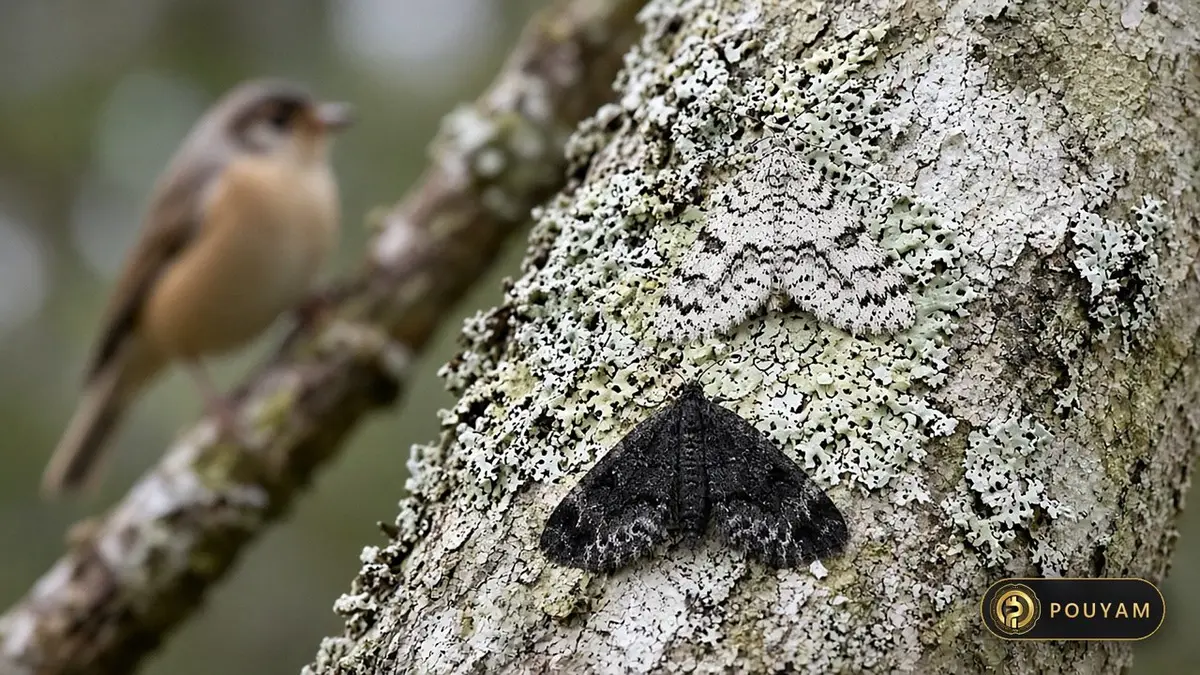
The classic real-world case is the peppered moth in Britain. During the Industrial Revolution, a black form largely replaced the common pale form in polluted areas, driven by bird predation on soot-darkened trees [8]. In 2016, researchers reported in Nature that the mutation behind the black form is a piece of mobile DNA inserted into a gene called cortex, and estimated that it arose around 1819 [8].
Selection can also be measured in the wild. On the Galápagos island of Daphne Major, Peter and Rosemary Grant tracked Darwin’s finches for decades. When a larger competitor species arrived and food ran short, the medium ground finch evolved smaller beaks, the strongest response to selection they recorded in 33 years of study [11].
Charles Darwin set out the idea in On the Origin of Species in 1859, without knowing about genes [5]. Later genetics supplied the missing piece: the inheritance and mutation that natural selection acts upon [3].
What are the main mechanisms of evolution besides natural selection?
Evolution has four basic mechanisms: natural selection, mutation, migration (gene flow) and genetic drift; mutation supplies new variation and the other three change how common each variant becomes [2].
Mutation is a change in DNA. Most mutations have little or no effect, some are harmful, and a few turn out to be useful in a given environment [3]. Without mutation there would be no new raw material for evolution.
Migration or gene flow happens when individuals move between populations and breed, carrying gene versions with them. It tends to make neighbouring populations more alike [2].
Genetic drift is change by chance. In a small population, a gene version can become more or less common just because of which individuals happen to reproduce, regardless of whether it helps or harms [2]. The chimpanzee genome study found that much of the protein-coding change between humans and chimpanzees reflects neutral or slightly harmful variants that spread this way, rather than selection [10].
Sexual selection is a special case of natural selection in which traits help an individual win mates rather than survive, which helps explain features such as bright plumage [2].
These forces act together. Selection is the only one that consistently produces adaptations, the features that fit organisms to their surroundings, while drift and mutation are random with respect to what an organism needs [2].
What is the evidence for evolution?
The evidence comes from several independent fields, fossils, anatomy, DNA, geography and direct observation, and they point to the same branching history of life [1][4].
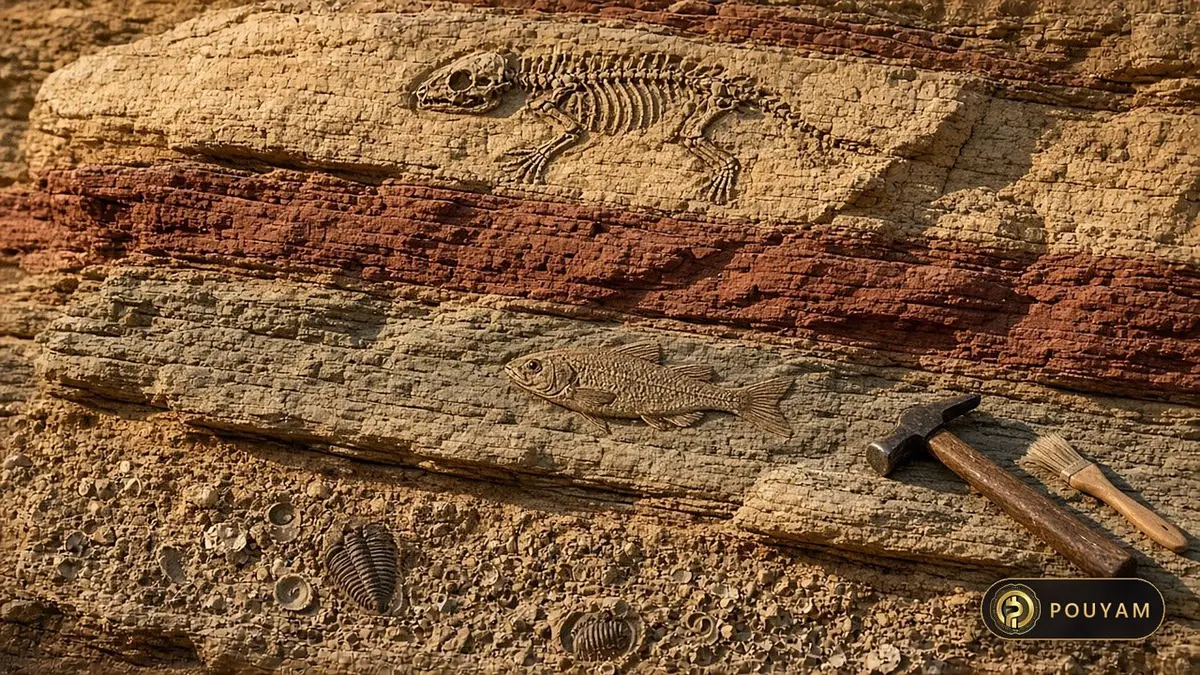
Fossils in order. Rock layers preserve life in sequence: simple marine organisms in the oldest layers, fish later, and four-limbed animals later still [4]. In 2006, palaeontologists described Tiktaalik roseae, a fish from the Late Devonian of Arctic Canada with fins, scales and gills but also a mobile neck and a functional wrist joint, an intermediate between fish with fins and animals with limbs [9]. It was found by searching rocks of the age where such a transition was predicted [9].
Shared anatomy. The same set of bones appears in a human arm, a bat wing and a whale flipper, adapted for different jobs. That pattern makes sense if the species inherited the structure from a common ancestor [1][4].
DNA. Genomes record ancestry. When the chimpanzee genome was sequenced in 2005, the consortium counted about 35 million single-letter differences from the human genome, about 1.23% of the sequence, plus about 5 million insertions and deletions [10]. The more closely related two species are by other evidence, the more similar their DNA, which is what common descent predicts [3][10].
Geography. Related species tend to live near each other, and islands such as the Galápagos host groups of species found nowhere else that descend from a few arrivals from the mainland [4][11].
Direct observation. Scientists can watch populations change over many generations in the lab and in the wild, which the next section covers [6][11].
The National Academy of Sciences concluded that, because the evidence is so strong, scientists no longer question whether biological evolution has occurred and continues to occur; they study how it works and how fast it can happen [4].
Can we see evolution happen?
Yes. In fast-breeding organisms, evolution can be measured within a human lifetime, most famously in a long-running E. coli experiment and in bacteria that become resistant to antibiotics [6][7][12].
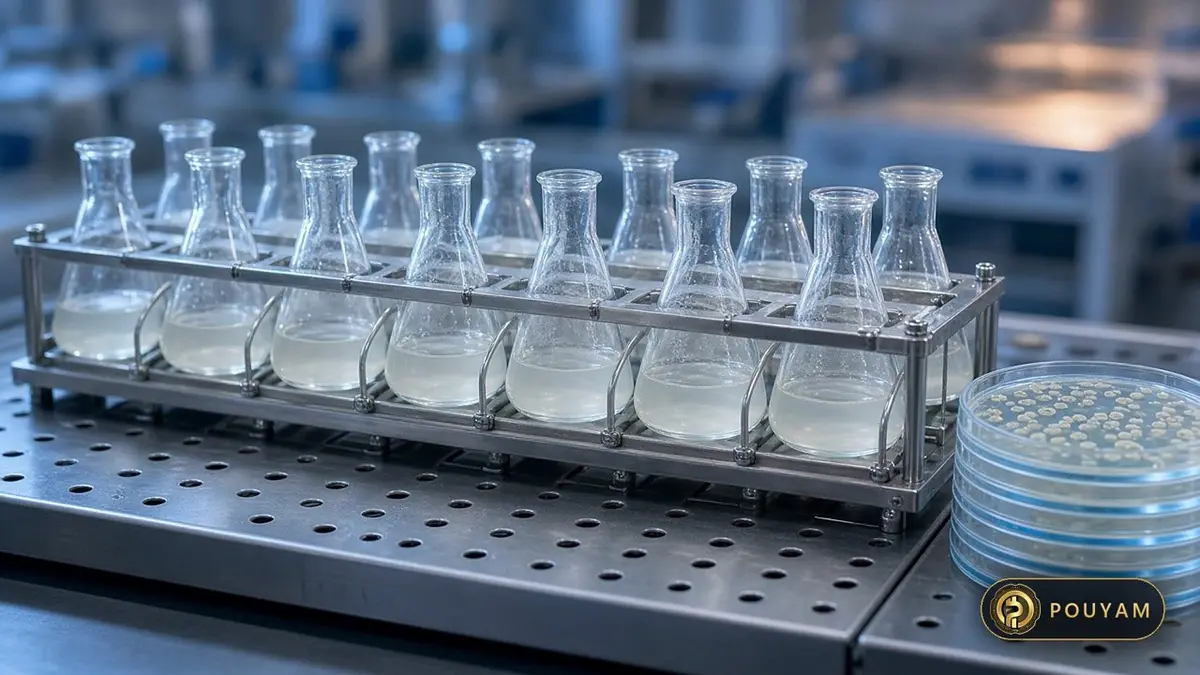
In 1988, biologist Richard Lenski began growing twelve populations of Escherichia coli from the same ancestor, transferring them to fresh flasks every day. A 2017 Nature study sequenced whole genomes from the populations every 500 generations through 60,000 generations and found signs of rapid adaptation throughout, with several beneficial mutations competing in each population [6].
One population produced a striking new trait. E. coli normally cannot use citrate, a compound in its growth medium, when oxygen is present. In a 2008 PNAS paper, Zachary Blount, Christina Borland and Lenski reported that one population evolved this ability after around 31,500 generations, and that it depended on earlier mutations in that population’s history [7].
Outside the lab, antibiotic resistance is evolution by natural selection with direct consequences for health. When antibiotics kill susceptible bacteria, any that carry resistance survive and multiply. The World Health Organization says misuse and overuse of antimicrobials drive drug-resistant pathogens, and that about 1 in 6 laboratory-confirmed bacterial infections worldwide were resistant to antibiotics in 2023 [12]. Our guide World AMR Awareness Week 2026: Why Antibiotics Stop Working explains why that matters and what slows it down.
The Galápagos finches show the same process in a wild animal: a measurable shift in average beak size over a few generations after a drought and the arrival of a competitor [11].
What is the difference between evolution and natural selection?
Evolution is the outcome, change in inherited traits across generations; natural selection is one cause of that change, the one that produces adaptations [2].
People often use the two words as if they mean the same thing, but they answer different questions. Evolution answers “has this population changed genetically over generations, and do these species share ancestors?” Natural selection answers “why did this particular trait become common here?” [1][2].
Evolution can happen without natural selection. Genetic drift can change a small population by chance alone, and migration can change it by bringing in new gene versions [2]. Natural selection, in turn, cannot happen without heritable variation, which ultimately comes from mutation [2][3].
Another common confusion is between evolution and progress. Evolution has no goal or ladder. A trait that helps in one environment can be useless or harmful in another, as the peppered moth showed when the pale form became common again after air pollution fell [8]. “Survival of the fittest” means reproducing well in a particular setting, not being the strongest [2].
Did humans evolve from monkeys?
No. Humans did not evolve from any living monkey or ape; humans and the African great apes share a common ancestor that lived roughly 8 to 6 million years ago, and each line has evolved separately since [13].
The Smithsonian’s Human Origins Program describes human evolution as the lengthy process by which people originated from apelike ancestors over about six million years [13]. Walking upright on two legs evolved more than 4 million years ago, while a large brain, tool-making and language developed later [13].
Chimpanzees and bonobos are our closest living relatives, which is why their genomes are so similar to ours [10]. Being cousins, not ancestors, is the key point: a chimpanzee is as evolved as a human, just along a different branch.
The fossils of early humans who lived between 6 and 2 million years ago come entirely from Africa, and most scientists recognise some 15 to 20 species of early humans, most of which left no living descendants [13]. Homo sapiens, our own species, evolved in Africa about 300,000 years ago [13]. Early humans moved into Asia probably between 2 million and 1.8 million years ago [13].
Archaeology adds detail on how early people lived, including their tools and hunting; our guide Oldest Poisoned Weapons: 125,000-Year-Old Clues in Arabia looks at one such find.
Is evolution just a theory?
In science, a theory is not a guess: the National Academy of Sciences defines it as a comprehensive explanation of some aspect of nature that is supported by a vast body of evidence [4].
In everyday speech, “theory” can mean a hunch. The Academy’s report Science, Evolution, and Creationism explains that the scientific meaning is quite different, and places evolution alongside other well-established theories such as the cell theory, atomic theory and plate tectonics [4].
The report also notes that like all scientific theories, the theory of evolution keeps being refined as new methods appear, such as genome sequencing, while scientists are confident its basic components will not be overturned [4].
Open questions are normal in active science. Researchers debate details such as how fast particular changes happen, how some species are related, and how much different mechanisms contribute [4][13]. Those debates are about how evolution works, not whether it happens [4].
For learners, the most useful habit is to separate the pattern (the branching tree of life, supported by fossils and DNA) from the processes (selection, drift, mutation and migration) that explain it [1][2].
| Mechanism | What it does | Random or not? | Example |
|---|---|---|---|
| Mutation | Creates new genetic variation | Random with respect to need | The black peppered moth mutation, around 1819 |
| Natural selection | Makes helpful inherited traits more common | Not random | Smaller beaks in Galápagos finches after a competitor arrived |
| Genetic drift | Changes gene frequencies by chance | Random | Variants spreading in small populations |
| Migration (gene flow) | Moves gene versions between populations | Depends on movement | Breeding between neighbouring groups |
| Line of evidence | What it shows | Example |
|---|---|---|
| Fossil order | Life changed in sequence through rock layers | Fish before four-limbed animals |
| Transitional fossils | Forms with mixed features predicted by common descent | Tiktaalik, about 375 million years old |
| Comparative anatomy | Same structures adapted for different uses | Arm, wing and flipper bones |
| DNA | Related species have similar genomes | Human and chimpanzee differ by about 1.23% in single letters |
| Observed change | Populations evolve in real time | E. coli over 60,000 generations; antibiotic resistance |
Common mistakes
Thinking individuals evolve during their lives.
Fix: Populations evolve across generations through inherited change [1][2].
Saying humans evolved from chimpanzees.
Fix: Humans and chimpanzees share a common ancestor that lived roughly 8 to 6 million years ago [13].
Treating evolution and natural selection as the same thing.
Fix: Evolution is the change; natural selection is one of four mechanisms that cause it [2].
Assuming evolution always leads to more complex or ‘better’ organisms.
Fix: Selection fits organisms to their current environment, and it has no long-term goal [2][8].
Reading ‘theory’ as ‘guess’.
Fix: A scientific theory is a comprehensive explanation supported by a vast body of evidence [4].
Frequently asked questions
What is evolution in simple words?
Change in the inherited traits of living things over generations, which over long periods gives rise to new species from shared ancestors [1].
What is natural selection?
The process in which inherited traits that help survival and reproduction become more common because their carriers leave more offspring [2].
What is the evidence for evolution?
Fossils in rock layers, transitional fossils like Tiktaalik, shared anatomy, DNA comparisons and populations observed changing [4][6][9][10].
What is the difference between evolution and natural selection?
Evolution is the overall change; natural selection is a mechanism that drives part of it, alongside mutation, drift and migration [2].
Who came up with the theory of evolution by natural selection?
Charles Darwin set it out in On the Origin of Species in 1859; genetics later explained how traits are inherited [3][5].
Glossary
- Evolution
- Descent with inherited modification across generations [1].
- Natural selection
- Differential survival and reproduction of individuals because of inherited traits [2].
- Mutation
- A change in DNA that can create new genetic variation [3].
- Genetic drift
- Random change in how common gene versions are, strongest in small populations [2].
- Common ancestor
- An ancestral population from which two or more species descend [1].
- Transitional fossil
- A fossil with features of both an ancestral group and its descendants, such as Tiktaalik [9].
Sources
- An introduction to evolution (Evolution 101) University of California Museum of Paleontology, Understanding Evolution
- Natural Selection (Evolution 101: Mechanisms) University of California Museum of Paleontology, Understanding Evolution
- Evolution (Talking Glossary of Genomic and Genetic Terms) National Human Genome Research Institute (NIH) · 2026-11-28
- Science, Evolution, and Creationism National Academy of Sciences and Institute of Medicine
- On the Origin of Species by Means of Natural Selection (first edition) Charles Darwin, John Murray (via Darwin Online) · 1859-11-24
- The dynamics of molecular evolution over 60,000 generations Nature (Good, McDonald, Barrick, Lenski, Desai) · 2017-10-18
- Historical contingency and the evolution of a key innovation in an experimental population of Escherichia coli PNAS (Blount, Borland, Lenski) · 2008-06-10
- The industrial melanism mutation in British peppered moths is a transposable element Nature (van't Hof et al.) · 2016-06-01
- A Devonian tetrapod-like fish and the evolution of the tetrapod body plan Nature (Daeschler, Shubin, Jenkins) · 2006-04-06
- Initial sequence of the chimpanzee genome and comparison with the human genome Nature (Chimpanzee Sequencing and Analysis Consortium) · 2005-09-01
- Evolution of Character Displacement in Darwin's Finches Science (Grant and Grant) · 2006-07-14
- Antimicrobial resistance (fact sheet) World Health Organization · 2026-07-16
- Introduction to Human Evolution Smithsonian National Museum of Natural History, Human Origins Program



Comments
Top comments