
Photosynthesis Explained: How Plants Make Food and Oxygen
- 0 views
- 0 likes
- 0 comments
- All languages combined
 +99
Sign in and earn +99 points by reading this
Read to the end, wait a few seconds, then tap the claim button below.
In short
Photosynthesis is the process plants, algae and cyanobacteria use to turn light energy, water and carbon dioxide into sugar, releasing oxygen as a by-product [1][4]. It happens in chloroplasts in two stages: light-dependent reactions that split water and make ATP and NADPH, and the Calvin cycle, which uses them to build sugar from carbon dioxide [1][3].
Key takeaways
- The overall equation is 6CO2 + 6H2O + light energy → C6H12O6 + 6O2: six carbon dioxide and six water molecules make one glucose and six oxygen molecules [1].
- Plants, algae and cyanobacteria are the only organisms that carry out photosynthesis, and almost all other life depends on the sugars they make [1][4].
- In plants it takes place in chloroplasts: the light reactions run in the thylakoid membranes and the Calvin cycle runs in the surrounding fluid, the stroma [1][4].
- The oxygen released comes from water, which is split to replace electrons lost by chlorophyll [2][4].
- Chlorophyll absorbs mainly blue and red light and reflects green, which is why leaves look green [2][4].
- Roughly half of Earth's oxygen production comes from the ocean, mostly from tiny plankton; global plant growth fixes about 105 billion tonnes of carbon a year, split roughly equally between land and sea [5][8].
- Melvin Calvin won the 1961 Nobel Prize in Chemistry for tracing the path of carbon in photosynthesis [10][11].
On this page 12 sections
- What is photosynthesis?
- What is the equation for photosynthesis?
- Where does photosynthesis take place in the cell?
- What happens in the light-dependent reactions?
- What is the Calvin cycle?
- How much oxygen does photosynthesis produce?
- What are C3, C4 and CAM plants?
- Why is photosynthesis important for life and climate?
- Common mistakes
- Frequently asked questions
- Glossary
- Sources
What is photosynthesis?
Photosynthesis is the process by which plants, algae and cyanobacteria capture energy from sunlight and store it in sugar made from carbon dioxide and water, releasing oxygen [1][4].
The word combines “photo”, meaning light, and “synthesis”, meaning putting together. The OpenStax Biology 2e textbook describes it as the only biological process that can capture energy from sunlight and convert it into chemical compounds that every organism uses to power its metabolism [1]. Sunlight energises electrons, and that energy ends up stored in the chemical bonds of sugar molecules [1].
Only plants, algae and a group of bacteria called cyanobacteria can do this [1]. Because they make their own food from light, they are called photoautotrophs, or “self-feeders using light” [1]. Animals, fungi and most other bacteria are heterotrophs: they rely on the sugars made by photosynthetic organisms, either directly by eating plants or indirectly by eating animals that did [1].
That is why photosynthesis sits at the base of almost every food chain. Nature Education’s Scitable notes that virtually all organic material on Earth has been produced by cells that convert energy from the Sun into energy-containing molecules [4]. OpenStax estimates that photosynthesis powers 99 percent of Earth’s ecosystems [1].
Photosynthesis also supplies oxygen. Plants and plankton give off oxygen as they split water, and that oxygen supports animals, people and most other organisms that breathe [1][2]. Even the coal and oil burned today hold sunlight captured by photosynthesis hundreds of millions of years ago [1].
What is the equation for photosynthesis?
The overall equation is 6CO2 + 6H2O + light energy → C6H12O6 + 6O2: carbon dioxide and water, powered by light, become glucose and oxygen [1].
In words, six molecules of carbon dioxide and six molecules of water, using energy from light, produce one molecule of glucose and six molecules of oxygen [1]. NASA’s Earth Observatory writes a simplified version, CO2 + H2O + energy = CH2O + O2, where CH2O stands for one unit of sugar [6].
OpenStax calls the equation “deceptively simple”: the real process happens in many steps with intermediate products [1]. The first sugar the plant actually makes is a three-carbon molecule called glyceraldehyde 3-phosphate (G3P); glucose is built from two G3P molecules, and G3P can also become sucrose, starch or dozens of other compounds [1].
Photosynthesis is essentially the reverse of cellular respiration, the process cells use to release energy from food. Respiration combines sugar with oxygen and gives off carbon dioxide, water and energy [6]. Scitable describes the making and breaking of glucose as opposing processes that together form part of the global carbon cycle [4].
The table below sets out what goes in and what comes out of each stage.
Where does photosynthesis take place in the cell?
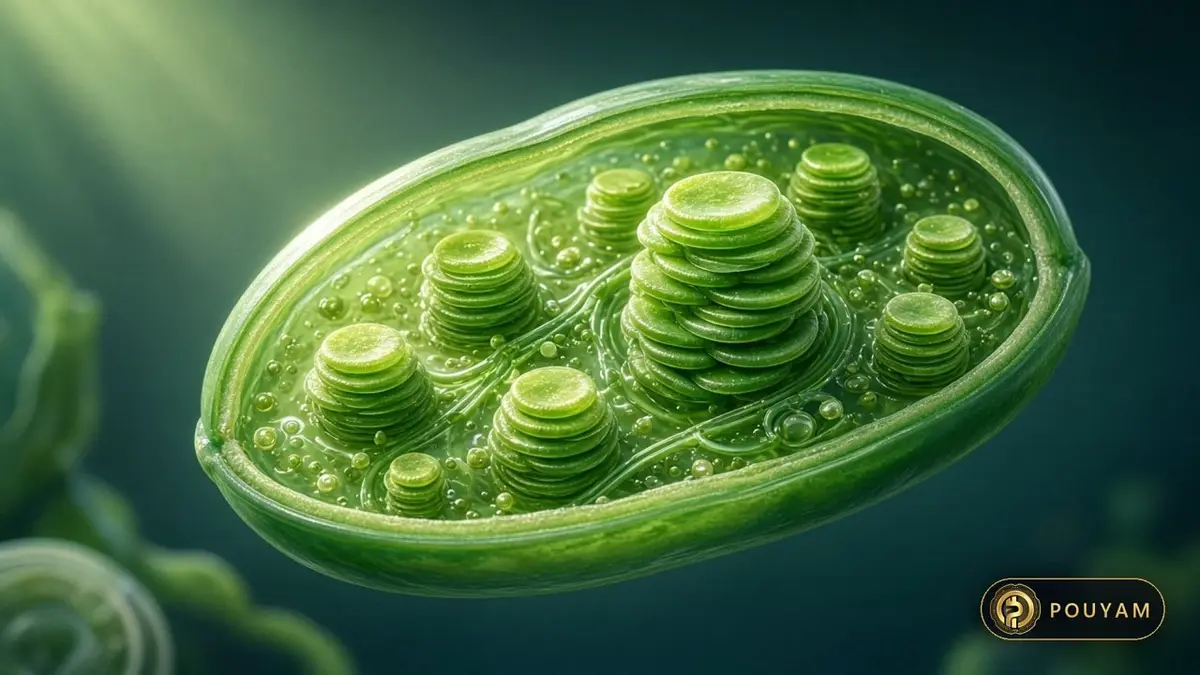
In plants and algae, photosynthesis takes place inside chloroplasts, mostly in the leaf’s middle layer of cells; the light reactions run in the thylakoid membranes and the Calvin cycle in the surrounding stroma [1][4].
In a typical plant, photosynthesis happens mainly in leaves, in a middle layer of cells called the mesophyll [1]. Carbon dioxide enters and oxygen leaves through tiny pores called stomata, usually on the underside of the leaf, which are opened and closed by guard cells to balance gas exchange against water loss [1].
Inside each mesophyll cell are chloroplasts. They have a double outer membrane and contain stacks of flattened, disc-shaped sacs called thylakoids; a stack is called a granum [1]. The green pigment chlorophyll sits in the thylakoid membrane, and the fluid-filled space around the stacks is the stroma [1][4]. Chloroplasts descend from ancient free-living cyanobacteria [1].
Chlorophyll gives plants their colour. Pigments absorb only certain wavelengths of light and reflect the rest [2]. Chlorophyll a absorbs mostly blue and red light from either end of the visible spectrum and reflects green, which is why leaves look green [2][4]. Other pigments called carotenoids absorb blue light and help shed excess energy as heat, protecting the leaf in strong sun [2].
Plants use light with wavelengths between about 400 and 700 nanometres, the same range the human eye sees, known to plant scientists as photosynthetically active radiation [2].
What happens in the light-dependent reactions?
In the light-dependent reactions, chlorophyll absorbs light, water is split to release oxygen, and the captured energy is stored in two carrier molecules, ATP and NADPH [2][4].
The light reactions take place in the thylakoid membranes [1][4]. Light energy is collected by antenna pigments, which contain several hundred chlorophyll and other pigment molecules, and is passed to a reaction centre in a protein complex called a photosystem [2]. Plants have two of them, photosystem II and photosystem I, numbered in the order they were discovered rather than the order in which they work [2].
The steps run in this order [2][4]:
- Light excites electrons. In photosystem II, light energy knocks a high-energy electron out of a special pair of chlorophyll a molecules.
- Water is split. The missing electron is replaced with one taken from water. Splitting water releases hydrogen ions and oxygen; two water molecules are needed to make one molecule of oxygen gas.
- Electrons pass along a chain. The electron travels through an electron transport chain, losing energy that is used to pump hydrogen ions into the thylakoid space.
- ATP is made. Hydrogen ions flow back out through an enzyme called ATP synthase, which uses the flow to make ATP.
- NADPH is made. In photosystem I, a second boost of light re-energises the electron, which is used to make NADPH.
OpenStax notes that about 10 percent of the oxygen made in a leaf is used by the leaf’s own mitochondria; the rest escapes to the air [2]. The ATP and NADPH last only millionths of a second, so they are used almost at once to power the next stage [3].
What is the Calvin cycle?
The Calvin cycle is the second stage of photosynthesis, in which the chloroplast uses ATP and NADPH to fix carbon dioxide from the air into sugar [3][4].
The Calvin cycle takes place in the stroma [3]. It is sometimes called the light-independent reactions or the “dark reactions”, but OpenStax notes that the older term is misleading: the cycle does not happen only at night, and several of its enzymes are activated by light [1][3]. It runs in three stages [3]:
- Fixation: an enzyme called RuBisCO joins carbon dioxide to a five-carbon sugar, RuBP, producing two molecules of a three-carbon compound, 3-PGA.
- Reduction: ATP and NADPH from the light reactions convert 3-PGA into G3P, the three-carbon sugar.
- Regeneration: most G3P is used, with more ATP, to rebuild RuBP so the cycle can continue.
Because only one carbon dioxide molecule is added per turn, the cycle must turn three times to export one G3P molecule and six times to make enough carbon for one glucose molecule [3].
The cycle is named after Melvin Calvin, who won the 1961 Nobel Prize in Chemistry “for his research on the carbon dioxide assimilation in plants” [10]. In his Nobel lecture he described feeding radioactive carbon dioxide to the single-celled green alga Chlorella and tracing where the carbon went; the main early labelled product turned out to be 3-phosphoglyceric acid [11]. Some scientists call it the Calvin-Benson cycle to credit another scientist involved in the discovery [3].
How much oxygen does photosynthesis produce?
Photosynthesis is the source of the oxygen in Earth’s atmosphere; roughly half of today’s oxygen production comes from ocean plankton and the rest from land plants [4][5].
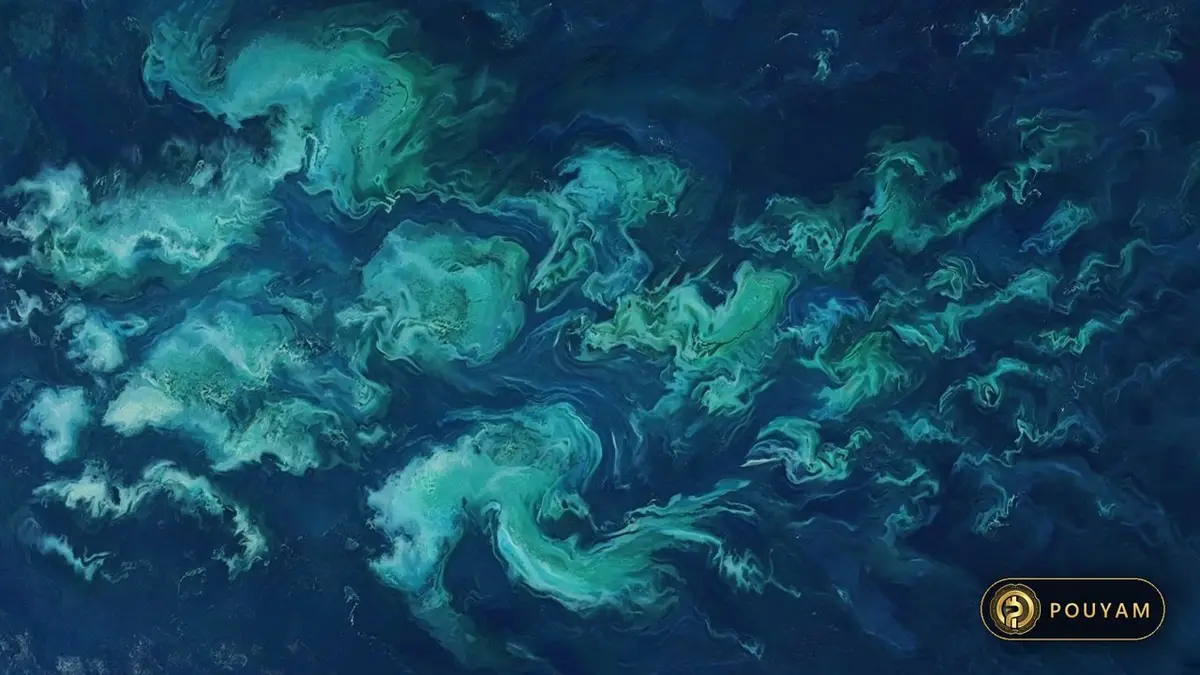
NOAA, the US ocean agency, estimates that roughly half of the oxygen production on Earth comes from the ocean, mostly from drifting plankton: plants, algae and some bacteria that photosynthesise [5]. One tiny bacterium, Prochlorococcus, the smallest photosynthetic organism on Earth, produces up to 20% of the oxygen in the biosphere [5]. Scitable gives a range, saying phytoplankton and cyanobacteria are thought to produce between one-third and one-half of atmospheric oxygen [4].
Production and consumption are close to balanced. NOAA notes that roughly as much oxygen as the ocean makes is used by marine life for breathing and by decay [5]. Most of the oxygen people breathe comes from the large store that has built up in the atmosphere over hundreds of millions of years [5].
Another way to measure photosynthesis is by the carbon it captures. A study in Science estimated global net primary production, the carbon plants and plankton fix minus what they use themselves, at 104.9 billion tonnes of carbon a year, with roughly equal contributions from land and oceans [8]. NASA notes that phytoplankton consume carbon dioxide on a scale equivalent to forests and other land plants [7].
Ocean photosynthesis rises and falls with climate patterns. NASA says the biggest influence on year-to-year changes in global phytoplankton productivity is the El Niño-Southern Oscillation; during El Niño, productivity in the equatorial Pacific drops as the upwelling of nutrient-rich water weakens [7]. For the current El Niño and what it means for weather, see our guide El Niño 2026: How Strong It Is and What It Means for Winter.
What are C3, C4 and CAM plants?
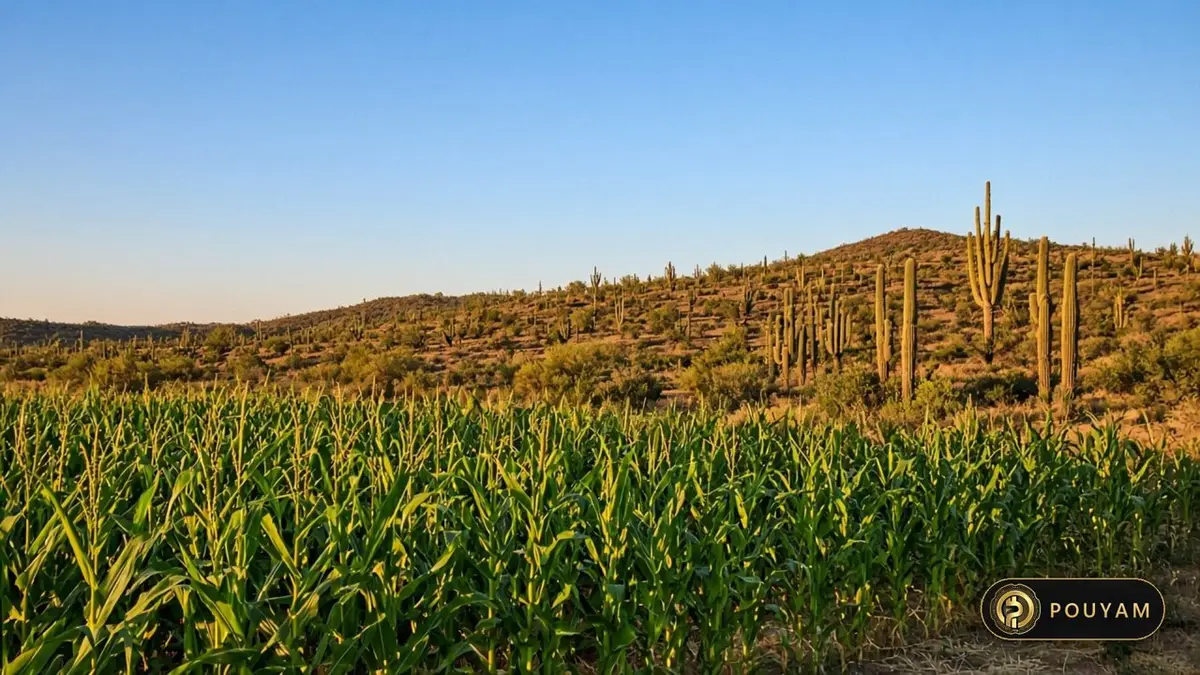
They are three ways of fixing carbon: most plants use the basic C3 route, C4 plants such as maize concentrate carbon dioxide first, and CAM plants such as cacti take it in at night to save water [3][12].
In most plants, called C3 plants, RuBisCO fixes carbon dioxide directly in the Calvin cycle, and the first product is the three-carbon 3-PGA [3]. RuBisCO has a weakness: it can also react with oxygen instead of carbon dioxide, which keeps it from working at its full rate [12].
C4 plants solve this with a carbon-dioxide pump. In 1966 Hal Hatch and Roger Slack, using radioactive carbon in sugarcane, found that the first compound formed was a four-carbon acid [12]. In most C4 plants, carbon dioxide is first captured in outer leaf cells and then released around RuBisCO in specialised inner cells, raising its concentration and suppressing the reaction with oxygen [12]. C4 plants first evolved in warm, semi-arid regions [12]. C4 photosynthesis evolved independently at least 61 times, giving more than 8,000 species, and C4 crops such as maize and sorghum have higher yields and use water and nitrogen more efficiently than C3 crops such as rice [12].
CAM plants, including many cacti, open their stomata at night, when it is cooler, and store carbon dioxide temporarily; during the day they keep their stomata closed and use the stored carbon dioxide for photosynthesis, which saves water [3].
None of these routes is very efficient at turning sunlight into plant matter. Researchers calculated the theoretical maximum at 4.6% for C3 plants and 6% for C4 plants at 30°C and a carbon dioxide level of 380 parts per million [9].
Why is photosynthesis important for life and climate?
Photosynthesis feeds almost every food chain, made the oxygen in the air and drives the fast part of the carbon cycle that helps regulate Earth’s climate [1][4][6].
Every item in a grocery store can be traced back to photosynthesis: grains and vegetables directly, and meat and dairy through the plants animals eat [1]. Paper, cotton and wood come from photosynthesis too, and fossil fuels are the remains of organisms that grew through it long ago [1][4].
Photosynthesis is also the “building” half of the carbon cycle [4]. NASA describes how land plants and phytoplankton take carbon dioxide from the atmosphere every year, and how the Northern Hemisphere’s spring and summer growth visibly draws down atmospheric carbon dioxide each year [6]. In the ocean, a “biological carbon pump” carries about 10 billion tonnes of carbon from the atmosphere to the deep ocean each year as phytoplankton die or are eaten and sink [7].
Plants and the ocean have absorbed a large share of the extra carbon dioxide released by burning fossil fuels; NASA estimated that land plants and the ocean had taken up about 55 percent of it, while about 45 percent stayed in the atmosphere [6]. Cutting down forests removes plants that would otherwise keep pulling carbon from the air [6]. For the latest global climate indicators, see our guide State of the Climate 2026: What WMO's COP31 Report Says.
Scientists are now trying to make photosynthesis more efficient in crops, for example by engineering C4 traits into C3 crops, because food production may need to roughly double before the end of the century [9][12].
| Light-dependent reactions | Calvin cycle | |
|---|---|---|
| Where | Thylakoid membranes | Stroma of the chloroplast |
| Needs | Light, water, NADP+, ADP | Carbon dioxide, ATP, NADPH |
| Produces | Oxygen, ATP, NADPH | G3P sugar (used to make glucose), ADP, NADP+ |
| Key players | Chlorophyll, photosystems II and I, ATP synthase | RuBisCO, RuBP |
| Needs light directly? | Yes | No, but it depends on the light reactions |
| Type | How carbon dioxide is fixed | Examples | Advantage |
|---|---|---|---|
| C3 | RuBisCO fixes it directly; first product has 3 carbons | Rice and most plants | Simplest route |
| C4 | Captured first as a 4-carbon acid, then concentrated around RuBisCO | Maize, sorghum, sugarcane | Higher yields; better water and nitrogen use in warm conditions |
| CAM | Taken in at night and stored, used by day | Many cacti | Saves water in deserts |
Common mistakes
Thinking the oxygen plants release comes from carbon dioxide.
Fix: It comes from water, which is split in the light reactions [2][4].
Believing the Calvin cycle only happens in the dark.
Fix: It does not need light directly, but it depends on the light reactions and runs during the day [1][3].
Thinking plants get their food from the soil.
Fix: Plants build their sugars from carbon dioxide taken from the air and water, using light energy [3][6].
Assuming rainforests make most of the world’s oxygen.
Fix: Roughly half of oxygen production comes from ocean plankton [5].
Thinking plants do not respire.
Fix: Plants also break down sugar for energy and release carbon dioxide [3][6].
Believing chlorophyll absorbs green light.
Fix: It absorbs mainly blue and red and reflects green [2].
Frequently asked questions
What is the equation for photosynthesis?
6CO2 + 6H2O + light energy → C6H12O6 + 6O2: carbon dioxide and water become glucose and oxygen [1].
What is the difference between the light reactions and the Calvin cycle?
The light reactions capture light energy, split water and make ATP and NADPH; the Calvin cycle uses them to turn carbon dioxide into sugar [2][3].
Where in the cell does photosynthesis take place?
In the chloroplasts: light reactions in the thylakoid membranes and the Calvin cycle in the stroma [1][4].
How much oxygen does photosynthesis produce?
Roughly half of Earth’s oxygen production comes from ocean plankton and the rest mainly from land plants [5].
Why are plants green?
Chlorophyll absorbs blue and red light and reflects green [2].
Glossary
- Chloroplast
- The organelle in plant and algal cells where photosynthesis happens [1].
- Chlorophyll
- The green pigment that absorbs light energy [2].
- Thylakoid
- A flattened membrane sac in the chloroplast where the light reactions occur [1].
- Stroma
- The fluid around the thylakoids where the Calvin cycle runs [1].
- ATP and NADPH
- Energy-carrying molecules made in the light reactions [2].
- RuBisCO
- The enzyme that fixes carbon dioxide in the Calvin cycle [3].
- Stomata
- Tiny leaf pores that let carbon dioxide in and oxygen out [1].
- Net primary production
- Carbon fixed by plants and plankton minus what they use themselves [8].
Sources
- Biology 2e, 8.1 Overview of Photosynthesis OpenStax, Rice University · 2018-03-28
- Biology 2e, 8.2 The Light-Dependent Reactions of Photosynthesis OpenStax, Rice University · 2018-03-28
- Biology 2e, 8.3 Using Light Energy to Make Organic Molecules OpenStax, Rice University · 2018-03-28
- Photosynthetic Cells Nature Education (Scitable)
- How much oxygen comes from the ocean? NOAA National Ocean Service · 2026-09-23
- The Carbon Cycle (Riebeek H.) NASA Earth Observatory · 2011-06-16
- What are Phytoplankton? (Lindsey R., Scott M.) NASA Earth Observatory · 2010-07-13
- Primary production of the biosphere: integrating terrestrial and oceanic components (Field C.B. et al.) Science · 1998-07-10
- What is the maximum efficiency with which photosynthesis can convert solar energy into biomass? (Zhu X.G., Long S.P., Ort D.R.) Current Opinion in Biotechnology
- The Nobel Prize in Chemistry 1961: Melvin Calvin NobelPrize.org
- The path of carbon in photosynthesis (Nobel Lecture, Calvin M.) Nobel Foundation · 1961-12-11
- C4 photosynthesis: 50 years of discovery and innovation (von Caemmerer S., Ghannoum O., Furbank R.T.) Journal of Experimental Botany · 2017-01-21


Comments
Top comments