
Oldest Poisoned Weapons? 125,000-Year-Old Points in Arabia
- 0 views
- 0 likes
- 0 comments
- All languages combined
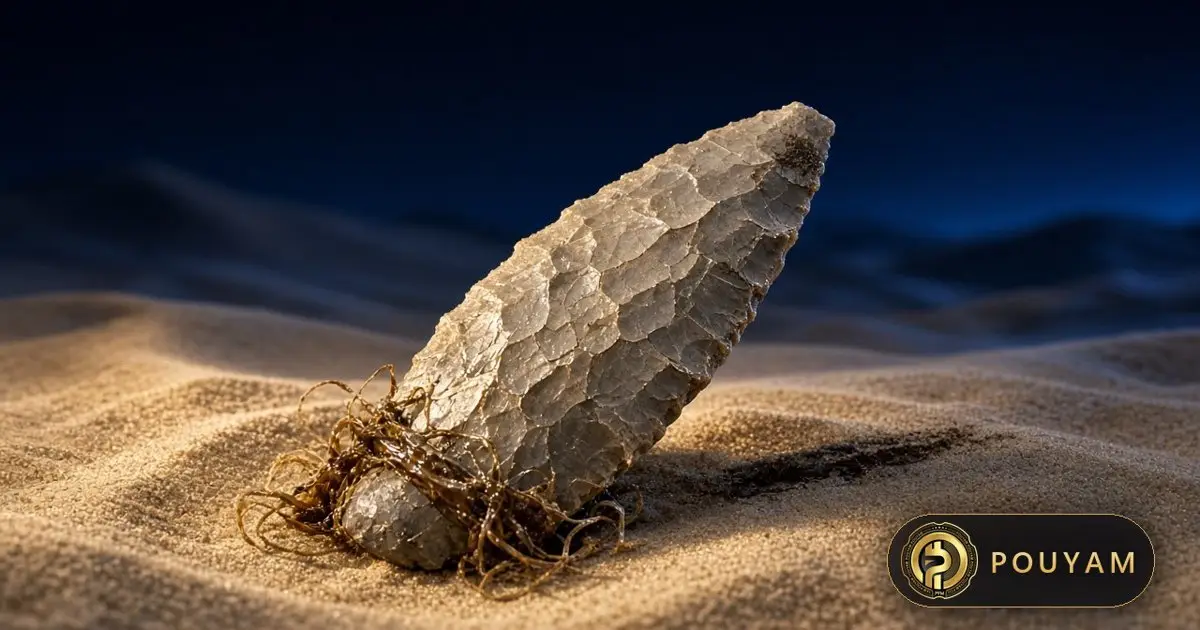
In short
Possibly the oldest poisoned weapons yet found were reported in Science on 12 November 2026: stone points from 'Uruq Aljelibah, a 125,000-year-old lakeshore in Saudi Arabia's Empty Quarter, show impact damage and chemical markers linked to the arrow-poison tree Acokanthera schimperi [1][3]. The researchers call it potential, not definitive, evidence [3].
Key takeaways
- The study was published in Science on 12 November 2026 by an international team led from Griffith University and KAUST [1][4].
- Several stone points show impact damage and residues linked to the arrow-poison tree, Acokanthera schimperi [1][4].
- If confirmed, that is about 65,000 years earlier than poisoned arrowheads from South Africa dated to around 60,000 years ago [2][3].
- The site sat beside a freshwater lake in the Mundafan basin, now in the Rub' al Khali desert, with hippos, buffalo, gazelles and ostriches nearby [1][2].
- No human bones were found; the team thinks the toolmakers were Homo sapiens [3][5].
- An independent archaeologist notes the tools came from the surface, so 125,000 years is a maximum age for them [3].
On this page 11 sections
- What are the oldest poisoned weapons ever found?
- What poison was found on the stone points?
- How did scientists show the points were weapons?
- What was Arabia like 125,000 years ago?
- How certain is the 125,000-year date?
- Who made the poisoned weapons?
- What happens next at 'Uruq Aljelibah?
- Common mistakes
- Frequently asked questions
- Glossary
- Sources
What are the oldest poisoned weapons ever found?
Stone points from 'Uruq Aljelibah in southern Saudi Arabia, dated to about 125,000 years ago, are now the oldest candidate poisoned hunting weapons, according to a study published in Science on 12 November 2026 [1][3]. The paper reports that several points show impact damage and residues linked to Acokanthera schimperi, the arrow-poison tree, and describes them as hafted weapon tips within composite hunting systems [1].
The previous earliest reported example was poisoned quartz arrowheads from South Africa, about 60,000 years old [3][5]. The authors write that their finds show poison-assisted hunting about 65,000 years earlier [2].
The lead author is careful. "I'd describe these as potentially the oldest evidence for poisoned hunting weapons, rather than an unequivocally established first," Chris Clarkson of Griffith University and the Max Planck Institute of Geoanthropology told Live Science, adding that the team has not shown exactly how the poison was prepared or whether it worked [3].
Sites in Arabia with both stone tools and animal bones are rare, Jeffrey Rose of the University of Algarve, who was not involved, told Live Science: "This one has thousands of artifacts on an old lakeshore alongside hippo, buffalo and ostrich... It's valuable new data" [3]. The site's name means "sand dunes of a watering hole", co-author Frans van Buchem of King Abdullah University of Science and Technology (KAUST) told Live Science [3].
What poison was found on the stone points?
Chemical markers linked to Acokanthera schimperi, the arrow-poison tree, which is known for toxic compounds called cardiac glycosides [1][4]. The researchers' own account says the tree's toxins affect the heart [2].
Live Science notes the tree is native to eastern and central Africa and southern Arabia, and that African hunters have historically coated spear tips and arrowheads with its extracts to paralyse or kill game [3].
The evidence comes from residue analysis [2][4]:
- on at least one impact-damaged point, potentially toxic plant compounds sat alongside animal residues;
- other tools carried traces consistent with extracting and processing toxic plant latex;
- other potentially toxic plant compounds were identified on weapon points.
Haaretz reports that the team also detected traces of juniper, bracken (eagle fern) and bitter apple, and that another tip had been in contact with Egyptian balsam, Indian senna or native Pistacia [5]. Those additional identifications come from press coverage; the paper's abstract names only Acokanthera schimperi [1][5].

How did scientists show the points were weapons?
By combining microscopic damage, residues and the layout of the site [1][2].
- Impact damage: several points had broken tips consistent with hitting an animal during hunting [2][4].
- Hafting traces: one point kept resin and plant fibres near its base, suggesting it was glued and bound to a shaft, with animal fats and protein nearer the tip [2].
- Biomarkers: chemical analysis found markers linked to the arrow-poison tree [1][4].
- Spatial patterns: the distribution of stone tools closely matched clusters of animal bones, suggesting hunting and butchery happened along the lakeshore [3][4].
- Refits: some flakes fit back together, showing tools were made on the spot [1][2].
The authors say they cannot tell whether the weapons were thrown or thrust [2]. Huw Groucutt of the University of Malta, named by Haaretz among the researchers who reported the study, told Haaretz that the points were spear tips, not arrows, since bows had not yet appeared [5]. "These weren't just people knocking stone flakes off cores," Clarkson said; "they were combining stone with wood, plant fibers, resins and potentially toxic substances" [3].
What was Arabia like 125,000 years ago?
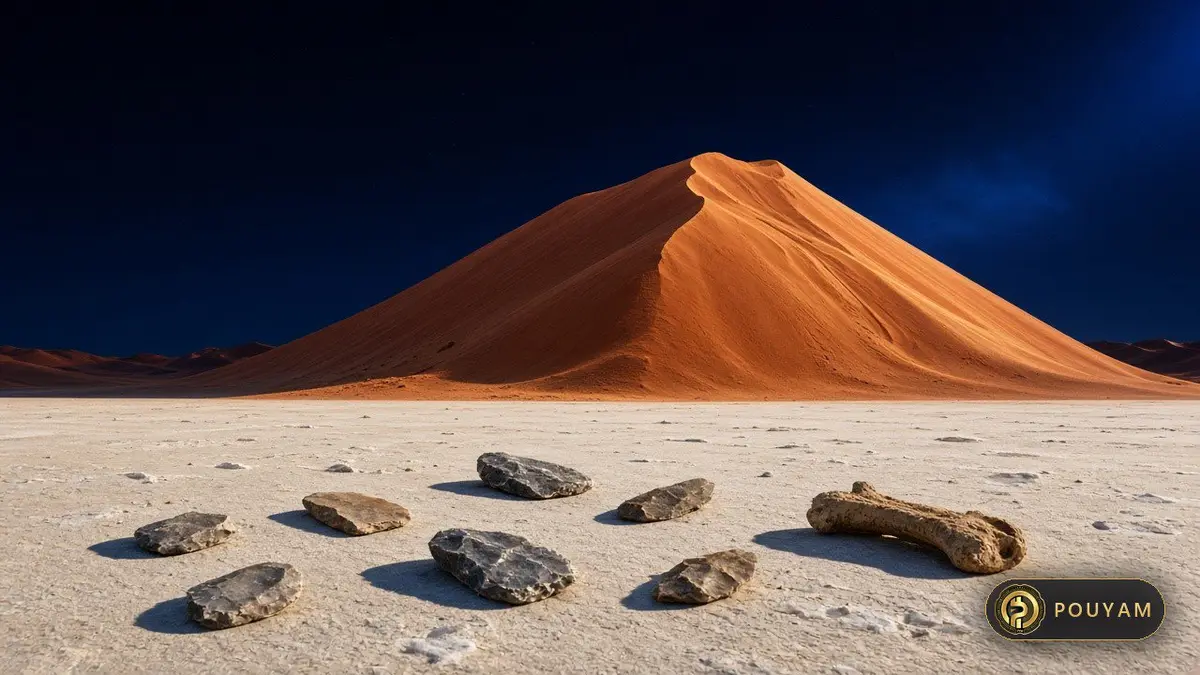
Green and wet, at least in places: a freshwater lake filled the Mundafan basin, surrounded by grasslands [2]. The site dates to a warm, humid phase known as marine isotope stage 5e [1][4].
Live Science reports the lake covered about 340 square kilometres and was up to 29 metres deep; Haaretz gives more than 300 square kilometres and about 30 metres, roughly double the area of the Sea of Galilee [3][5]. Today the spot lies at the base of a huge sand dune in the Rub' al Khali, or Empty Quarter, which Live Science describes as hot, extremely dry and covered with extensive sand dunes [2][3].
Fossils show hippopotamus, buffalo, gazelle, ostrich and camel, according to the paper [1]. Oryx also roamed the grasslands, and plant traces include palms, reeds, tubers, trees and shrubs [1][2][3]. The team dated the shoreline with luminescence dating of buried sand grains, supported by data from hippo teeth [2].
"The idea of hippopotamuses and enormous buffalo living around a lake in what is now the Empty Quarter really brings home just how dramatically these landscapes, and global climates, have changed," Clarkson said [3]. For today's climate picture, see State of the Climate 2026: What WMO's COP31 Report Says.

How certain is the 125,000-year date?
The lake is dated to about 125,000 years ago, but the tools themselves may be younger [3].
- For the claim: the paper dates the site to about 125,000 years ago and reports in situ toolmaking and carcass processing [1]. Eleanor Scerri of the Max Planck Institute of Geoanthropology, who was not involved, called the evidence "remarkable" and the spatial link between hunting tools and hippo bones "very convincing" [3].
- The caution: Jeffrey Rose of the University of Algarve, also not involved, noted that all the stone artefacts were collected from the surface. "The 125,000-year date belongs to the lake, not to the tools. For the tools, it is only a maximum age," he told Live Science [3].
- The poison itself: Clarkson says the team has not demonstrated how the poison was prepared or whether it was effective [3].
Rose suggested future work should look for artefacts sealed inside the dated lake beds, which is hard in Arabia because wind has stripped most sites down to surface scatters [3].
Who made the poisoned weapons?
Probably early Homo sapiens, though no human remains were found [3][5]. "We know that H. sapiens had already expanded out of Africa and were present in Southwest Asia during this period," Clarkson told Live Science; "the age of the site fits with those early movements" [3].
Groucutt told Haaretz that the stone tools resemble those made by Homo sapiens in southwest Asia and northeast Africa, while Neanderthals who appear to have reached Arabia around 55,000 years ago brought different tool types [5]. The tools include those made with the Levallois technique, the paper notes [1][2].
Other evidence places our species in the region early: fossils in Greece and Israel by about 200,000 years ago, and a finger bone from northern Arabia at least 85,000 years old, the authors write [2]. Haaretz also cites footprints at Alathar in the Nefud Desert from about 130,000 to 115,000 years ago [5].
For the team, the site shows people were not just passing through. "They were exploiting them in quite sophisticated ways," Clarkson said of these environments [3].
What happens next at 'Uruq Aljelibah?
More digging for tools sealed in dated layers, and more work on what the residues mean [2][3].
The authors say they do not yet know where the lakeshore's inhabitants went as the climate dried [2]. The artefacts are curated by the Saudi Ministry of Culture's Heritage Commission in Riyadh and available for research with approval, and the data are published openly on Zenodo [1].
Phys.org's release from Griffith University says the site challenges the idea that Arabia was merely a transit corridor during human dispersals [4]. Michael Petraglia of Griffith's Australian Research Centre for Human Evolution said wet "Green Arabia" phases "provided the water and other resources that people needed to settle and develop complex ways of life" [4].
A practical note for readers: the arrow-poison tree's toxins affect the heart [2], and the study is about ancient residues, not about handling the plant. For another science story from this week, see Coldest Temperature Ever: 10 Picokelvin in Space Explained.
| Item | Detail | Source |
|---|---|---|
| Location | Mundafan palaeolake, Rub' al Khali, southern Saudi Arabia | Science [1]; The Conversation [2] |
| Age | About 125,000 years (marine isotope stage 5e); maximum age for surface tools | Science [1]; Live Science [3] |
| Artefacts | More than 5,500 stone tools and debris | The Conversation [2]; Live Science [3] |
| Poison residue | Acokanthera schimperi (arrow-poison tree) | Science [1] |
| Weapon type | Hafted points; described as spear tips | Science [1]; Haaretz [5] |
| Fauna | Hippo, buffalo, gazelle, ostrich, camel, oryx | Science [1]; The Conversation [2] |
| Previous oldest poisoned weapons | South Africa, about 60,000 years ago | Live Science [3] |
| Human remains | None found | Live Science [3] |
Common mistakes
Calling them poison arrows.
Fix: They were hafted points, described as spear tips; bows had not appeared yet [5].
Saying poison use is proven.
Fix: The authors call it potential evidence; preparation and effectiveness are not shown [3].
Treating 125,000 years as the exact tool age.
Fix: The date belongs to the lake; surface tools could be younger [3].
Saying human fossils were found.
Fix: No human remains were found; Homo sapiens is inferred [3].
Picturing Arabia as always desert.
Fix: A freshwater lake and grasslands existed during wet phases [1][2].
Frequently asked questions
What are the oldest poisoned weapons ever found?
Possibly 125,000-year-old stone points from 'Uruq Aljelibah, Saudi Arabia, reported in Science on 12 November 2026 [1][3].
What poison was found on the stone points?
Residues linked to the arrow-poison tree, Acokanthera schimperi [1][4].
How did scientists show the points were weapons?
Impact damage, hafting residues, animal tissue near tips and tools clustered with animal bones [2][4].
What was Arabia like 125,000 years ago?
A freshwater lake with hippos, buffalo and ostriches, surrounded by grassland [1][2].
How certain is the 125,000-year date?
It dates the lake; because tools were found on the surface, it is a maximum age for them [3].
Who made the weapons?
Probably early Homo sapiens, though no human bones were found [3].
Glossary
- Acokanthera schimperi
- The arrow-poison tree, a plant whose toxins have been used to poison hunting weapons.
- Hafting
- Attaching a stone point to a shaft with glue or binding.
- Levallois technique
- A prepared-core method of making stone flakes and points.
- Marine isotope stage 5e
- A warm interglacial period about 125,000 years ago.
- Luminescence dating
- Dating sediment by measuring when buried grains last saw sunlight.
Sources
- Poisoned hunting weapons, megafauna, and plant use at a 125,000-year-old Arabian paleolakeshore Science · 2026-11-12
- Discoveries from a 125,000-year-old lakeshore reveal life in a greener Arabia The Conversation · 2026-11-12
- 125,000-year-old poisoned stone points discovered on shore of ancient lake in Saudi Arabia Live Science · 2026-11-12
- Chemical traces hint at poisoned hunting weapons in Arabia 125,000 years ago Phys.org (Griffith University) · 2026-11-12
- Oldest Use of Poison Detected at Homo Sapiens Site in Saudi Arabia Haaretz · 2026-11-12




Comments
Top comments