
Enceladus Ocean: What Salty Ice Grains Reveal
- 0 views
- 0 likes
- 0 comments
- All languages combined
In short
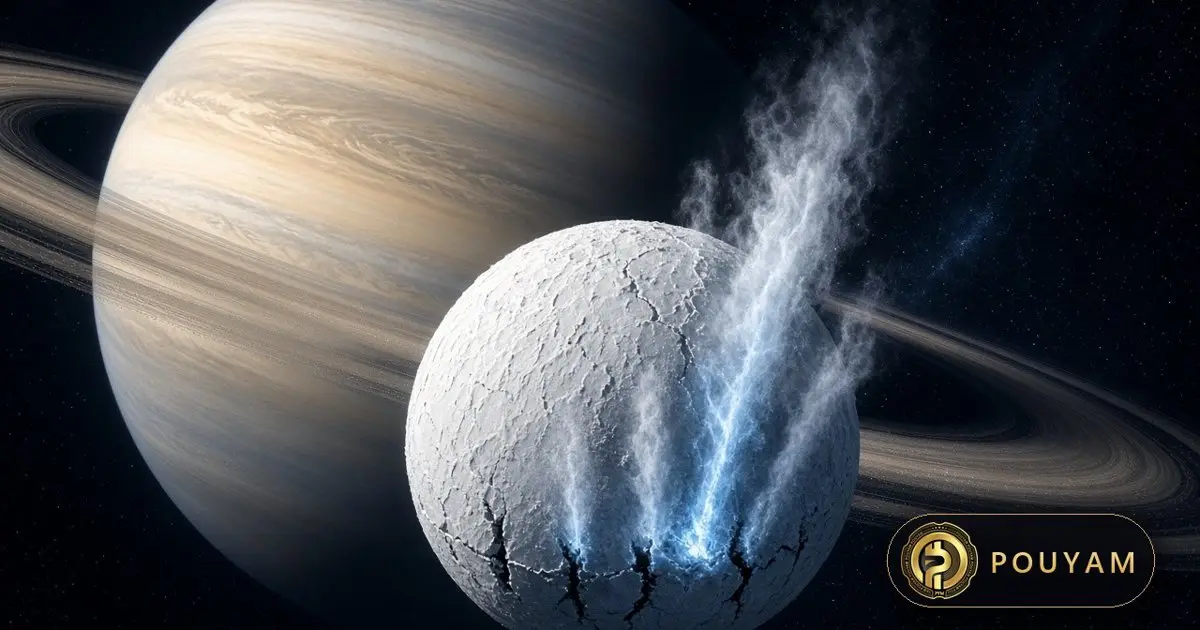
As of 13 November 2026, a Science Advances study of Cassini data proposes that salty droplets from Enceladus's hidden ocean freeze slowly in its vents, separating different salts, before shattering into the chemically distinct ice grains the spacecraft detected; the finding could aid future searches for signs of life [1][2][3].
Key takeaways
- Saturn's moon Enceladus hides a global ocean under its ice and sprays it into space from fractures near its south pole [3].
- A 2026 Science Advances study analysed 961 mass spectra of salt-rich 'Type 3' ice grains measured by the Cassini spacecraft's Cosmic Dust Analyser [3].
- The grains were chemically diverse, enriched in different salts such as sodium chloride, carbonates, phosphates and potassium chloride [3].
- Lab experiments found that large ocean droplets freezing slowly, at about 10 kelvin per minute or less, separate their salts [3].
- The team proposes the frozen droplets then shatter on vent walls into small grains, each carrying different chemistry [3].
- The result is a proposed mechanism, not a direct observation, and some details remain unexplained [3][4].
On this page 12 sections
- What did the Enceladus study find?
- What did Cassini measure at Enceladus?
- How does slow freezing separate the salts?
- How do ocean droplets become tiny ice grains?
- Why does this matter for finding life?
- What is still uncertain about the Enceladus finding?
- What is Enceladus and why study its ocean?
- What comes next for Enceladus research?
- Common mistakes
- Frequently asked questions
- Glossary
- Sources
What did the Enceladus study find?
A 2026 study proposes that slow freezing and shattering of ocean droplets in Enceladus's vents explains why its ejected ice grains are so chemically varied [3]. The work, led by Frank Postberg of Freie Universität Berlin with colleagues including Yasuhito Sekine at the Earth-Life Science Institute of the Institute of Science Tokyo, appeared in Science Advances [3][5].
Enceladus, a moon of Saturn, hides a global ocean beneath its frozen surface, and material from that ocean sprays into space as a plume of water vapour and ice particles from fractures near its south pole [3]. Those particles let scientists study an alien ocean without drilling through kilometres of ice [3].
In a News and Views piece in Nature on 11 November 2026, Kevin Hand of the Jet Propulsion Laboratory wrote that Saturn's outermost ring, the E ring, which is supplied mainly by the erupting ice plumes of Enceladus, continues to inform planetary science and astrobiology, nine years after Cassini's last data reached Earth [1]. He added that the authors also discuss what the data can say about the subsurface ocean, including whether it could be habitable [1].
What did Cassini measure at Enceladus?
Cassini's Cosmic Dust Analyser measured the composition of individual ice grains in Saturn's E-ring between 2004 and 2017 [3]. The E-ring is supplied mainly by material ejected from Enceladus, so these grains carry ocean material [1][3].
The researchers analysed 961 mass spectra of salt-rich grains, known as Type 3 particles [3]. According to a detailed account of the study, these came from 7,353 E-ring grain spectra recorded during 15 favourable observation periods between 2004 and 2008, with 961 classified as Type 3 by their strong salt signatures [4].
The team found wide chemical diversity: different grains were enriched in different salts, including sodium chloride, carbonates, phosphates and potassium chloride [3]. Notably, chloride and carbonate were rarely found together in the same sodium-rich grain [3]. Sekine said the diversity was what surprised the team, given that the droplets originate from essentially the same ocean water [3].
How does slow freezing separate the salts?
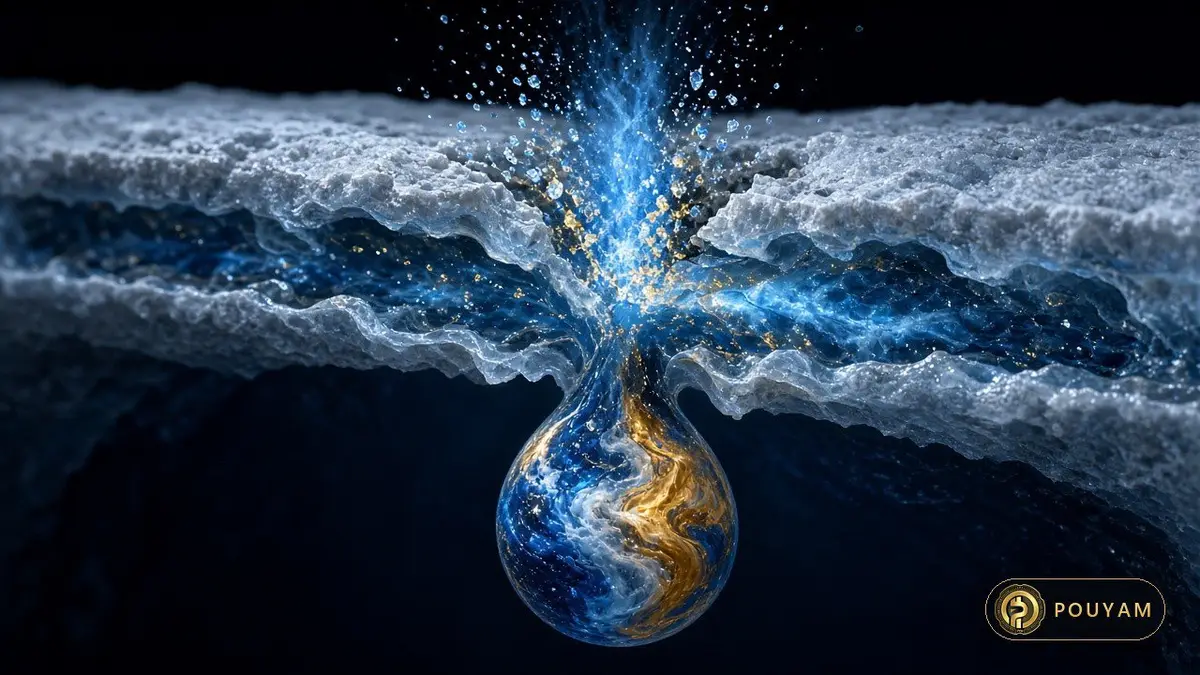
In laboratory tests, slowly freezing salty droplets caused different salts to separate into distinct regions within each droplet [3]. Sekine and colleagues at ELSI made droplets designed to reproduce the main salts expected in Enceladus's ocean, then froze droplets of different sizes at different cooling rates [2][3].
Cooling rate mattered. In droplets about 200 micrometres across, salts became spatially separated when the droplets froze slowly, at roughly 10 kelvin per minute or less; faster freezing produced a more uniform distribution [3]. In the modelled fluid described by one detailed account, sodium bicarbonate (nahcolite) precipitates once cooling reaches about 255 kelvin, and the account gives about 20 kelvin per minute as the cooling rate below which the needed conditions arise [4].
"What surprised us was that the diversity seen by Cassini could emerge from droplets originating from essentially the same ocean water," Sekine said [3]. "Our experiments show that when relatively large ocean droplets freeze slowly, different salts can separate within them. If those frozen droplets are later broken apart, they can produce much smaller ice grains." [3]
How do ocean droplets become tiny ice grains?
The team proposes a multi-stage journey from ocean spray to the small grains Cassini sampled [3]. What Cassini observed is the grain compositions; the freezing-and-shattering history is inferred from experiments and models [3][4]. The steps, as the researchers describe them [3]:
- Droplets form. Ocean spray initially forms droplets tens to hundreds of micrometres across.
- Slow travel and freezing. These droplets move relatively slowly through deeper parts of the vent system, giving salts time to separate as the droplets gradually freeze.
- Acceleration and shattering. Closer to the surface, the gas flow speeds up and the frozen droplets collide with the walls of narrow ice channels at high speed, shattering them.
- Ejection. The fragments, each carrying different salt-rich regions, are carried into Saturn's E-ring, where Cassini could sample them one by one.
"Cassini may have sampled fragments of larger frozen ocean droplets, each preserving different components that became separated during their journey towards the surface," Postberg said [3]. In a model of a 1,500-metre vent, cooling rates start near 3 kelvin per minute and stay below 20 kelvin per minute through the lower three-quarters; the account says this shows the conditions are physically possible, not a reconstruction of a specific Enceladus vent [4].
Why does this matter for finding life?
Because freezing and fragmentation concentrate chemicals into separate grains, which could help future spacecraft detect compounds that are diluted in the ocean [3]. The study does not report any sign of life; the link to life searches is the authors' suggestion for future missions [3]. Salts are separated not only from each other but also from organics, and previous analyses had found many organic species separated from each other at elevated concentrations [3].
Analysing particles one at a time could therefore help future spacecraft spot compounds that would otherwise be diluted in the ocean and mixed with many others [3]. As the Science Tokyo team put it, Enceladus conveniently performs the separation and concentration steps that chemistry labs on Earth normally do before analysis [3].
The release adds a further possibility: slow freezing may create small pockets of liquid brine between growing ice crystals, where salts and organic compounds become concentrated [3]. Such concentration could be relevant to prebiotic chemistry, the chemistry that could precede life, where bringing dilute organic molecules together is an important challenge; since much of the plume material falls back onto the moon, these processes could potentially occur repeatedly [3]. Understanding how the grains form gives both a picture of the hidden environment under the ice and a guide for interpreting what future missions collect [3].
What is still uncertain about the Enceladus finding?
Quite a lot: this is a proposed mechanism built from observations, experiments and models, not a direct look inside a vent [3][4]. As one detailed account stresses, no spacecraft watched an Enceladus droplet slowly freeze, separate, strike a wall and break into the exact grains Cassini later measured; the full chain is the researchers' scenario [4].
Specific gaps remain [4]:
- Potassium: in slow-cooling experiments potassium could form potassium carbonate, which is not seen in the Cassini data, while calculations suggest it should mostly be potassium chloride.
- Hydroxide: more than 20% of regular Type 3 spectra show sodium hydroxide without a carbonate signal, which equilibrium calculations alone did not produce; the account says rapid carbon-dioxide loss after a pressure drop may leave a hydroxide-enriched brine.
- Vent length: the modelled 1,500-metre vent may be longer than current estimates of the ice shell beneath the south pole, and real 3D flow could change the cooling rates.
The experiments also do not fully reproduce the degree of sodium segregation or the high potassium levels of the potassium-rich Type 3 group [4]. Uncertain factors named include vent geometry, individual droplet cooling histories, the starting fluid composition and the processes behind some potassium and hydroxide patterns [4].
What is Enceladus and why study its ocean?
Enceladus is a moon of Saturn with a global ocean under its icy crust, and future missions could search it for clues to its habitability and signs of life [2][3]. It vents that ocean straight into space, which is rare and valuable [3].
Saturn is surrounded by eight rings of ice and rock fragments, and the E ring, the outermost, is supplied mainly by Enceladus's erupting ice plumes [1]. Cassini's Cosmic Dust Analyser measured grains in the E ring from 2004 to 2017, and its archive is still yielding results nine years after the mission's last data [1][3].
The grains carry chemistry from a place no lander has reached. Previous analyses had already found organic species separated at elevated concentrations, and this study proposes a physical explanation for how the ocean's chemistry gets sorted on the way out [3].
What comes next for Enceladus research?
Future missions that analyse the plume grain by grain could use findings like this one [3]. The study's practical message is that analysing particles individually could help detect compounds otherwise diluted in the ocean [3].
For now, the science rests on Cassini's archive. Hand notes the latest analysis comes nine years after Cassini's final data [1]. More laboratory work and better models of the vents would help close the gaps around potassium, hydroxide and vent geometry [4].
None of the sources read for this guide announces a confirmed mission to Enceladus or a launch date, so none is described here; the findings reflect the published research available on 13 November 2026 [1][3]. The release describes the plume particles as a rare opportunity to investigate an extraterrestrial ocean [3].
| Item | Detail | Source |
|---|---|---|
| Moon | Enceladus (Saturn) | Science Advances [3] |
| Data source | Cassini Cosmic Dust Analyser, 2004-2017 | Science Advances [3] |
| Grains analysed | 961 mass spectra of salt-rich 'Type 3' grains | Science Advances [3] |
| Salts found | NaCl, carbonates, phosphates, KCl | Science Advances [3] |
| Key lab result | Slow freezing (~10 K/min) separates salts | Science Advances [3] |
| Droplet size | Tens to hundreds of micrometres (proposed spray droplets) | Science Advances [3] |
| Proposed final step | Shattering on vent walls into small grains | Science Advances [3] |
| Status | Proposed mechanism, not direct observation | Account [4]; release [3] |
Common mistakes
Saying the study found life on Enceladus.
Fix: It explains how ice grains form and could aid future searches; it reports no sign of life [3].
Treating the freezing-and-shattering chain as directly observed.
Fix: It is a proposed mechanism from data, experiments and models [3][4].
Assuming the grains show the ocean's average composition.
Fix: They are chemically sorted fragments, enriched in different salts [3].
Thinking this is brand-new spacecraft data.
Believing every chemical detail is explained.
Fix: Potassium and hydroxide patterns remain partly unresolved [4].
Frequently asked questions
What did the Enceladus study find?
That slow freezing and shattering of ocean droplets in the moon's vents can explain its chemically diverse ice grains [3].
What did Cassini measure at Enceladus?
The composition of individual ice grains in Saturn's E-ring from 2004 to 2017, including 961 mass spectra of salt-rich Type 3 grains [3].
How does slow freezing separate the salts?
When droplets freeze at about 10 kelvin per minute or less, different salts separate into distinct regions [3].
Why does this matter for finding life?
Concentrating chemicals into separate grains could help future spacecraft detect compounds diluted in the ocean, including organics; no sign of life has been reported [3].
Glossary
- Enceladus
- A small icy moon of Saturn with a global ocean beneath its surface.
- Plume
- The jet of water vapour and ice particles erupting from Enceladus's south pole.
- E-ring
- Saturn's outermost ring, supplied mainly by Enceladus's plume.
- Cosmic Dust Analyser
- The Cassini instrument that measured the composition of single ice grains.
- Type 3 grains
- Salt-rich ice grains in the Cassini data, with strong salt signatures.
- Prebiotic chemistry
- Chemical processes that could lead towards the origin of life.
Sources
- Salty grains in Saturn's outermost ring formed from the slow freeze of plumes from the moon Enceladus Nature · 2026-11-11
- How Enceladus' ocean spray becomes chemically diverse ice grains Earth-Life Science Institute (ELSI) · 2026-09-28
- How Enceladus' ocean spray becomes chemically diverse ice grains Institute of Science Tokyo · 2026-10-22
- Enceladus' strange salt-rich ice grains may be fragments of larger frozen droplets Science News Today · 2026-09-29
- Cassini CDA observes compositional segregation of Enceladus' ice grains from slow freezing and fragmentation of oceanic spray Science Advances · 2026-09-25

Comments
Top comments