
How Much Water Should You Drink a Day? What Evidence Says
- 0 views
- 0 likes
- 0 comments
- All languages combined
 +99
Sign in and earn +99 points by reading this
Read to the end, wait a few seconds, then tap the claim button below.
In short
US experts set adequate total water intakes of about 2.7 litres a day for women and 3.7 litres for men, counting all drinks and food; Europe’s food-safety agency says 2.0 and 2.5 litres [1][3]. About 80% comes from drinks [1]. Needs vary widely, and for most healthy people thirst plus pale yellow pee is a good guide [1][5].
Key takeaways
- The US National Academies set adequate intakes of about 2.7 litres of total water a day for women and 3.7 litres for men, from drinks and food together [1].
- The European Food Safety Authority (EFSA) sets lower adequate intakes: 2.0 litres a day for women and 2.5 litres for men, also counting food [3].
- Food supplies about 20% of total water; the rest comes from drinking water and other beverages [1][8].
- The NHS suggests 6 to 8 cups or glasses of fluid a day as a guide; tea, coffee, lower-fat milk and lower-sugar drinks all count [5].
- A 2022 study of 5604 people in 23 countries found water needs vary widely with body size, activity, climate and age, and said the 8-glasses rule is not backed by objective evidence [4].
- Aim for pee that is a clear pale yellow; dark yellow, strong-smelling pee and thirst are signs of dehydration [5][6].
- Drinking far too much is rare but can be dangerous, because healthy kidneys can only clear about 0.7–1.0 litres an hour [2][9].
On this page 12 sections
- How much water should you drink a day?
- Do you really need 8 glasses of water a day?
- How much water do you need in litres and ounces?
- How much water do children, teenagers and pregnant people need?
- Does coffee or tea count towards water intake?
- What changes how much water you need?
- How do you know if you are drinking enough?
- Can you drink too much water?
- Common mistakes
- Frequently asked questions
- Glossary
- Sources
How much water should you drink a day?
Most healthy adults need roughly 2 to 3.7 litres of total water a day, counting water in all drinks and food; US experts use 2.7 litres for women and 3.7 litres for men, while EFSA uses 2.0 and 2.5 litres [1][3].
The most widely cited numbers come from the Institute of Medicine of the US National Academies. Its 2004 report found that women who appeared well hydrated took in an average of about 2.7 litres (91 ounces) of total water a day, and men about 3.7 litres (125 ounces) [1]. These are adequate intakes: amounts that seem to keep healthy, mostly sedentary people in temperate climates well hydrated, not minimum requirements [1][2].
“Total water” is the key phrase. It includes plain water, every other drink and the moisture in food. About 80% of people’s total water comes from drinking water and beverages, including caffeinated ones, and about 20% from food [1]. So a man’s 3.7 litres means about 3.0 litres from drinks, and a woman’s 2.7 litres about 2.2 litres from drinks [2].
The European Food Safety Authority (EFSA) reached lower figures in 2010: adequate total water intakes of 2.0 litres a day for women and 2.5 litres for men, again from drinks and food together, under moderate temperature and moderate activity [3]. The two sets of numbers differ because they rest on different population data and methods, not because Americans and Europeans have different bodies.
Both expert groups stress that these figures are averages. The US panel said most healthy people meet their daily needs “by letting thirst be their guide”, and offered no rule of thumb in glasses [1]. Mayo Clinic adds that how much water a body needs depends on health, age, activity, where you live and the weather [8].
Do you really need 8 glasses of water a day?
No fixed number of glasses suits everyone: the 8 × 8 rule is easy to remember, but a large 2022 study found it is not backed by objective evidence [4].
The familiar advice is eight 8-ounce glasses, about 2 litres. In a study published in Science in 2022, researchers measured water turnover, the total water the body uses and replaces each day, in 5604 people aged from 8 days to 96 years in 23 countries, using a stable-isotope tracer [4]. They concluded that one size does not fit all and that the common suggestion of 8 × 8-ounce glasses a day is not backed by objective evidence [4].
That does not make 8 glasses wrong for everyone. The NHS, using the UK government’s Eatwell Guide, suggests aiming for 6 to 8 cups or glasses of fluid a day as “just a guide” [5]. Mayo Clinic calls eight glasses easy to remember and a good goal, while noting that some people need less and others more [8]. The US National Academies panel went further and declined to give any rule based on glasses, because water comes from so many sources [1].
Two points explain the confusion. First, guidance in glasses usually means fluid from drinks, while the litre figures in expert reports mean total water including food [1][5]. Second, the body also gets water from food and from its own metabolism, so the amount you need to drink is smaller than the amount you use [3][4].
In practice, 6 to 8 glasses of fluid is a reasonable starting point for many adults in a mild climate, and it is not a target to force down if you are not thirsty [1][5].
How much water do you need in litres and ounces?
US adequate intakes are 3.7 litres (125 ounces) of total water a day for men and 2.7 litres (91 ounces) for women, of which about 3.0 and 2.2 litres come from drinks [1][2].
The table below sets out the main adult reference values side by side. They are averages for healthy people; a very active person in hot weather can need much more, and a small, sedentary person in a cool climate may need less [1][4].
To turn litres into everyday measures: 1 litre is about 34 US fluid ounces, or about four standard 250 ml glasses. Mayo Clinic expresses the US figures as about 15.5 cups (3.7 litres) for men and about 11.5 cups (2.7 litres) for women of total fluid, from all sources [8].
The study of water turnover gives another view [4]. It found that turnover rises with age until about 30 and is higher in men (4.3 litres a day) than in women (3.4 litres a day), then falls to averages of 3.1 and 2.8 litres a day in men and women over 70 [4]. Turnover counts all water passing through the body, including water from food and from metabolism, so it is higher than the amount people drink [4].
The study also built equations to predict needs. A non-athletic 20-year-old man weighing 70 kg in a mild climate is predicted to turn over about 3.2 litres a day, and a woman of the same age weighing 60 kg about 2.7 litres [4]. An athletic man in hot, humid weather at altitude was predicted to need 7.3 litres a day [4].
How much water do children, teenagers and pregnant people need?
Children need less in total but more for their size; the US values run from 1.3 litres a day at ages 1–3 to 3.3 litres for teenage boys, and pregnancy and breastfeeding raise needs [2][3].
The US National Academies set these adequate intakes of total water [2]:
- Ages 1–3: 1.3 litres a day.
- Ages 4–8: 1.7 litres a day.
- Ages 9–13: 2.4 litres for boys and 2.1 litres for girls.
- Ages 14–18: 3.3 litres for boys and 2.3 litres for girls.
- Pregnancy: 3.0 litres a day; breastfeeding: 3.8 litres a day.
EFSA’s values are again a little lower: 1.3 litres a day at ages 2–3, 1.6 litres at 4–8, 2.1 litres for boys and 1.9 litres for girls aged 9–13, and adult values from age 14 [3]. For pregnancy EFSA adds 300 ml a day to the usual adult intake, and for breastfeeding about 700 ml a day [3]. The 2022 turnover study measured a similar pattern: an extra 670 ml a day in the third trimester and 260 ml a day during breastfeeding, compared with before pregnancy [4].
For children’s drinks, the NHS says the best choices are water and milk, and that children should avoid sugary fizzy drinks, squash and juice drinks completely [5]. Babies and children are among the groups at higher risk of dehydration, especially when they are ill [6].
Does coffee or tea count towards water intake?
Yes. Tea, coffee, milk and other drinks all count, and the US expert panel found no convincing evidence that caffeine causes a lasting water deficit [1][5][8].
A common belief is that coffee and tea “dehydrate” you. The US National Academies panel looked at this and concluded that caffeine’s diuretic effect may be short-lived and that there is no convincing evidence it leads to a cumulative loss of body water, so caffeinated drinks can count as much as others towards daily needs [1]. The NHS lists water, lower-fat milk and lower-sugar drinks, including tea and coffee, as part of daily fluid intake [5], and Mayo Clinic says tea, coffee and milk help keep you hydrated [8].
Counting is one thing; choosing is another. Health agencies still put plain water first:
- Water has no calories, and the CDC notes that replacing sugary drinks with plain water can help cut calorie intake [7].
- Caffeine: the CDC says moderate caffeine, up to 400 mg a day, can be part of a healthy diet for most adults, about 2 to 3 cups of plain coffee [7]. The NHS advises no more than 200 mg a day in pregnancy [5].
- Juice and smoothies: the NHS suggests no more than one small glass (150 ml) a day, with a meal, because of their sugar [5].
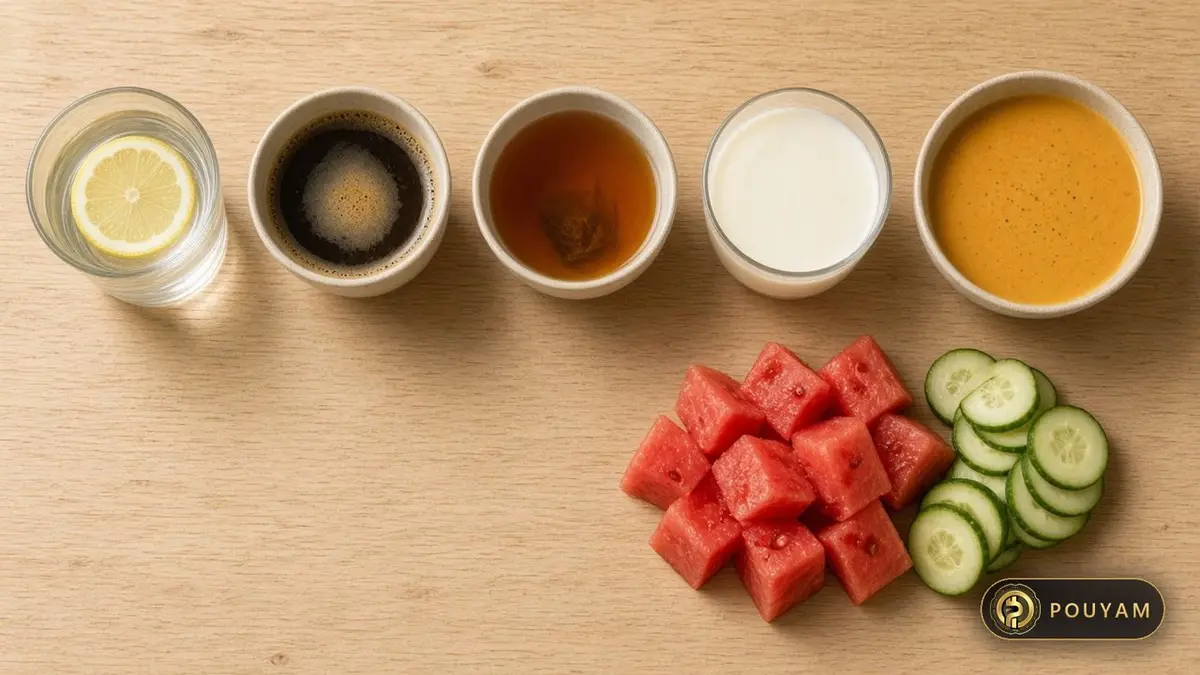
- Food: fruits and vegetables such as watermelon, strawberries, cantaloupe and cabbage are almost entirely water by weight [8].
Alcohol is a fluid, but the CDC advises that anyone who drinks should do so in moderation [7]. For how health bodies now judge body weight beyond a single number, see our guide BMI vs Waist Size: New Obesity Definition Tested.
What changes how much water you need?
Activity, heat, humidity, altitude, body size, age, pregnancy and illness all change water needs, sometimes by several litres a day [1][4][7].
The 2022 turnover study put numbers on several of these factors, with everything else held equal [4]:
- Physical activity: a rise of 1.0 in physical activity level (a measure of daily energy use) adds about 1 litre a day, and athletes turn over about 1 litre more than non-athletes.
- Heat: at an air temperature of 30 °C, turnover is about 1 litre a day higher than at the lowest point, between 0 and 10 °C.
- Humidity and altitude: a 50% rise in relative humidity adds about 300 ml, and living 1000 m higher adds about 500 ml.
- Body size and sex: 50 kg more body weight adds about 700 ml; men turn over about 400 ml more than women of the same weight, because of more lean mass.
- Season: in 72 people measured twice, turnover was 3.7 litres a day in summer against 3.0 litres in spring.
The US panel noted that very active people continually exposed to hot weather often need six litres or more of total water a day [1]. EFSA says losses under extreme heat and exercise can reach about 8000 ml a day and must be replaced [9].
Illness matters too. The CDC says the body needs more water when you have a fever, diarrhoea or vomiting, are in a hot climate or are more active [7], and the NHS suggests extra fluids when recovering from illness [5]. If you are building up exercise, plan drinks before, during and after workouts, as Mayo Clinic suggests [8]; for one recent study on exercise and weight loss, see our guide Mounjaro Muscle Loss: Weight Training Helps, Trial Finds.
How do you know if you are drinking enough?
Check your pee and your thirst: a clear pale yellow colour and rarely feeling thirsty suggest you are drinking enough [5][8].
The simplest test is the one the NHS gives: drink enough through the day that your pee is a clear pale yellow [5]. Mayo Clinic says you are probably drinking enough if you do not often feel thirsty and your urine is colourless or light yellow [8].
Signs you may need more fluid, according to the NHS and Mayo Clinic [6][8]:
- feeling thirsty;
- dark yellow, strong-smelling pee, or peeing less often than usual;
- headaches, or feeling tired and dizzy;
- doing less well than usual during physical activity.
Practical habits make it easier to keep up [5][7][8]:
- Drink regularly through the day rather than all at once.
- Have water with each meal and between meals.
- Carry a reusable bottle and choose water when eating out.
- Drink extra in heat, during exercise or when ill, when losses are higher.
- Add flavour if plain water is hard: sparkling water or a slice of lemon or lime.
Some people need to pay more attention. The NHS says babies, children and older adults are at higher risk of dehydration, and that children under 5 and older adults should get plenty of fluids [6]. EFSA notes that older people’s kidneys concentrate urine less well, so their water needs per unit of food energy are higher, even though they eat less [9].
Can you drink too much water?
Yes, but it is rare in healthy people: drinking much faster than the kidneys can clear water, about 0.7–1.0 litres an hour, can cause dangerously low blood sodium (hyponatraemia) [2][8][9].
Mayo Clinic explains that when you drink too much water, the kidneys cannot get rid of the excess, and sodium in the blood becomes too diluted; this condition, hyponatraemia, can be life-threatening [8]. The US panel notes it mostly occurs in some athletes doing strenuous activity and in some people with certain psychiatric disorders, and is highly unusual; for that reason it set no upper limit for water [1].
The reference tables put the limit in physical terms: people with normal kidney function can excrete roughly 0.7 litres of excess water an hour, and EFSA gives a range of 0.7–1.0 litres an hour [2][9]. Spreading drinks through the day, and not forcing large volumes in a short time, keeps intake well within that range.
Some health conditions and medicines change how the body handles fluid, so the general figures may not fit everyone. Your own doctor can tell you the right amount for you [8]. This guide summarises published reference values; it is not medical advice.
The bottom line from the evidence: there is no single magic number. Use 2 to 3.7 litres of total water a day as a broad adult range, let thirst and the colour of your pee guide you, and drink more when it is hot, when you are active, pregnant or breastfeeding, or when you are unwell [1][3][5].
| Source | Women | Men | What it counts |
|---|---|---|---|
| US National Academies (2004) | 2.7 litres (91 oz) | 3.7 litres (125 oz) | Total water from drinks and food |
| US National Academies, drinks part | 2.2 litres | 3.0 litres | Water and other beverages only |
| EFSA (2010) | 2.0 litres | 2.5 litres | Total water from drinks and food |
| NHS Eatwell Guide | 6 to 8 cups or glasses | 6 to 8 cups or glasses | Fluid from drinks |
| Group | US National Academies | EFSA |
|---|---|---|
| Ages 1–3 | 1.3 | 1.1–1.2 (age 1–2); 1.3 (age 2–3) |
| Ages 4–8 | 1.7 | 1.6 |
| Boys 9–13 | 2.4 | 2.1 |
| Girls 9–13 | 2.1 | 1.9 |
| Boys 14–18 | 3.3 | 2.5 (adult value) |
| Girls 14–18 | 2.3 | 2.0 (adult value) |
| Pregnancy | 3.0 | Adult value plus 0.3 |
| Breastfeeding | 3.8 | Adult value plus about 0.7 |
| Factor | Change | Approximate effect |
|---|---|---|
| Physical activity level | Up by 1.0 | About +1 litre a day |
| Athlete vs non-athlete | Athlete | About +1 litre a day |
| Air temperature | 30 °C vs 0–10 °C | About +1 litre a day |
| Altitude | 1000 m higher | About +500 ml a day |
| Body weight | 50 kg heavier | About +700 ml a day |
| Relative humidity | 50% higher | About +300 ml a day |
| Age | 80 vs 30 years | About −700 ml a day |
Common mistakes
Treating 8 glasses as a strict daily rule.
Fix: Needs vary widely; the 8 × 8 rule is not backed by objective evidence [4].
Counting only plain water.
Fix: Tea, coffee, milk and food all count; food gives about 20% of total water [1][5].
Comparing a litre target for total water with what you drink.
Fix: Expert litre figures include food; the drinks part is about 80% [1][2].
Forcing down water when not thirsty.
Fix: For most healthy people thirst and pale yellow pee are a good guide [1][5].
Drinking large volumes very fast, for example before a race.
Fix: Kidneys clear only about 0.7–1.0 litres an hour; too much can cause hyponatraemia [8][9].
Forgetting extra fluid in heat, exercise or illness.
Fix: Fever, diarrhoea, vomiting, hot weather and activity raise needs [6][7].
Frequently asked questions
How much water should you drink a day in litres and ounces?
US adequate intakes are about 2.7 litres (91 ounces) of total water for women and 3.7 litres (125 ounces) for men; about 80% comes from drinks [1].
Do you need 8 glasses a day?
Not necessarily. The NHS suggests 6 to 8 glasses of fluid as a guide, but a 2022 study found the 8 × 8 rule is not backed by objective evidence [4][5].
Does coffee or tea count towards water intake?
Yes. The US expert panel found caffeinated drinks count, and the NHS includes tea and coffee in daily fluid [1][5].
How do you know if you are drinking enough?
Your pee should be a clear pale yellow and you should rarely feel thirsty [5][8].
Does food count towards water intake?
Yes. Food supplies about 20% of total water, and many fruits and vegetables are almost all water [1][8].
Glossary
- Total water
- All water taken in from drinking water, other beverages and food moisture [1].
- Adequate intake (AI)
- An average intake that appears to keep healthy people adequately supplied; not a strict requirement [2].
- Water turnover
- The total water the body uses and replaces each day [4].
- Hyponatraemia
- Low sodium in the blood, which can follow drinking far too much water [8].
- EFSA
- The European Food Safety Authority, which sets EU dietary reference values [3].
Sources
- Report Sets Dietary Intake Levels for Water, Salt, and Potassium To Maintain Health and Reduce Chronic Disease Risk National Academies (Institute of Medicine) · 2004-02-11
- Dietary Reference Intakes: Electrolytes and Water (summary table) National Academies, Food and Nutrition Board
- Scientific Opinion on Dietary Reference Values for water European Food Safety Authority, EFSA Journal · 2010-03-25
- Variation in human water turnover associated with environmental and lifestyle factors (Yamada et al.) Science · 2022-11-25
- Water, drinks and hydration NHS · 2023-05-17
- Dehydration NHS · 2026-05-01
- About Water and Healthier Drinks US Centers for Disease Control and Prevention · 2026-03-05
- Water: How much should you drink every day? Mayo Clinic · 2026-01-21
- Dietary Reference Values for nutrients: Summary report European Food Safety Authority · 2017-12-04


Comments
Top comments