
Hera Mission: What ESA Found at DART's Asteroid Target
- 1 views
- 0 likes
- 0 comments
- All languages combined
In short
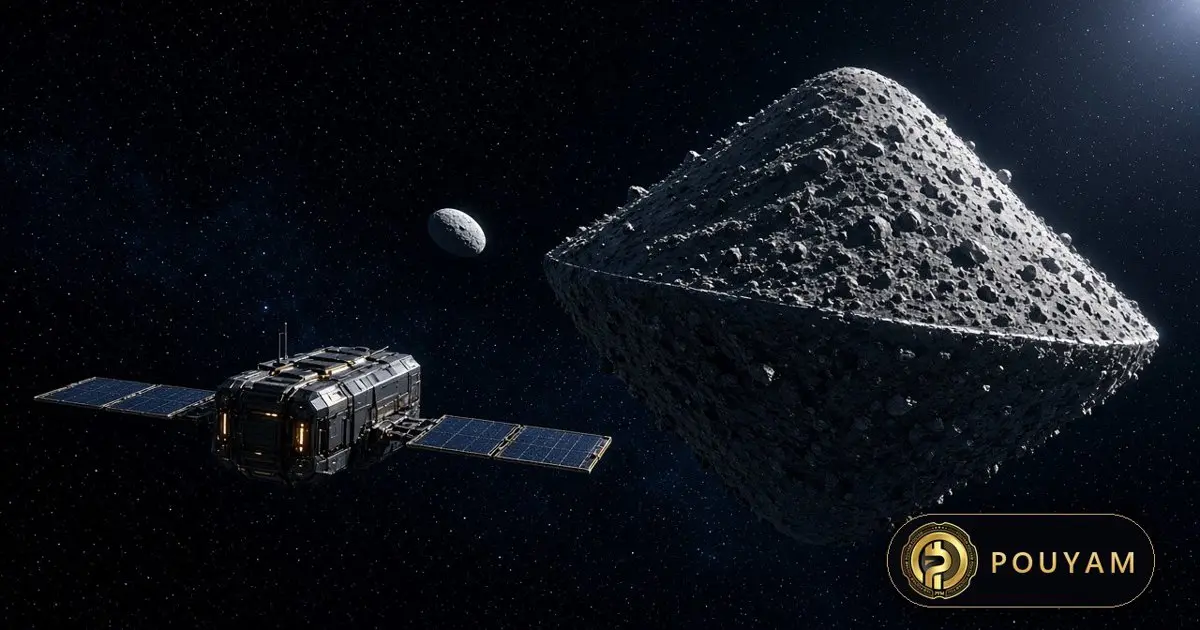
As of 13 November 2026, ESA says its Hera spacecraft has arrived at the Didymos-Dimorphos asteroid pair and is inspecting it from 30-25 km away, studying the aftermath of NASA's 2022 DART impact; ESA plans to unveil detailed images of both asteroids on 25 November [1][2][3].
Key takeaways
- Hera is ESA's first planetary defence mission; ESA expected in 2025 that it would reach the Didymos binary asteroid system in November 2026, a month earlier than first planned, and on 11 November 2026 it reported Hera had arrived [2][4].
- It began its 'early characterisation phase' from 30-25 km away, ESA announced on 11 November 2026 [2].
- Hera is studying what NASA's DART impact did to the small moonlet Dimorphos in 2022 [1][2].
- NASA confirmed in 2022 that DART shortened Dimorphos's orbit around Didymos by 32 minutes (ESA now says around 33), far beyond the 73-second success benchmark [1][5].
- Hera carries science instruments and two CubeSats, Milani and Juventas, which will survey Dimorphos and attempt a landing [2][3][4].
- Detailed images of both asteroids are due to be unveiled on 25 November 2026 [1].
On this page 12 sections
- What is the Hera mission?
- When did Hera arrive at Didymos?
- What did NASA's DART mission do to the asteroid?
- What has Hera seen so far?
- How does Hera orbit two asteroids at once?
- What are the Milani and Juventas CubeSats?
- Why does the Hera mission matter?
- What happens next for Hera?
- Common mistakes
- Frequently asked questions
- Glossary
- Sources
What is the Hera mission?
Hera is the European Space Agency's first mission dedicated to planetary defence, sent to study the Didymos binary asteroid system [2][4]. It launched on 7 October 2024 [4]. It is a small-car-sized spacecraft carrying science instruments and two CubeSats [2][3][4].
Its target is a pair: the main asteroid Didymos, about 780 m across, and its small moonlet Dimorphos, about 151 m across [2]. Dimorphos is the asteroid that NASA's DART spacecraft deliberately crashed into in 2022, in the first test of deflecting an asteroid [2][5].
Hera's job is a follow-up investigation. ESA calls it a "crash site investigation": Hera will measure, in detail, what the DART impact did to Dimorphos, using multiple instruments and eventually deploying its CubeSats for a closer look and a landing attempt [1][2]. Mission scientist Michael Kueppers said the images "will reveal for the first time what a small asteroid looks like globally, having experienced a hypervelocity impact" [2].
The broader goal is to turn asteroid deflection from a one-off demonstration into a reliable, well-understood technique [4].
When did Hera arrive at Didymos?
ESA announced on 11 November 2026 that Hera had arrived at the Didymos system, in the month ESA had targeted in 2025, a month earlier than originally planned [2][4]. The 11 November announcement placed the spacecraft 30-25 km from the binary system, beginning its early characterisation phase [2]; ESA's page gives no exact arrival date.
The early arrival came from the spacecraft's good performance. ESA's Sylvain Lodiot said the reliable propulsion system "enabled the team to design a new more aggressive manoeuvre plan that involves 'braking' later and harder during the approach to Didymos", letting Hera target arrival a month early [4].
Hera took a winding route to get there. After launch it swung towards Mars, made a Mars flyby in March 2025 that bent its path towards Didymos, and used the encounter to test its instruments on a planetary body [4]. It is controlled from ESA's ESOC mission control centre in Darmstadt, Germany, with contact for about eight hours a day across 196.5 million km of space via 35-m Deep Space Antennas in Argentina, Spain and Australia [2].
What did NASA's DART mission do to the asteroid?
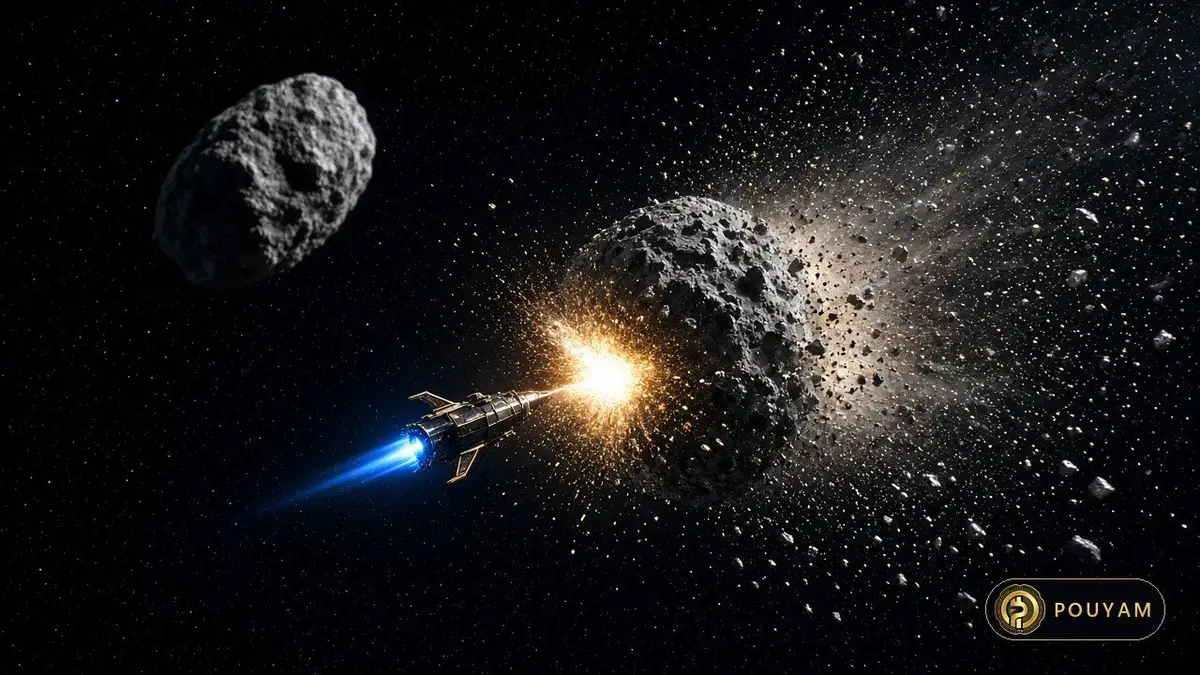
DART shortened the moonlet's orbit around Didymos by 32 minutes, which NASA called the first time humanity purposely changed the motion of a celestial object [5]. On 26 September 2022, NASA's 580-kg DART spacecraft struck Dimorphos at about 6.1 km/s [1].
Before the impact, Dimorphos took 11 hours and 55 minutes to orbit Didymos [5]. NASA confirmed on 11 October 2022 that the collision cut that to 11 hours and 23 minutes, a change of 32 minutes with an uncertainty of about plus or minus 2 minutes [5]. ESA's 2026 pages describe the slowdown as "around 33 minutes" [1]. NASA had set a minimum success benchmark of a 73-second change, so DART beat it by more than 25 times [5].
The impact also blasted out debris. ESA says the collision "sent out a plume of debris across 10 000 km of space" [1]. NASA notes the recoil from that ejecta substantially enhanced DART's push, like air escaping a balloon [5]. The deflection was larger than impact simulations had predicted, which is one of the puzzles Hera is meant to solve [1].
What has Hera seen so far?
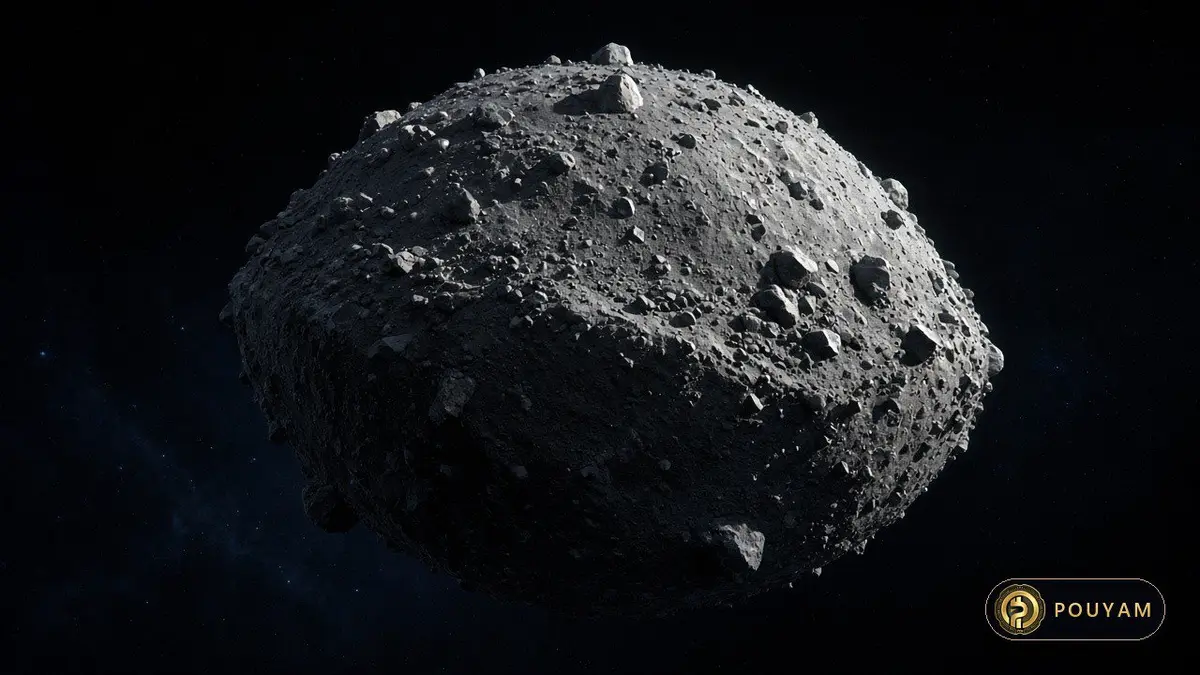
Early preview images of Didymos and a glimpse of the hidden moonlet Dimorphos [1]. On 12 November 2026, ESA released an image acquired from 56 km away showing one face of the 780-m Didymos, with a small part of Dimorphos peeking out near the top [1].
ESA says the image reveals the main asteroid's geological richness, including large boulders, smoother regions and "a surprisingly sharp equatorial ridge" [1]. ESA says Didymos, shaped like a spinning top, rotates every 2.2 hours, fast enough that it is close to coming apart, and that the ridge may be linked to this spin [1]. Numerical models suggest the spin may make surface material flow from higher latitudes down to the equator, and some material is sloughed off, which could help explain how Dimorphos formed [1].
Dimorphos itself orbits a little more than a kilometre from Didymos, with a few boulders visible along its top side [1]. Detailed images of both asteroids are due to be unveiled on 25 November 2026 [1].
How does Hera orbit two asteroids at once?
It does not fly a normal circular orbit; it traces 'rectangular orbits' around the pair's shared centre of gravity [2]. The gravity here is extraordinarily weak: Didymos has gravity about 40,000 times weaker than Earth's, and Dimorphos about 200,000 times weaker [2].
In that environment, a traditional orbit is impractical [2]. Instead Hera moves at just 12 cm/s, about as fast as a rapidly crawling insect, in nearly straight lines [2]. On a cycle of every three days then four days, as it drifts away from the asteroids, it fires its thrusters to turn its course by 90 degrees, tracing a rectangle while holding its 30-25 km distance [2].
ESA says the design, drawn from its Rosetta comet mission, is inherently safe: if a thruster firing fails, Hera simply drifts away rather than risking a collision [2]. Next month, Hera is scheduled to move closer for a 'detailed characterisation phase', shifting to more complex bowtie-shaped arcs from around 20 km away [2]. Euronews likewise reported that Hera will move to within 20 km next month [3].
What are the Milani and Juventas CubeSats?
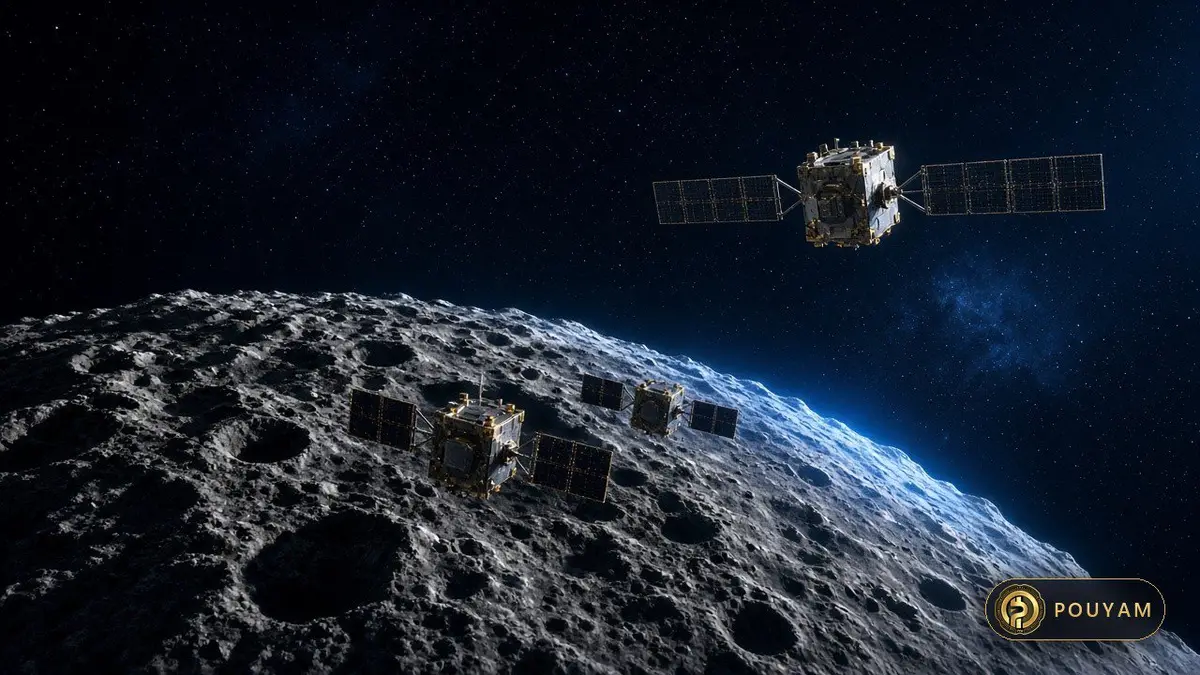
They are two suitcase-sized CubeSats riding with Hera that will study Dimorphos up close [4]. ESA says Hera carries "a pair of shoebox-sized 'CubeSats' for a still closer survey, eventually progressing to landing" [1].
The two are named Milani and Juventas [4]. During the cruise, the Hera team regularly woke them to check their health and test the inter-satellite link that will relay their data to Earth through the main spacecraft [4]. Operating them is hard: the gravity is so weak that even the push of sunlight, solar radiation pressure, can significantly change their paths [4].
The operation is a first. ESA says Hera's mission "will be the first to attempt to keep three independently operated spacecraft safely coordinated in this kind of environment" [4]. The CubeSats are flown by partners, with Milani operated by Tyvak in Italy and Juventas by GomSpace in Luxembourg, supported by France's space agency CNES and a dedicated control centre in Belgium [4].
Why does the Hera mission matter?
It aims to make asteroid deflection a reliable way to protect Earth, not just a one-time success [1][4]. DART proved a kinetic impact can move an asteroid, but key questions remain [1].
ESA lists the open questions: what did the impact do to Dimorphos itself; did it leave a crater or reshape the whole body; what is its precise makeup, structure and mass; and which properties explain a deflection much larger than simulations predicted [1]. Hera is meant to help humankind learn how to reliably change the trajectory of an asteroid [4].
Hera also tests new technology, including an autonomous 'self-driving' navigation system it needs because it is too far from Earth for real-time commands [4]. Both Didymos and Dimorphos are safe: NASA stresses neither poses any hazard to Earth before or after the DART impact [5].
For another recent space-science result, see Euclid Telescope Data Release: What ESA's New Map Shows, which covers ESA's new map of the distant universe.
What happens next for Hera?
Closer approaches, the full 'crash site investigation' and the CubeSat deployments, according to ESA's plans [1][2]. The near-term milestones:
- 25 November 2026: ESA plans to unveil detailed images of both asteroids [1].
- Next month: Hera moves to its detailed characterisation phase, flying bowtie arcs from around 20 km [2].
- Coming months: a close-up 'crash site investigation' of Dimorphos with several instruments, with the CubeSats deployed for a closer survey and eventually landing [1][2]. ESA's open questions include whether the impact left a crater and what Dimorphos's mass is; no answers have been released [1].
Some caution applies to the early phase. ESA's current images are big-picture previews; the science results come later [1][2]. And scientists note that some DART debris could still be near the asteroids, Euronews reported [3].
Hera's work feeds a longer story in planetary defence. ESA notes that Apophis, once considered the most hazardous known asteroid, will safely pass Earth on 13 April 2029 [4]. This guide reflects ESA and NASA information available on 13 November 2026.
| Item | Detail | Source |
|---|---|---|
| Launch | 7 October 2024 | ESA [4] |
| Arrival at Didymos | Arrival announced 11 November 2026 (targeted for November, a month early) | ESA [2][4] |
| Current distance | 30-25 km (early characterisation, ESA announcement of 11 November 2026) | ESA [2] |
| Didymos diameter | About 780 m | ESA [2] |
| Dimorphos diameter | About 151 m | ESA [2] |
| DART impact | 26 September 2022, at 6.1 km/s | ESA [1] |
| Orbit change from DART | 32 minutes shorter (±2 min) | NASA [5] |
| Detailed images due | 25 November 2026 | ESA [1] |
Common mistakes
Thinking Hera is deflecting or hitting the asteroid.
Fix: Hera studies the aftermath of DART's 2022 impact; it does not strike anything [1][2].
Assuming the asteroids are a threat to Earth.
Fix: NASA says neither Dimorphos nor Didymos poses any hazard to Earth [5].
Saying Hera is orbiting in a circle.
Fix: The gravity is far too weak; Hera flies 'rectangular orbits' at about 12 cm/s [2].
Treating the early images as the mission's science results.
Fix: These are previews; detailed images are due on 25 November and science comes later [1][2].
Calling Hera a NASA mission.
Fix: Hera is a European Space Agency mission; DART was NASA's [1][4].
Frequently asked questions
What is the Hera mission?
ESA's first planetary defence mission, studying the Didymos-Dimorphos asteroid pair after NASA's DART impact [2][4].
When did Hera arrive at Didymos?
ESA announced on 11 November 2026 that Hera had arrived; in 2025 it had targeted November 2026, a month earlier than first planned, and no exact arrival date is given [2][4].
What did DART do to the asteroid?
NASA confirmed in 2022 that it shortened Dimorphos's orbit around Didymos by 32 minutes (ESA now says around 33) [1][5].
What has Hera seen so far?
Early images of Didymos showing boulders and a sharp equatorial ridge, with Dimorphos partly hidden [1].
What are Milani and Juventas?
Two CubeSats carried by Hera that will survey Dimorphos and attempt a landing [3][4].
When are detailed Hera images coming?
ESA plans to unveil detailed images of both asteroids on 25 November 2026 [1].
Glossary
- Planetary defence
- Efforts to detect and deflect asteroids or comets that could hit Earth.
- Kinetic impact
- Deflecting an asteroid by crashing a spacecraft into it.
- Binary asteroid
- A pair of asteroids orbiting each other, like Didymos and Dimorphos.
- CubeSat
- A small, standardised satellite, here about the size of a suitcase or shoebox.
- Ejecta
- Rock and debris thrown off an asteroid by an impact.
- DART
- NASA's Double Asteroid Redirection Test, which hit Dimorphos in 2022.
Sources
- Hera spies a half-hidden asteroid moonlet European Space Agency · 2026-11-12
- Hera spacecraft in 'rectangular orbit' around target asteroids European Space Agency · 2026-11-11
- Europe's Hera spacecraft begins close inspections of asteroid in planetary defence mission Euronews · 2026-11-12
- ESA's Hera targets early arrival at Didymos asteroids European Space Agency · 2025-10-07
- NASA Confirms DART Mission Impact Changed Asteroid's Motion in Space NASA · 2022-10-11




Comments
Top comments