
Earliest Compact Quasar Pair: Webb at 900 Million Years
- 0 views
- 0 likes
- 0 comments
- All languages combined
In short
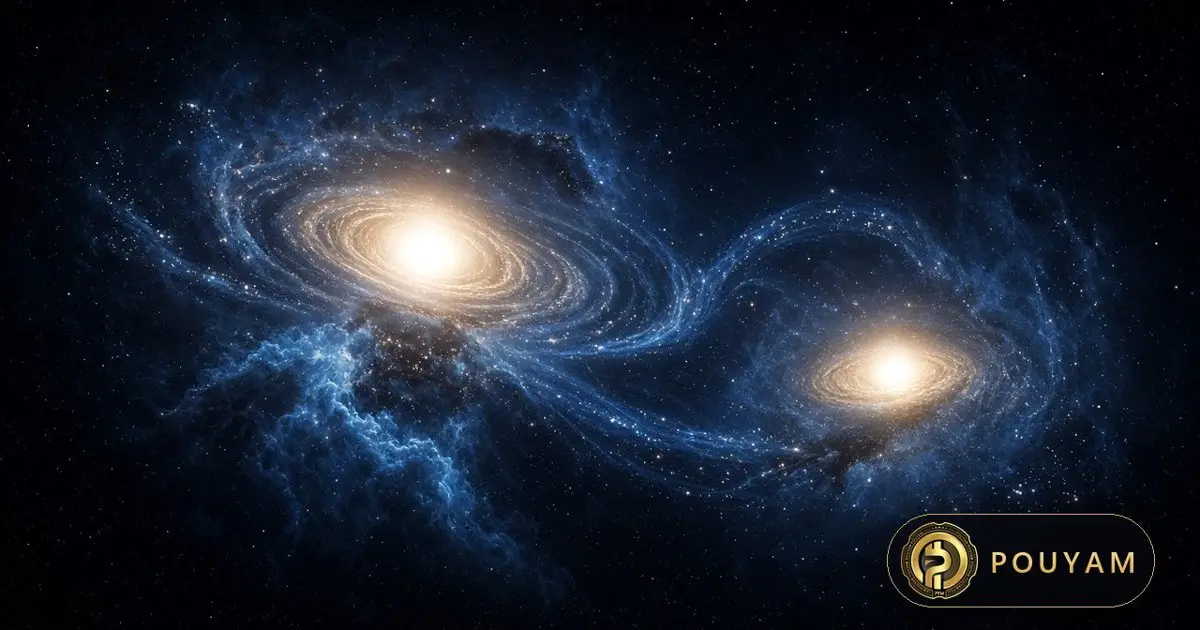
The earliest compact quasar pair yet found, J1602+4228AB, nicknamed Nāpōwawāʻenakaulua, was announced on 10 November 2026: two feeding supermassive black holes of 1.5 billion and 400 million Suns, about 18,100 light-years apart, seen 900 million years after the Big Bang by the James Webb Space Telescope and Gemini North [1][2].
Key takeaways
- The pair was announced by NSF NOIRLab on 10 November 2026 and published in The Astrophysical Journal Letters the same day [1][2].
- It is the most distant, and so oldest, compact quasar pair known, and only the third quasar pair found at cosmic dawn [2].
- The black holes weigh about 1.5 billion and 400 million solar masses and are roughly 18,100 light-years apart [1][2].
- It was spotted in Webb's Aether survey of 200 early quasars and resolved from the ground by Gemini North in Hawaii [2].
- Lead author Silvia Onorato says there is no definitive theoretical explanation for how such massive black holes existed so early [2].
- The team favours a real pair, but says a lens model is still needed to rule out a gravitational-lensing illusion [2][5].
On this page 11 sections
- What is the earliest quasar pair ever found?
- How big are the two black holes?
- Why can't scientists explain this quasar pair?
- How did Webb and Gemini find the quasar pair?
- Could it be one quasar seen twice?
- What does the name Nāpōwawāʻenakaulua mean?
- What comes next for the quasar pair?
- Common mistakes
- Frequently asked questions
- Glossary
- Sources
What is the earliest quasar pair ever found?
It is J1602+4228AB, nicknamed Nāpōwawāʻenakaulua, a pair of actively feeding supermassive black holes seen just 900 million years after the Big Bang, announced on 10 November 2026 [1][2]. NSF NOIRLab calls it the most distant, and thus oldest, compact pair of quasars ever found, and the most compact pair found in the early-Universe era known as cosmic dawn [2].
A quasar is a supermassive black hole feeding so fast that the gas around it outshines all the stars in its host galaxy [2]. Pairs are expected because galaxy collisions and mergers feed black holes with gas and stars, but close pairs are hard to separate: NOIRLab says the fainter companion is so close and dim that observing it from the ground "should have been nearly impossible" [2].
The study, led by Silvia Onorato, a postdoctoral researcher at NSF NOIRLab, appears in The Astrophysical Journal Letters [1][2]. An earlier version was posted on arXiv on 25 September 2026 as a preprint under review [3]. NOIRLab says it is only the third quasar pair known at cosmic dawn [2].
Why does that era matter? NOIRLab describes the first billion years as a period of furious assembly, when dark matter halos collapsed, galaxies lit their first stars and the first supermassive black holes formed at their centres [2]. Space.com notes that a quasar shines because gas in a flattened accretion disk around the black hole is heated by friction until it glows, often brighter than every star in the surrounding galaxy combined [4]. Seeing two such engines together, this early, gives astronomers a rare view of how galaxy collisions fed black hole growth [2].
How big are the two black holes?
About 1.5 billion and 400 million times the mass of the Sun [1][2]. The paper gives black hole masses of roughly 1.5 × 10^9 and 4.0 × 10^8 solar masses, with both feeding at about or slightly above the theoretical Eddington limit, the point where radiation pressure balances gravity (Eddington ratios of about 1.23 and 1.07) [3].
For scale, Universe Magazine notes that Sagittarius A*, the black hole at the centre of our Milky Way, has about 4 million solar masses, so the larger member of the pair is more than 300 times as massive [5].
The two quasars are about 18,100 light-years apart, roughly one-fifth of the Milky Way's diameter [2]. On the sky, that is a separation of only 0.98 arcseconds, and their redshifts, about 6.078, are almost identical, with a velocity difference of around 15 kilometres per second [3].
Onorato says the pair is seen when the Universe was "only a thirteenth of its age", and finds it astonishing that its black holes are about as massive as those seen today [2].
Why can't scientists explain this quasar pair?
Because black holes this massive should need more time to grow than the Universe had at that point [2][4]. Onorato says there is "no definitive theoretical explanation" for how even a single one of these giant quasars exists so early, let alone two [2].
Space.com explains that, under current models, black holes should need at least a billion years of feeding and merging to reach millions or billions of solar masses [4]. Universe Magazine adds the physics: matter cannot fall in at any rate, because heated gas emits radiation that pushes other material away; starting from a stellar-remnant seed, reaching a billion Suns would require near-maximum feeding for almost the whole time since the Big Bang [5].
The research paper also finds that a pair this close is far more common than expected from measurements of how early quasars cluster, by a factor of about 100 to 1,000 [3]. The authors suggest this hints at a hidden population of merger-triggered quasar pairs, or at an unusually dense environment [3].
Astronomers have previously found individual fast-growing black holes in the early Universe; finding two side by side makes the puzzle harder [4][5]. For another black hole result this month, see M87 Black Hole Image Confirmed: What the New Study Shows.
How did Webb and Gemini find the quasar pair?
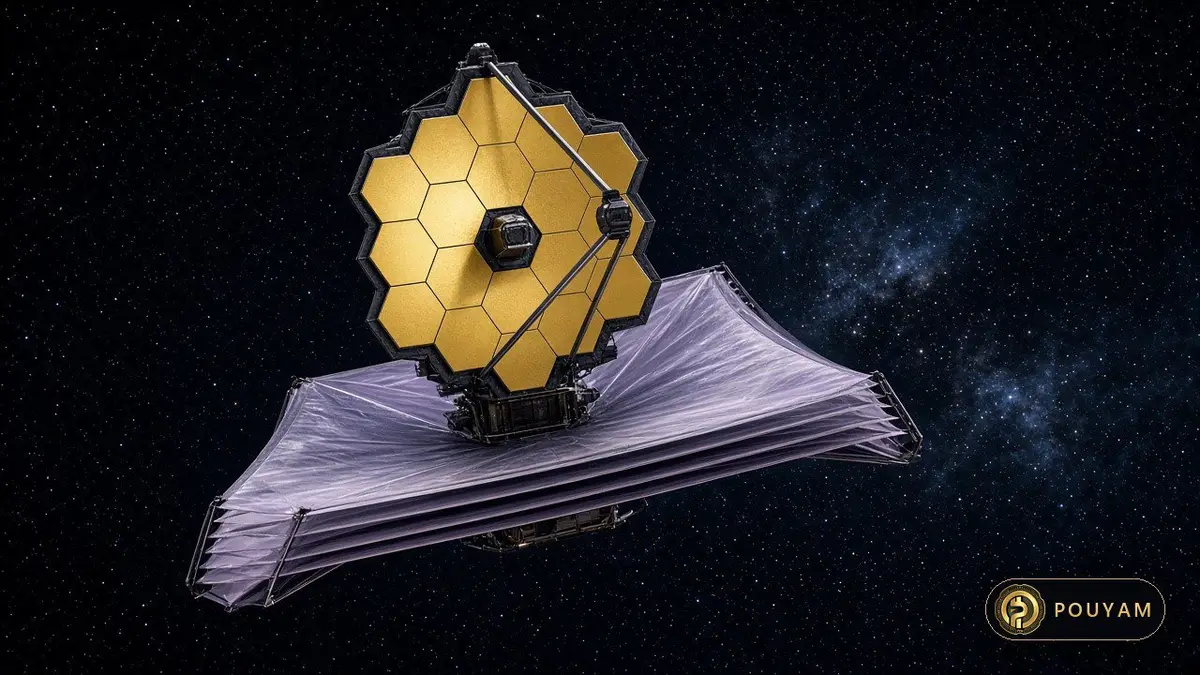
Webb spotted the second quasar in survey data, and Gemini North separated the two from the ground [2]. The steps, as NOIRLab describes them [2]:
- Survey: the Aether survey, a JWST programme led by Emanuele Paolo Farina of NSF NOIRLab/Gemini, used Webb's Near-Infrared Spectrograph Integral Field Unit to observe 200 quasars, 43% of all known quasars from this period.
- Spot: during visual inspection of the data, the team noticed that quasar J1602+4228A had a companion.
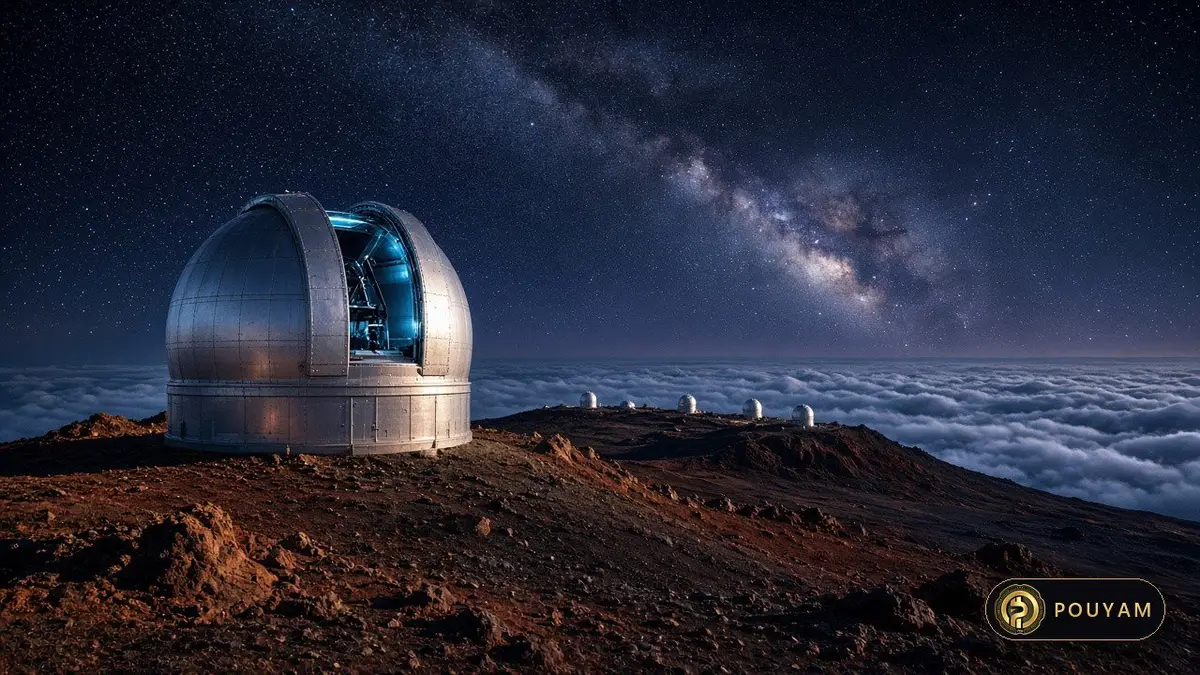
- Resolve: the Gemini Near-Infrared Spectrograph (GNIRS) on Gemini North, on Maunakea in Hawaii, resolved the two quasars individually. The fainter one, J1602+4228B, is so close and dim that observing it from the ground should have been nearly impossible.
- Check: the Gemini Multi-Object Spectrograph (GMOS) was used to test whether a gravitational lens could be creating a second image of one quasar.
Onorato says the sky over Maunakea was "so clean and sharp" that the team collected the data in only two nights [2]. Gemini North is part of the International Gemini Observatory, led by the US National Science Foundation with Canada, Chile, Brazil, Argentina and the Republic of Korea [2].
Could it be one quasar seen twice?
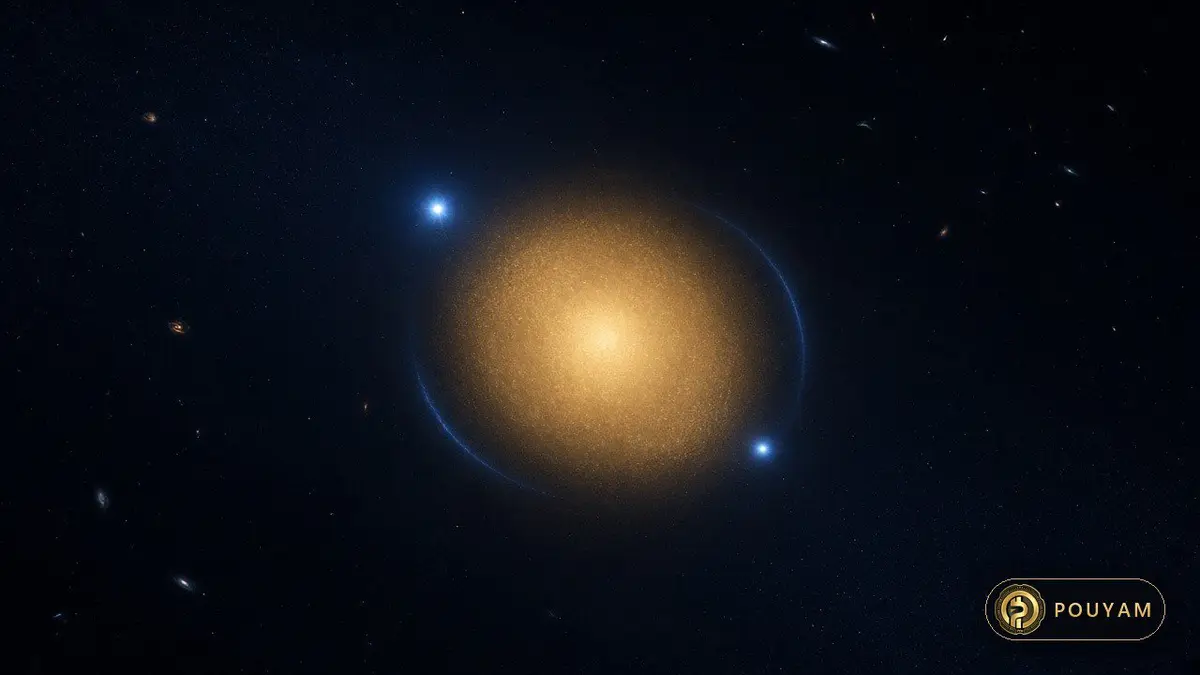
Possibly, though the team thinks not; a lens model is still needed to rule it out completely [2][5]. A massive galaxy between us and a quasar can bend its light into more than one image. Such copies would have the same spectral shape [5].
- Evidence for a real pair: GMOS spectra show differences in the shapes of the two quasars' spectra, which led the team to favour a real physical pair [2].
- Remaining doubt: NOIRLab states that a lens model is needed to definitively rule out gravitational lensing [2]. The paper's abstract describes the object as "the most compact known quasar pair candidate" in the epoch of reionisation [3].
That caution matters when reading headlines that say astronomers are "stunned" [4]. The result is published and peer-reviewed, but its interpretation as two separate black holes is the team's favoured reading, not yet a certainty [1][2].
What does the name Nāpōwawāʻenakaulua mean?
It translates as "Two celestial bodies of fathomless powerful darkness in the brilliance of heat reincarnating energy into the Universe" [2]. The name was created by the A Hua He Inoa programme at the ʻImiloa Astronomy Center of Hawaiʻi and the University of Hawaiʻi's Ka Haka ʻUla O Keʻelikōlani Hawaiian Language College [2].
NOIRLab says it was created by Larry Kimura and combines [2]:
- Nā: a plural marker;
- Pō: fathomless powerful darkness, for the black holes;
- Wawā: reincarnation or procreation;
- ʻEna: brilliance of heat, for the radiation from infalling matter;
- Kaulua: double or pair.
It echoes two earlier names from the same programme: Pōwehi, for the first black hole image in 2019, and Pōniuāʻena, the most distant quasar known when it was found in 2020 [2].
What comes next for the quasar pair?
Building a lens model, and searching for the galaxies that may surround the pair [2][5]. The team proposes that Nāpōwawāʻenakaulua may mark an extreme peak in the density of matter in the early Universe, where galaxy interactions fed both star formation and rapid black hole growth [2].
If that is right, other galaxies should cluster around the pair, so a search for that surrounding population is the next test, Universe Magazine notes [5]. Onorato calls the system "a laboratory" for studying how the first massive galaxies and their central black holes assembled [2].
The pair was found in the Aether sample of 200 early quasars [2], and the paper reads its rarity relative to clustering as a hint of merger-triggered pairs or a dense environment [3]. For more on how large sky surveys find rare objects, see Euclid Telescope Data Release: What ESA's New Map Shows.
| Property | Value | Source |
|---|---|---|
| Announced | 10 November 2026 | NOIRLab [2]; ApJL [1] |
| Seen at | About 900 million years after the Big Bang | NOIRLab [2] |
| Redshift | About 6.078 | Paper [3] |
| Black hole A mass | About 1.5 billion Suns | NOIRLab [2]; paper [3] |
| Black hole B mass | About 400 million Suns | NOIRLab [2]; paper [3] |
| Separation | About 18,100 light-years (0.98 arcseconds) | NOIRLab [2]; paper [3] |
| Velocity offset | About 15 km/s | Paper [3] |
| Discovery data | JWST NIRSpec IFU, Aether survey | NOIRLab [2] |
| Confirmation | Gemini North GNIRS and GMOS | NOIRLab [2] |
| Status | Favoured real pair; lensing not yet fully ruled out | NOIRLab [2] |
Common mistakes
Calling it the earliest quasar ever found.
Fix: It is the earliest compact quasar pair; single quasars are known from earlier times [2][4].
Saying lensing has been ruled out.
Fix: The team favours a real pair, but a lens model is still needed [2].
Saying the discovery breaks physics.
Fix: It challenges models of early black hole growth; it does not overturn established physics [2][4].
Crediting Webb alone.
Fix: Webb spotted the companion; Gemini North resolved and characterised the pair [2].
Citing the arXiv version as final.
Fix: The arXiv preprint was under review; the peer-reviewed paper is in ApJL [1][3].
Frequently asked questions
What is the earliest quasar pair ever found?
J1602+4228AB, nicknamed Nāpōwawāʻenakaulua, seen 900 million years after the Big Bang [1][2].
Why can't scientists explain this quasar pair?
Models suggest black holes need more time to grow that massive [2][4].
How did Webb and Gemini find the quasar pair?
Webb's Aether survey spotted a companion; Gemini North's GNIRS resolved the two [2].
Could it be one quasar seen twice?
The spectra differ, so the team favours a real pair, but a lens model is still needed [2].
How far apart are the two quasars?
About 18,100 light-years, roughly a fifth of the Milky Way's diameter [2].
Glossary
- Quasar
- A feeding supermassive black hole that outshines its entire host galaxy.
- Cosmic dawn
- The era when the first stars, galaxies and black holes formed, within the first billion years.
- Redshift
- The stretching of light by cosmic expansion; higher redshift means farther away and earlier.
- Eddington limit
- The feeding rate at which radiation pressure from infalling gas balances gravity.
- Gravitational lens
- A massive object that bends light from a source behind it, sometimes creating multiple images.
Sources
- Nāpōwawā‘enakaulua: A Close Quasar Pair at Cosmic Dawn in the Aether Survey The Astrophysical Journal Letters · 2026-11-10
- Astronomers Discover Nāpōwawāʻenakaulua, the Oldest Compact Quasar Pair in the Universe NSF NOIRLab · 2026-11-10
- Nāpōwawā‘enakaulua: a close quasar pair at cosmic dawn in the Aether survey (preprint) arXiv · 2026-09-25
- Astronomers stunned after James Webb Space Telescope discovers the earliest pair of black hole-powered quasars Space.com · 2026-11-12
- Two black holes turn out to be unexpectedly massive for the early Universe Universe Magazine · 2026-11-11



Comments
Top comments