
Coldest Temperature Ever: 10 Picokelvin in Space Explained
- 1 views
- 0 likes
- 0 comments
- All languages combined
In short
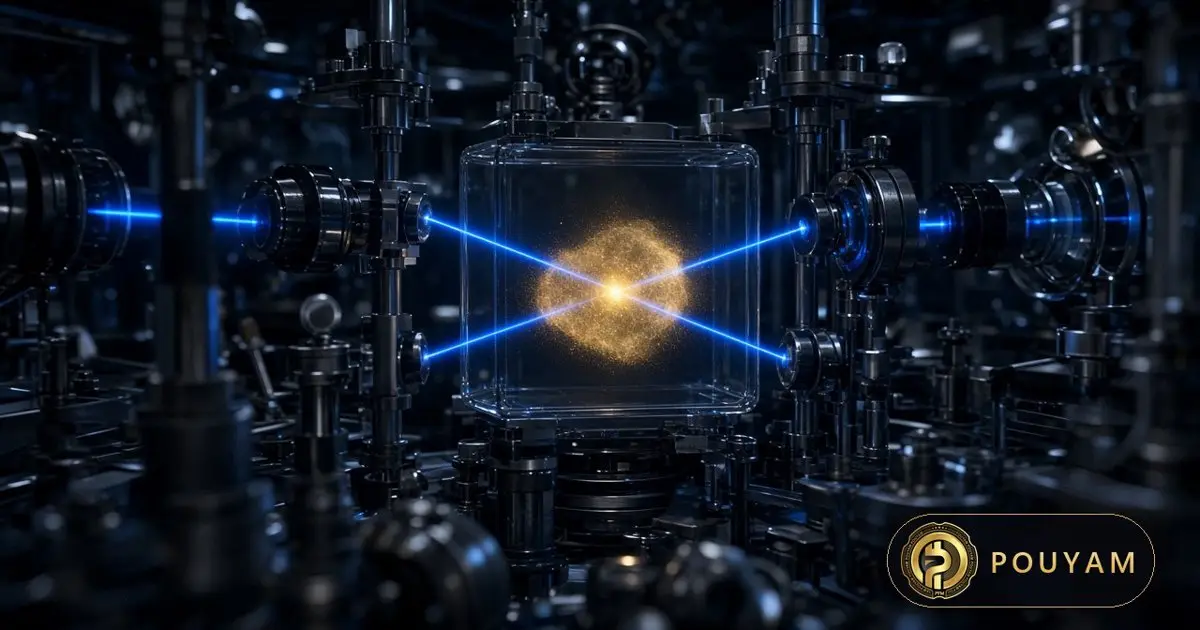
As of 13 November 2026, the coldest temperature ever reported is an equivalent temperature of 9.7 picokelvin, less than ten-trillionths of a degree above absolute zero, reached by 20,000 rubidium atoms aboard China's Tiangong space station and published in Science on 5 November 2026 [1][2]. It beats the previous record of 38 picokelvin by a factor of about four [1][2].
Key takeaways
- The record is an equivalent temperature of 9.7 picokelvin (pK), published in Science on 5 November 2026 [1].
- It was reached in a Bose-Einstein condensate of 20,000 rubidium atoms aboard the China Space Station, also called Tiangong [1][2].
- The previous record, 38 pK, came from an atom-chip experiment in microgravity; a Bose-Einstein condensate on NASA's Cold Atom Laboratory on the ISS reached effective temperatures as low as 52 pK, reported in 2022 [1][2][6].
- The temperature describes how slowly the atoms expand, not the temperature of the equipment around them [3].
- The cloud could be watched expanding for 7 seconds, which independent physicists call even more important than the temperature itself [1][2].
- Absolute zero itself is considered unreachable under the third law of thermodynamics [4].
On this page 11 sections
- What is the coldest temperature ever recorded?
- How cold is 10 picokelvin compared with space?
- How did scientists reach 10 picokelvin?
- Is 9.7 picokelvin a real temperature?
- Why was the record set in space instead of on Earth?
- What is a Bose-Einstein condensate?
- What could ultracold atoms in space be used for?
- Common mistakes
- Frequently asked questions
- Glossary
- Sources
What is the coldest temperature ever recorded?
The coldest temperature ever reported is an equivalent temperature of 9.7 picokelvin, set aboard China's space station and published in the journal Science on 5 November 2026 [1][2]. A picokelvin is one trillionth of a kelvin, so the atoms were less than ten-trillionths of a degree above absolute zero [2].
The research paper, titled "Quantum gases below 10 picokelvin in space", reports a Bose-Einstein condensate (BEC) of 2.0 × 10^4, or 20,000, atoms that reached that equivalent temperature with a free expansion time of 7.0 seconds [1]. The team used rubidium atoms [2][3].
Science's news report says the result lowered the coldest temperature ever achieved by a factor of four [2]. Ernst Rasel, a quantum physicist at Leibniz University Hannover whose team recorded the previous record in 2021, told Science: "I congratulate the scientists. I'm very impressed" [2].
Many headlines round the figure to 10 picokelvin. Both numbers appear in coverage: the paper reports below 10 pK, and Science's reporter describes the final atomic speeds as equivalent to about 10 pK [1][2].
How cold is 10 picokelvin compared with space?
Far colder than anything in nature that astronomers know of. Empty space is filled with the cosmic microwave background, which NASA measures at about 2.725 kelvin [5]. Dividing 2.725 K by 9.7 pK shows that the background glow of the Universe is roughly 280 billion times warmer than the atoms on Tiangong.
Absolute zero, 0 kelvin, is minus 273.15 °C or minus 459.67 °F [4]. On those scales the new record is indistinguishable from absolute zero, which is why physicists use kelvin and its tiny subdivisions:
- Nanokelvin (nK): one billionth of a kelvin. Early BEC experiments reached about 100 nK [2].
- Picokelvin (pK): one trillionth of a kelvin. Space experiments are now in this range [1][2].
Reaching exactly zero is thought to be impossible. One version of the third law of thermodynamics says reaching absolute zero would take an infinite number of steps, Saibal Mitra, a physicist interviewed by Live Science, explained [4].

How did scientists reach 10 picokelvin?
By trapping rubidium atoms with lasers in microgravity, letting the hottest ones escape, then letting the rest spread out gently [2][3]. According to Science's account, the steps were [2]:
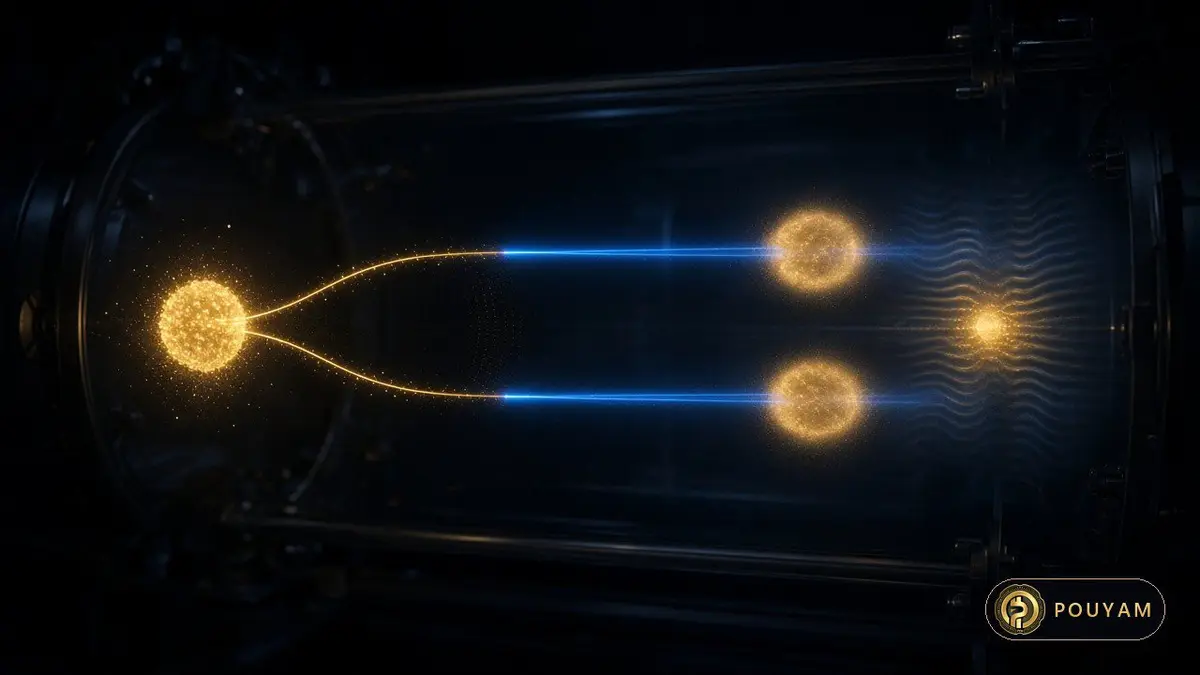
- Trap: about 2 million rubidium atoms were held in an inner optical trap 54 micrometres wide, formed where two intense laser beams cross. The lasers ran at 5 watts.
- Evaporate: the power was eased down to 0.2 milliwatts, letting the more energetic atoms escape. The remaining 20,000 atoms cooled to 3 nK.
- Expand: the atoms were allowed to spread into a wider trap 124 micrometres across, which reduced how strongly they interacted. In the end they moved at less than 100 micrometres per second.
"We keep the same number of atoms. Only the interaction energy changes," said Xuzong Chen of Peking University, the instrument's chief scientist [2]. The Shanghai Institute of Optics and Fine Mechanics adds that evaporative cooling in an optical trap works less well in microgravity, so the team used an extra magnetic gradient to help produce the condensate [3].
The instrument is the Cold Atom Physics Rack in the station's Mengtian laboratory module, launched in 2022 [2][3]. The institute says its developers shrank a ground system of about 20 cubic metres and 10 tonnes into a flight instrument of about 0.7 cubic metres and half a tonne [3].
Is 9.7 picokelvin a real temperature?
It is an equivalent temperature that describes how slowly the atoms move, not a reading on a thermometer [3]. The Shanghai institute states that the 9.7 pK figure "characterizes the atoms' extremely slow expansion" and does not mean the equipment or its surroundings reached the same temperature [3].
The research paper itself uses the phrase "equivalent temperature" [1]. Scientists estimate it from how fast the released cloud of atoms spreads; slower spreading means lower energy [2][3]. Science gives the final speeds as less than 100 micrometres per second [2]. Phys.org's report on the paper gives an uncertainty range of 7.0 to 12.9 pK around the 9.7 pK value [7].
That distinction matters when comparing records. The earlier record of 38 pK, and NASA's 52 pK, are likewise effective temperatures inferred from how fast the cloud expands, so the comparison is between like quantities, although the experiments differ in method [2][6][7]. Comparisons with the temperature of a fridge, a planet or deep space are useful for scale, but not precise physics.
Why was the record set in space instead of on Earth?
Gravity pulls ultracold atoms downward, which forces scientists to hold them in stronger traps that keep them warmer [2][3]. Science explains that gravity squeezes the atoms against the fields suspending them, driving their temperature up [2]. In orbit, the trap can be made much weaker and the atoms observed for longer [3].
MIT physicist Wolfgang Ketterle, a 2001 Nobel laureate, put the seven-second observation in perspective: "On Earth, it would fall down by about 250 meters, so it would actually crash to the ground unless you have a vacuum chamber, which is 250 meters high" [3].
Earlier attempts to escape gravity included dropping atom chips down towers and flying them on suborbital rockets [2]. NASA launched its Cold Atom Laboratory to the International Space Station in 2018 [2], and a Bose-Einstein condensate made on the station reached effective temperatures as low as 52 pK, reported in Nature Communications in 2022 [6]. The previous record, 38 pK with 2 seconds of free expansion, came from an atom-chip magnetic trap in microgravity [1]; Science News describes it as a drop-tower experiment published in 2021 [6].
The Chinese instrument differs because it uses optical traps, made of laser light, rather than magnetic ones [1][2]. The paper notes that optical traps had not been used to prepare such quantum gases in microgravity before [1].
What is a Bose-Einstein condensate?
A Bose-Einstein condensate is a state of matter in which very cold atoms crowd into a single quantum wave and behave collectively [2][3]. Science compares it to the photons in a laser beam, and notes that atoms in a BEC can flow without resistance and create interference patterns [2].
Satyendra Nath Bose and Albert Einstein predicted condensates in 1924; two teams first made them in 1995, one with rubidium-87 and one with sodium-23, work recognised with the 2001 Nobel Prize in Physics [2]. Live Science describes the condensate as behaving akin to a single atom [4].
Because the effects are visible on scales far larger than single atoms, BECs let researchers study quantum behaviour directly [3]. For a beginner-friendly introduction to related ideas, see Quantum Computing Explained for Beginners: What It Is and What It Is Not. For another space-science story from this week, see Euclid Telescope Data Release: What ESA's New Map Shows.
What could ultracold atoms in space be used for?
Mainly precision measurement and quantum simulation; the researchers and independent experts describe these as directions for future work [2][3].
- Testing gravity: long expansion times are ideal for interference experiments that could test whether gravity pulls on all types of atoms equally, as general relativity assumes, Science reports [2]. "The 7 seconds is an even more important figure of merit than the 10 picokelvin," said Holger Mueller of UC Berkeley [2].
- Atom interferometers: Rasel told the Shanghai institute that their sensitivity increases with the square of the time atoms spend in the instrument, and that such tools could help measure Earth's gravity field and test dark matter models [3].
- Quantum simulation: the team plans optical lattices, grids of laser spots that mimic a crystal, to simulate effects related to high-temperature superconductivity [2][3].
- Mixed atoms: Hélène Perrin of Sorbonne Paris Nord University noted that optical traps can hold atoms in different internal states at once [2].
Weibiao Chen of the Shanghai institute told Science the rack is "open for the international community" [2]. None of these applications has been demonstrated with this instrument yet.
| Experiment | Temperature | Free expansion | Source |
|---|---|---|---|
| Early BEC experiments on the ground (1990s onward) | About 100 nK | Not stated | Science news [2] |
| NASA Cold Atom Laboratory, ISS (reported 2022) | 52 pK | 1 s | Science News [6]; Phys.org [7] |
| Atom-chip magnetic trap in microgravity (drop tower, 2021, previous record) | 38 pK | 2 s | Science paper [1]; Science News [6] |
| China Space Station optical trap (Science, 5 Nov 2026) | 9.7 pK | 7.0 s | Science paper [1] |
| Cosmic microwave background, for scale | About 2.725 K | - | NASA [5] |
Common mistakes
Saying the space station or its equipment reached 10 picokelvin.
Fix: Only the atom cloud's motion corresponds to that equivalent temperature [3].
Claiming scientists reached absolute zero.
Fix: The record is 9.7 pK above it; absolute zero is considered unreachable [1][4].
Calling it the coldest place in the Universe as a proven fact.
Fix: Say it is the coldest temperature ever reported in a laboratory; it is far below the 2.725 K cosmic background [2][5].
Mixing up the records.
Fix: 38 pK was the previous record; NASA's ISS lab reached effective temperatures as low as 52 pK, reported in 2022 [1][2][6].
Assuming the applications already work.
Fix: Gravity tests and quantum simulation are planned directions, not results in this paper [2][3].
Frequently asked questions
What is the coldest temperature ever recorded?
9.7 picokelvin, reached by 20,000 rubidium atoms on China's space station and published in Science on 5 November 2026 [1][2].
How cold is 10 picokelvin compared with space?
The cosmic microwave background is about 2.725 K, roughly 280 billion times warmer [5].
How did scientists reach 10 picokelvin?
Laser traps, evaporative cooling to 3 nK, then gentle expansion into a wider trap in microgravity [2][3].
Is 9.7 picokelvin a real temperature?
It is an equivalent temperature based on how slowly the atoms expand, not the temperature of the equipment [3].
Glossary
- Picokelvin
- One trillionth of a kelvin.
- Absolute zero
- 0 kelvin, or minus 273.15 °C; the lowest possible temperature.
- Bose-Einstein condensate
- A state of matter in which ultracold atoms share one quantum wave.
- Optical dipole trap
- A trap that holds atoms where intense laser beams cross.
- Evaporative cooling
- Cooling by letting the most energetic atoms escape a trap.
Sources
- Quantum gases below 10 picokelvin in space Science · 2026-11-05
- China space experiment creates coldest temperature ever Science (AAAS) · 2026-11-05
- China's space station sets new atomic cooling record Shanghai Institute of Optics and Fine Mechanics, CAS · 2026-11-10
- Chinese scientists cool atoms to coldest temperatures ever observed in record-breaking space station experiment Live Science · 2026-11-12
- Tests of Big Bang: The CMB NASA WMAP · 2026-04-16
- Record-low temperature created on China's space station Science News · 2026-11-05
- Scientists achieve record-breaking low temperature on China's space station, paving the way for new physics experiments Phys.org · 2026-11-06




Comments
Top comments