
Foundayo for Sleep Apnea: What the ATTAIN-OSA Trials Show
- 11 views
- 0 likes
- 0 comments
- All languages combined
 +30
Sign in and earn +30 points by reading this
Read to the end, wait a few seconds, then tap the claim button below.
In short
As of 13 November 2026, two phase 3 JAMA trials found that Lilly's daily GLP-1 pill Foundayo (orforglipron) cut breathing interruptions during sleep more than placebo in adults with moderate to severe obstructive sleep apnea and excess weight [1]. It is not approved for sleep apnea; Lilly plans to apply to the FDA by the end of 2026 [2].
Key takeaways
- ATTAIN-OSA ran two 52-week placebo-controlled trials: 363 people not using positive airway pressure (PAP) and 349 people using it [1].
- In the JAMA treatment-regimen analysis, the apnea-hypopnea index fell by 17.8 events per hour on orforglipron versus 4.5 on placebo in trial 1, and 17.3 versus 5.3 in trial 2 [1].
- Lilly's headline figures (a 43.8% fall, 21.1 events per hour) use a different analysis, the efficacy estimand, which assumes everyone stayed on treatment [2].
- Gastrointestinal side effects affected about 68% to 71% on orforglipron versus about 37% on placebo [1].
- Foundayo's FDA approval (1 April 2026) is for weight management, not sleep apnea; tirzepatide (Zepbound) was the first drug the FDA approved for obstructive sleep apnea, in December 2024 [4][5].
On this page 11 sections
- What did the ATTAIN-OSA trials find?
- Why do Lilly's numbers differ from JAMA's?
- Who took part in the trials?
- What other changes did the trials measure?
- What side effects were reported?
- Is Foundayo approved for sleep apnea?
- What is obstructive sleep apnea?
- Common mistakes
- Frequently asked questions
- Glossary
- Sources
What did the ATTAIN-OSA trials find?
In both trials, orforglipron reduced the apnea-hypopnea index (AHI) significantly more than placebo at 52 weeks: by 13.2 more events per hour in trial 1 and by 12.0 more in trial 2 (both P < .001), using the treatment-regimen estimand reported in JAMA [1].
- Trial 1 (no PAP): AHI change −17.8 events per hour on orforglipron versus −4.5 on placebo; difference −13.2 (95% CI −17.7 to −8.7) [1].
- Trial 2 (using PAP): −17.3 versus −5.3; difference −12.0 (95% CI −17.1 to −6.9) [1].
- Secondary goals: of seven key multiplicity-controlled secondary end points, six were statistically significant in favour of orforglipron; the sleep-related impairment score (PROMIS) was not, in the pooled analysis (difference −1.5, P = .07) [1].
- Published: JAMA, 9 November 2026, alongside presentation at the American Heart Association's Scientific Sessions [1][2].
The JAMA authors concluded that the findings offer "evidence for the potential use" of oral orforglipron to improve sleep-disordered breathing in this group [1]. The table below compares the figures from the two analyses.
Why do Lilly's numbers differ from JAMA's?
The figures differ because they come from two statistical analyses of the same trials: JAMA's abstract leads with the treatment-regimen estimand, while Lilly's press release reports the efficacy estimand [1][2].
- Efficacy estimand: Lilly defines it as the effect had all randomised participants stayed on study treatment for 52 weeks without starting PAP, sleep apnea surgery or other weight treatments [2].
- Lilly's efficacy figures, trial 1: AHI fell by 21.1 events per hour (43.8%) from an average of 50.7, versus 4.3 events per hour (6.3%) on placebo [2].
- Lilly's efficacy figures, trial 2: 18.3 events per hour (27.5%) from 57.6, versus 5.5 (3.0%) on placebo [2].
- Treatment-regimen estimand: the analysis JAMA's abstract leads with; it gives smaller reductions of 17.8 and 17.3 events per hour [1].
Both analyses show a statistically significant benefit over placebo; the efficacy estimand produces the larger numbers, which are the ones Lilly's release leads with [1][2]. Summaries that strip out which analysis a number comes from are a common source of error, including in AI-generated answers, as explained in AI Hallucinations Explained: Why Chatbots Make Things Up and How to Get Accurate Answers.
Who took part in the trials?
The trials enrolled adults with moderate to severe obstructive sleep apnea (AHI of at least 15) and a body mass index of 27 or higher, at 66 sites in the US, Argentina, Brazil, China, the Czech Republic, Germany, Japan, Mexico and Taiwan [1][3].
- Trial 1: 363 people unable or unwilling to use PAP; mean age 48.4, mean BMI 37.4, mean AHI 50.7, 31.4% women [1].
- Trial 2: 349 people who had used PAP for at least three months and kept using it; mean age 51.1, BMI 38.6, AHI 57.6, 26.9% women [1][3].
- Excluded: people with type 1 or type 2 diabetes, previous upper-airway surgery for sleep apnea, mainly central sleep apnea, or prior or planned obesity surgery [3].
- Treatment: once-daily orforglipron at each participant's maximum tolerated dose, or placebo, randomised 1:1 [1].
- Timeline: enrolment ran from November 2024 to July 2025, with final follow-up on 30 July 2026 [1].
- Sponsor: Eli Lilly and Company [3].
Because people with diabetes were excluded, the results do not show how orforglipron affects sleep apnea in that group [3].
What other changes did the trials measure?
According to Lilly's efficacy-estimand figures, orforglipron also reduced oxygen loss during sleep, body weight, an inflammation marker and blood pressure [2].
- Hypoxic burden (how deeply and how long oxygen falls during breathing pauses): down 55.9% without PAP and 45.8% with PAP, versus 18.3% and 17.0% on placebo [2].
- Body weight: down 11.5% (12.7 kg) and 11.2% (12.8 kg), versus 1.8% and 0.9% on placebo [2].
- hsCRP (an inflammation marker): down 48.9% and 38.6% on average [2].
- Systolic blood pressure: down 8.6 and 7.3 mmHg on average; Lilly notes this measure was not controlled for multiple testing [2].
- Remission or mild disease: 31.5% without PAP and 19.6% with PAP, defined as AHI under 5, or 5 to under 15 without excessive daytime sleepiness [2].
JAMA lists hypoxic burden, a sleep-related impairment score and hsCRP among the seven key secondary end points; the sleep-related impairment score was the one that did not reach statistical significance in the pooled analysis (difference −1.5, P = .07) [1].
Lilly says a separate phase 3 programme, ATTAIN-Hypertension, is testing orforglipron's effect on high blood pressure [2].
What side effects were reported?
Gastrointestinal events were the most common adverse events: 68.0% on orforglipron versus 37.4% on placebo in trial 1, and 70.6% versus 36.6% in trial 2 [1].
- Types: nausea, diarrhoea, constipation, indigestion and vomiting, generally mild to moderate, according to Lilly [2].
- Stopping because of side effects: 12.2% versus 3.8% without PAP, and 6.8% versus 0.6% with PAP [2].
- Consistency: Lilly says safety was generally consistent with earlier ACHIEVE and ATTAIN trials [2].
The approved US label for Foundayo in weight management carries warnings including acute pancreatitis, severe gastrointestinal reactions, acute kidney injury from fluid loss, gallbladder disease and diabetic retinopathy complications in people with type 2 diabetes [4]. It also carries a boxed warning for thyroid C-cell tumours and should not be used in people with a personal or family history of medullary thyroid cancer or multiple endocrine neoplasia syndrome type 2 [4].
This is not medical advice. Decisions about your own treatment belong with a qualified clinician who knows your history.
Is Foundayo approved for sleep apnea?
No. The FDA approved Foundayo on 1 April 2026 for weight reduction and long-term weight maintenance in adults with obesity, or overweight plus at least one weight-related condition, alongside diet and physical activity [4].
- Sleep apnea filing: Lilly plans to submit Foundayo to the FDA for moderate to severe obstructive sleep apnea in adults with obesity or overweight by the end of 2026, with other submissions to follow [2].
- Existing drug option: in December 2024 the FDA approved Zepbound (tirzepatide), given once weekly, as the first drug treatment option for moderate to severe OSA in adults with obesity [5].
- Similar design: that approval rested on two placebo-controlled 52-week studies of 469 adults without type 2 diabetes, one with PAP users and one with people unable or unwilling to use PAP [5].
- How weight drugs help: the FDA said the improvement in AHI with Zepbound "is likely related to body weight reduction" [5].
- Fast approval: Foundayo was the first new molecular entity approved under the FDA's Commissioner's National Priority Voucher pilot, 50 days after filing [4].
The Zepbound and Foundayo trials used different designs and populations and have not been compared head to head, so their numbers cannot be ranked directly [1][5].
What is obstructive sleep apnea?
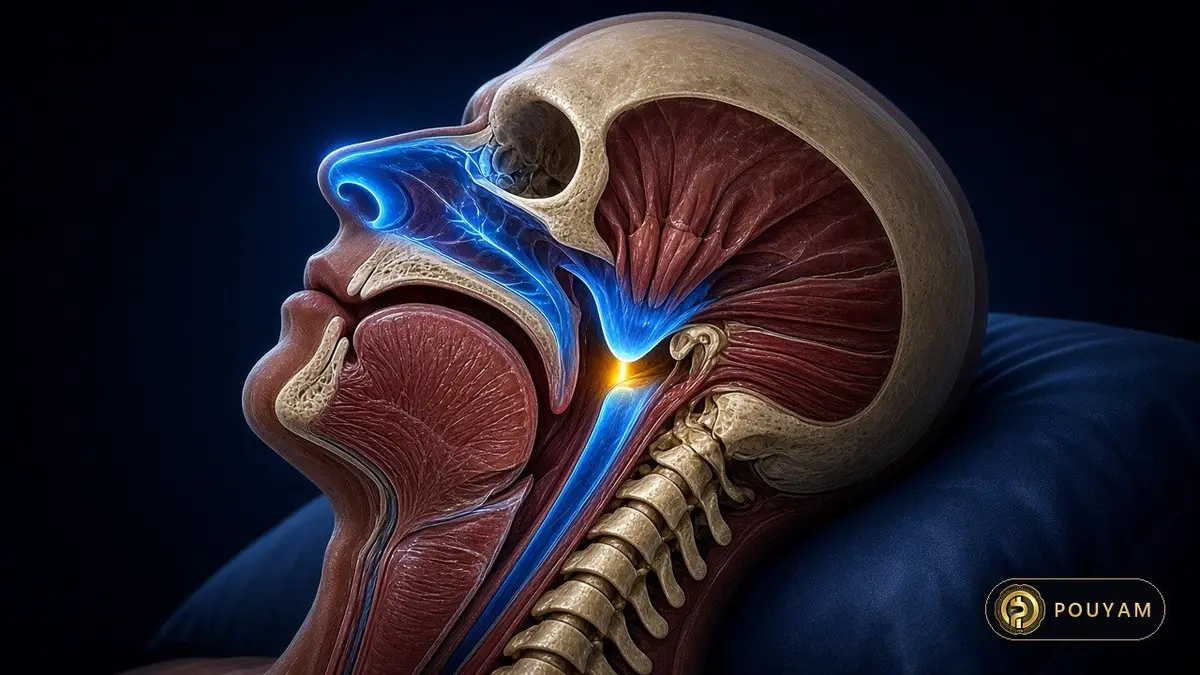
Obstructive sleep apnea happens when the upper airway becomes blocked many times during sleep, reducing or stopping airflow; it is the most common type of sleep apnea, according to the US National Heart, Lung, and Blood Institute [6].
- Risk factors: obesity, large tonsils and hormone changes can narrow the airway [6].
- Warning signs: snoring, gasping for air during sleep and excessive daytime sleepiness [6].
- Diagnosis: usually a sleep study [6].
- Standard treatments: breathing devices such as CPAP and lifestyle changes; surgery if these do not work [6].
- If untreated: higher risk of stroke, heart attack and other serious problems, plus trouble concentrating and remembering [6].
- How common: Lilly, citing a 2019 Lancet Respiratory Medicine analysis, puts the number of adults with OSA worldwide at an estimated 936 million, most undiagnosed [2]. NHLBI says 50 to 70 million Americans have a sleep disorder of some kind [6].
- Severity scale: an AHI of 15 to 29 events per hour is moderate and 30 or more is severe [2].
The FDA describes PAP as the standard of care for moderate to severe OSA [5]. What AI tools can and cannot do in health care, and how they are regulated, is covered in AI in Healthcare: What It Can Do Today, Where It Fails and How It Is Regulated.
| Measure | Trial 1 (no PAP) | Trial 2 (with PAP) | Source |
|---|---|---|---|
| Participants | 363 | 349 | [1] |
| Baseline AHI (events/hour) | 50.7 | 57.6 | [1] |
| Orforglipron vs placebo, treatment-regimen | −17.8 vs −4.5 | −17.3 vs −5.3 | [1] |
| Difference (95% CI) | −13.2 (−17.7 to −8.7) | −12.0 (−17.1 to −6.9) | [1] |
| Orforglipron vs placebo, efficacy estimand | −21.1 vs −4.3 | −18.3 vs −5.5 | [2] |
| Percent change, efficacy estimand | −43.8% vs −6.3% | −27.5% vs −3.0% | [2] |
| GI adverse events | 68.0% vs 37.4% | 70.6% vs 36.6% | [1] |
Common mistakes
Saying Foundayo is approved for sleep apnea
Fix: It is approved for weight management; an OSA filing is planned [2][4].
Quoting 43.8% without context
Fix: That is Lilly's efficacy-estimand figure for one trial; JAMA leads with smaller figures [1][2].
Assuming it replaces CPAP
Fix: Trial 2 tested it on top of PAP; PAP remains standard of care [1][5].
Applying results to people with diabetes
Fix: People with diabetes were excluded [3].
Ranking Foundayo against Zepbound
Frequently asked questions
What did the ATTAIN-OSA trials find?
Orforglipron cut AHI by 12 to 13 more events per hour than placebo at 52 weeks [1].
Why do Lilly's numbers differ from JAMA's?
Lilly uses the efficacy estimand; JAMA's abstract leads with the treatment-regimen estimand [1][2].
Who took part in the trials?
712 adults with moderate to severe OSA and BMI 27 or more, without diabetes [1][3].
What other changes did the trials measure?
Lower hypoxic burden, weight, hsCRP and blood pressure, per Lilly [2].
What side effects were reported?
Mostly gastrointestinal: about 68% to 71% versus about 37% on placebo [1].
Is Foundayo approved for sleep apnea?
No; it is approved for weight management, with an OSA filing planned by end-2026 [2][4].
What is obstructive sleep apnea?
Repeated blockage of the upper airway during sleep [6].
Glossary
- Apnea-hypopnea index (AHI)
- Number of breathing stops or shallow-breathing episodes per hour of sleep.
- PAP / CPAP
- Positive airway pressure: a machine that keeps the airway open with air pressure.
- Hypoxic burden
- How deeply and how long oxygen levels fall during breathing pauses.
- Estimand
- The precise question a trial analysis answers, such as effect if everyone stayed on treatment.
- GLP-1 receptor agonist
- A medicine that activates the GLP-1 hormone receptor, used for diabetes and weight.
- hsCRP
- High-sensitivity C-reactive protein, a blood marker of inflammation.
Sources
- Orforglipron for Obstructive Sleep Apnea: Results From 2 Randomized Clinical Trials (ATTAIN-OSA) JAMA · 2026-11-09
- Lilly's Foundayo (orforglipron) significantly reduced obstructive sleep apnea severity Eli Lilly and Company · 2026-11-09
- A Master Protocol for Orforglipron in Participants With Obstructive Sleep Apnea and Obesity or Overweight (ATTAIN-OSA) ClinicalTrials.gov · 2026-09-14
- FDA Approves First New Molecular Entity Under National Priority Voucher Program U.S. Food and Drug Administration · 2026-04-01
- FDA Approves First Medication for Obstructive Sleep Apnea U.S. Food and Drug Administration · 2024-12-20
- Sleep Apnea National Heart, Lung, and Blood Institute (NIH) · 2025-01-09
Comments
Top comments