
Breast Cancer Blood Test: What the New Nature Study Found
- 8 views
- 0 likes
- 0 comments
- All languages combined
 +30
Sign in and earn +30 points by reading this
Read to the end, wait a few seconds, then tap the claim button below.
In short
As of 13 November 2026, the new breast cancer blood test reported in Nature on 11 November is an experimental research method: in stored samples it separated women with early luminal breast cancer from healthy women with an AUC of 0.95 [1][2]. The authors say larger prospective studies are still needed [1].
Key takeaways
- The study, by researchers at the Weizmann Institute of Science and the Hebrew University of Jerusalem with partner hospitals, was published in Nature on 11 November 2026 [1][2].
- The method, called EPINUC, reads chemical tags (epigenetic marks) on DNA-protein fragments called nucleosomes that circulate in blood plasma [1].
- In 77 women with luminal breast cancer and 30 healthy women, the 29-marker panel reached an AUC of 0.95, including tumours of 2 cm or less [1][2].
- In the same patients, blood taken before surgery predicted five-year recurrence with an AUC of 0.81, and 0.92 in a smaller second set [1].
- The authors call the results retrospective and say larger prospective validation is still needed; neither the paper nor the Weizmann release reports any regulatory approval [1][2].
- Mammography remains the screening method recommended by WHO and the US Preventive Services Task Force [4][5].
- Questions about screening or symptoms belong with a doctor or a national screening programme.
On this page 12 sections
- Is there a blood test for breast cancer?
- How does the new breast cancer blood test work?
- How accurate is the breast cancer blood test?
- Can a blood test predict breast cancer recurrence?
- What did the study find inside breast tumours?
- Could a blood test replace a mammogram?
- When will the breast cancer blood test be available?
- How should you read headlines about cancer blood tests?
- Common mistakes
- Frequently asked questions
- Glossary
- Sources
Is there a blood test for breast cancer?
The blood test in the news is an experimental research method, not a validated screening test: it was studied in stored samples, and the authors say larger prospective validation is still needed [1][2]. The blood tests people often hear about do other jobs. The US National Cancer Institute (NCI) lists the tumour markers CA15-3 and CA27.29 as blood tests used to assess whether breast cancer treatment is working or whether the cancer has come back, not to find it in healthy people [6].
A second kind of test is often confused with cancer detection. BRCA1 and BRCA2 testing looks for inherited gene changes that raise the risk of breast cancer, and the NCI says it may be done using a blood or saliva sample [8]. A positive BRCA result is about risk; it does not show that a tumour is present.
The new method belongs to a third group, called a liquid biopsy: a test that looks for traces of a tumour in blood instead of in a piece of tissue. The Weizmann Institute's release says such tests are already used to tailor treatment for some patients but still struggle to detect cancer early in the general population, because early traces of cancer in blood are scarce and hard to read without false alarms [2].
How does the new breast cancer blood test work?
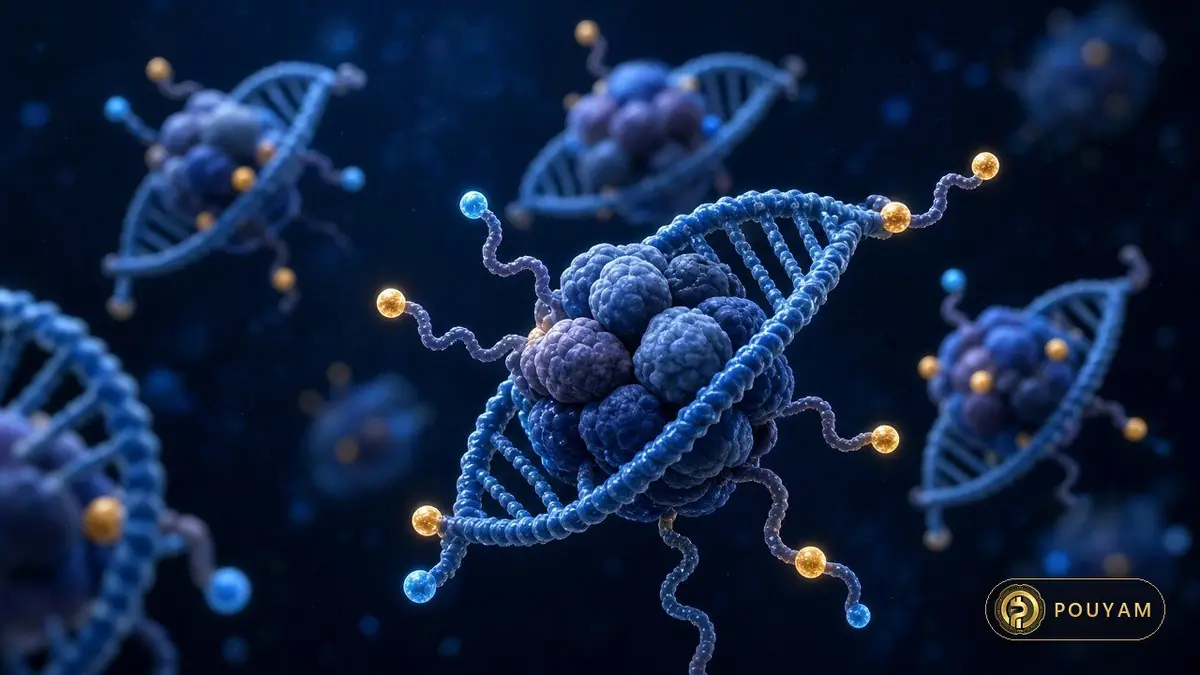
The test, called EPINUC (epigenetics of plasma isolated nucleosomes), counts chemical tags on fragments of DNA that dying cells release into the blood [1]. A nucleosome is a short stretch of DNA wrapped around a core of proteins called histones. When cells die, including cancer cells, nucleosomes leak into the bloodstream, and the paper says these cell-free nucleosomes keep the epigenetic patterns of the tissue they came from [1].
Epigenetic marks are small chemical tags on DNA or histones that help switch genes on or off without changing the DNA code. The Weizmann release compares DNA to a cookbook and the tags to sticky notes telling the cell which recipes to use [2].
- Capture: nucleosomes from less than 1 ml of plasma are captured on a microscope coverslip [1].
- Imaging: fluorescent antibodies mark different histone modifications, and single molecules are imaged with a technique called TIRF microscopy [1].
- Proteins: in parallel, the team measured breast-related proteins such as K5, L1CAM and MUC1 [1].
- Pattern reading: machine-learning classifiers combined the 29 measurements into one prediction [1].
The Nature paper says the same platform had earlier detected colorectal cancer, including early-stage disease, and helped profile children's brain tumours; the Weizmann release adds earlier promise in pancreatic cancer [1][2]. For a plain explanation of how such pattern-finding software is used and regulated in medicine, see the Pouyam guide AI in Healthcare: What It Can Do Today, Where It Fails and How It Is Regulated.
How accurate is the breast cancer blood test?
In the main study group, the expanded test separated women with luminal breast cancer from healthy women with an AUC of 0.95; the original 20-marker version scored 0.85 [1]. AUC (area under the curve) is a summary of how well a test ranks sick and healthy samples across all cut-off points: 1.0 is perfect and 0.5 is a coin toss. It is not the same as "95% of results are correct", although the Weizmann release and some news reports describe the result as 95 percent accuracy [2][3].
The key numbers, all from the Nature paper [1]:
- First cohort (MAYO-1): 77 women with luminal breast cancer and 30 healthy women. AUC 0.95 for all cancers, 0.95 for T1 tumours (42 women) and 0.96 for T2 to T4 tumours (30 women).
- Repeat set (MAYO-2): a separately processed set collected 6 to 12 months later gave an AUC of 0.98 with the model trained on the first cohort.
- Several medical centres pooled: 188 samples (51 healthy and 137 luminal cancer) from three medical centres; a model trained on 75% of them reached an AUC of 0.96 on the remaining 25%, a test set of 13 healthy and 34 luminal samples.
- Breast density: performance was not affected by breast density scores, including extremely dense breasts.
T1 means a tumour no larger than 2 cm, which the Weizmann release describes as cancer still confined to the breast [2]. Luminal tumours are the hormone-receptor-positive types [1]. The paper also reports comparable results in a smaller set of triple-negative cancers, but the main cohorts were luminal [1].
Can a blood test predict breast cancer recurrence?
In this study, blood taken before surgery predicted which patients relapsed within five years with an AUC of 0.81, a result that still has to be confirmed in larger, forward-looking studies [1]. The first Mayo Clinic cohort had at least five years of follow-up: 44 women stayed disease-free and 33 relapsed [1].
The authors found that marks linked to an aggressive "basal-like" group of cells, especially methylation of histone H3 at lysine 4 (H3K4me1 and H3K4me3), were higher in the plasma of women whose cancer came back [1]. The paper says the best model outperformed predictions based on classical factors such as stage, grade and subtype [1].
In the second, smaller set (20 disease-free, 10 relapsed), which focused on samples with available OncotypeDX scores, the blood test predicted recurrence with an AUC of 0.92 [1]. OncotypeDX is the existing tumour-based score the authors compared against. In an OncotypeDX subset of 49 women (40 disease-free, 9 relapsed), the scores did not differ between the groups, while EPINUC still separated them, and combining the two assays did not improve performance [1]. The Weizmann release turns this into the headline that the blood test "outperforms conventional tissue biopsies"; the paper's own wording is narrower and limited to this setting [1][2].
Why recurrence matters: the Weizmann release says breast cancer returns in 20 to 40 percent of cases even when it is caught early and treatment seems to work [2].
What did the study find inside breast tumours?
In 12 tumours removed at surgery, the team found a recurring group of "basal-like" cells with aggressive traits inside luminal tumours, a type that generally responds to hormone therapy [1]. The women had not received treatment before surgery, and almost all tumours were luminal; only one was triple-negative [1].
The team used mass cytometry (CyTOF), which tags proteins with metal labels and measures them one cell at a time, on more than 1.1 million cells [1]. Clustering found three recurring cell groups in each tumour, which the authors called cycling, luminal and basal-like [1]. The basal-like cells showed aggressive traits and weaker hormone-receptor signalling [1].
Some supporting work was done in the laboratory: in breast cancer cell lines and in patient tumours grown in mice (patient-derived xenografts) [1]. In the Weizmann release, the lead researcher Efrat Shema says that when the team grew breast cancer models in the lab from non-aggressive cells, an aggressive population always emerged eventually [2]. These cell-line and mouse results explain biology; they are not evidence about patients on their own.
The link back to blood came from 10 women whose tumours and pre-surgery blood were both profiled: most histone marks correlated between tumour and plasma, with the recurrence-linked marks H3K4me1 and H3K9ac showing the strongest link [1].
Could a blood test replace a mammogram?
No: the study does not show that a blood test can replace a mammogram, and the authors do not claim it [1]. Mammography is the screening test named in official guidance. WHO describes screening as mammography in apparently healthy women, usually aged 50 to 69 [4]. In the United States, the Preventive Services Task Force recommends screening every other year from age 40 to 74 [5].
The new test addresses one known weakness. Nearly half of women have dense breasts, which the Task Force says raises breast cancer risk and means mammograms may not work as well [5]. The NCI notes that false-negative mammogram results are more common in women with dense breasts [7]. In the Weizmann release, Shema says that regular mammograms reduce the risk of dying from breast cancer by 22 percent, but a tumour can "hide" in dense tissue, and that the blood test performed well regardless of density [2].
A screening test must be accurate in large numbers of healthy people, where cancer is rare. The first cohort had only 30 healthy women, and the authors themselves say larger prospective validation is needed [1]. A false positive leads to more scans and sometimes biopsies, which the NCI lists among the harms of screening [7].
When will the breast cancer blood test be available?
Neither the paper nor the Weizmann release gives a date or reports any regulatory approval for EPINUC in breast cancer, as of 13 November 2026 [1][2]. The paper describes its plasma results as retrospective, meaning they come from stored samples whose outcomes were already known, and it frames its support for EPINUC as "pending larger prospective validation" [1]. A prospective study would test women first and then follow what happens.
There is also a commercial side. The competing-interests statement says Yeda Research and Development has filed a US provisional patent application related to the method, several authors are named inventors, and a company called Epivision Genetics holds an exclusive licence [1]. Researchers from Epivision Genetics are among the co-authors [2]. A patent filing and a licence do not make the results wrong, but they are worth knowing when reading claims about the test.
Until large trials report, the practical picture stays the same: screening programmes use mammography, and anyone with a new lump or other breast change should see a doctor, which WHO stresses even when the lump does not hurt [4].
How should you read headlines about cancer blood tests?
Check four things: the type of study, the number of healthy people tested, whether "accuracy" is really an AUC, and whether any regulator has approved the test.
- Study design: was it retrospective (stored samples) or prospective (people tested and then followed)? This one was retrospective [1].
- Who was tested: 30 healthy women is a small group on which to base a screening claim [1].
- Which number: an AUC of 0.95 is a ranking score; sensitivity and specificity at a fixed cut-off tell you how many cancers are found and how many false alarms happen [1].
- Approval: look for a decision by a regulator such as the US FDA or a national health ministry, not a press release.
The same habits help with other AI-based claims. The Pouyam guide How Accurate Are AI Detectors? What the Research Says for Students and Teachers explains why a high headline accuracy can still produce many false positives when the thing being detected is rare.
This is not medical advice. For decisions about screening, talk to a doctor or your national screening service.
| Question tested | Groups | Result (AUC) |
|---|---|---|
| Cancer vs healthy, all stages (MAYO-1) | 77 luminal cancer, 30 healthy | 0.95 |
| Early T1 tumours (2 cm or less) vs healthy | 42 T1 cancer, 30 healthy | 0.95 |
| T2 to T4 tumours vs healthy | 30 cancer, 30 healthy | 0.96 |
| Original 20-marker panel, cancer vs healthy | MAYO-1 | 0.85 |
| Repeat set processed later (MAYO-2) | Separately processed samples collected 6 to 12 months later (group sizes not given in the text) | 0.98 |
| Several medical centres pooled, held-out 25% test set | 51 healthy and 137 luminal cancer samples from three centres (188 in total) | 0.96 |
| Five-year recurrence (MAYO-1) | 44 disease-free, 33 relapsed | 0.81 |
| Recurrence, second set (MAYO-2) | 20 disease-free, 10 relapsed | 0.92 |
Common mistakes
Reading "95% accuracy" as 95 out of 100 results being right.
Fix: The paper reports an AUC of 0.95, a ranking score across cut-offs; real-world error rates depend on the cut-off and on how rare cancer is in the people tested [1].
Thinking the test can be ordered now.
Fix: It is a research method; neither the paper nor the Weizmann release reports any regulatory approval, and the authors say prospective validation is needed [1][2].
Skipping a mammogram because a blood test is coming.
Fix: WHO and the US Task Force still describe mammography as the screening method; follow your national programme and ask a doctor [4][5].
Confusing a BRCA blood test with a cancer test.
Fix: BRCA testing looks for inherited risk genes, using blood or saliva, and does not show whether a tumour is present [8].
Treating the mouse and cell-line findings as patient results.
Fix: Parts of the tumour biology were shown in cell lines and mouse xenografts; the patient evidence comes from tumour samples and stored blood [1].
Frequently asked questions
Is there a blood test for breast cancer?
The new EPINUC test is experimental and has not been validated prospectively [1]. The screening method described by WHO and the US Task Force is mammography [4][5]. Tumour markers such as CA15-3 and CA27.29 are used to follow treatment or recurrence [6].
How does the new breast cancer blood test work?
It captures DNA-protein fragments called nucleosomes from less than 1 ml of plasma and reads their epigenetic tags one molecule at a time, then a machine-learning model combines 29 measurements [1].
How accurate is the breast cancer blood test?
In 77 women with luminal breast cancer and 30 healthy women it reached an AUC of 0.95, and 0.95 for tumours of 2 cm or less. These are retrospective results [1].
Can a blood test predict breast cancer recurrence?
In this study, pre-surgery blood predicted five-year recurrence with an AUC of 0.81, and 0.92 in a smaller second set; larger prospective studies are still needed [1].
Glossary
- Liquid biopsy
- A test that looks for traces of a tumour in a body fluid such as blood instead of in a tissue sample [2].
- Nucleosome
- A short length of DNA wrapped around histone proteins; dying cells release them into the blood [1].
- Epigenetic mark
- A chemical tag on DNA or histones that helps control which genes are active without changing the DNA sequence [2].
- AUC
- Area under the ROC curve: a score from 0.5 (chance) to 1.0 (perfect) for how well a test separates two groups.
- Luminal breast cancer
- Hormone-receptor-positive breast cancer that generally responds to endocrine (hormone) therapy [1].
- Retrospective study
- A study that analyses stored samples or records where the outcomes are already known.
Sources
- Epigenetic heterogeneity in breast tumours informs diagnosis and prognosis Nature · 2026-11-11
- Cancer Leaves Its Mark: New Blood Test Detects Early Breast Cancer and Helps Predict Its Return Weizmann Canada (Weizmann Institute of Science news release) · 2026-11-11
- New Israeli blood test detects early breast cancer, predicts risk of recurrence Ynet News
- Breast cancer: fact sheet World Health Organization · 2026-07-03
- Breast Cancer: Screening (final recommendation) US Preventive Services Task Force · 2024-04-30
- Tumor Markers in Common Use National Cancer Institute · 2023-12-07
- Breast Cancer Screening (PDQ), Patient Version National Cancer Institute
- BRCA Gene Changes: Cancer Risk and Genetic Testing Fact Sheet National Cancer Institute
Comments
Top comments