
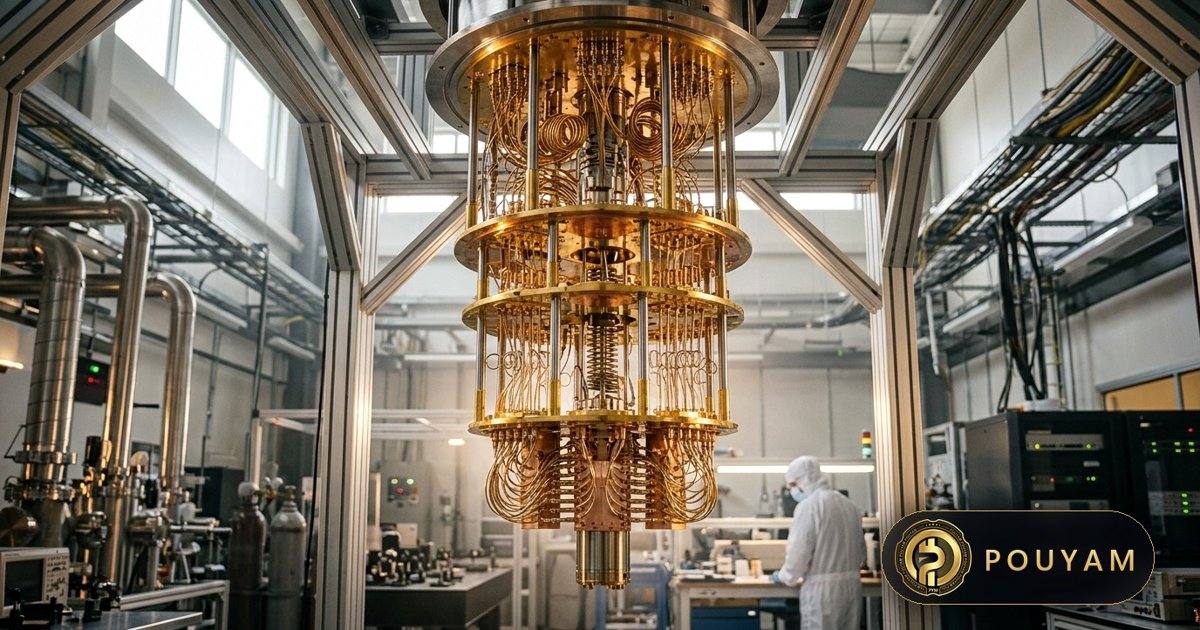
In short
Quantum computing uses qubits, superposition, entanglement and interference to tackle certain problems that classical computers handle poorly [1]. It is not a faster replacement for ordinary computers, which remain best for most tasks [1]. As of 3 November 2026 the hardware is still experimental, and NIST has already published encryption standards designed to resist future quantum attacks [5].
Key takeaways
- A qubit can hold a weighted combination of 0 and 1, and interference is what boosts right answers and cancels wrong ones [1].
- Classical computers are expected to remain the best solution for most kinds of tasks [1].
- Google's 105-qubit Willow chip halved its error rate each time its encoded grid grew from 3x3 to 5x5 to 7x7 [2].
- Headline speed-ups so far are on narrow tasks; Google says random circuit sampling has no known practical commercial use [2].
- A 2025 estimate puts breaking RSA-2048 at under a million noisy qubits running for less than a week, under stated assumptions [8].
- NIST published three post-quantum encryption standards on 13 August 2024 and urges organisations to start moving now [5].
- The UK NCSC asks organisations to finish migrating to post-quantum cryptography by 2035 [7].
On this page 12 sections
- What is quantum computing?
- How does a quantum computer actually work?
- What can quantum computers do, and what can they not do?
- Will quantum computers break today's encryption?
- How far along is quantum computing in 2026?
- Which quantum computing claims should you treat with caution?
- What are the benefits and limits of quantum computing?
- What happens next?
- Common mistakes
- Frequently asked questions
- Glossary
- Sources
What is quantum computing?
Quantum computing is a field of computer science and engineering that uses the rules of quantum mechanics to process information, aiming at problems that classical computers cannot solve, or cannot solve fast enough [1]. Instead of ordinary bits, it uses qubits (quantum bits), the basic unit of quantum information [1].
Four ideas explain how it differs from ordinary computing, in IBM's summary [1]:
- Superposition: a qubit can hold a combination of the 0 and 1 states rather than just one of them, and groups of qubits can represent combinations of many configurations at once [1].
- Entanglement: qubits can be linked so that their states are correlated; measuring one tells you something about the others [1].
- Interference: the possible outcomes behave like waves that can reinforce or cancel each other. A quantum algorithm is designed so that wrong answers cancel and the right answer is amplified [1].
- Decoherence: disturbance from measurement or the environment collapses the quantum state into an ordinary one, so quantum computers must keep it to a minimum [1].
As of 3 November 2026 the field is still in development. IBM says it first demonstrated “quantum utility”, meaning reliable results on problems beyond brute-force classical simulation, in 2023 [1]. It defines quantum advantage as a better, faster or cheaper solution than all known classical methods, and says it expects the first such advantages by late 2026 [1].
How does a quantum computer actually work?
A common misunderstanding is that a quantum computer simply tries every answer at once and reads off the best one. Measurement collapses a superposition into a single result [1], so that alone would give a random answer. The useful work comes from interference: algorithms arrange the computation so that the probabilities of correct outcomes build up and incorrect ones cancel out before the qubits are measured [1]. IBM calls interference the engine of quantum computing [1].
The hard engineering problem is noise. Qubits are fragile, and decoherence destroys the quantum state [1]. The answer researchers pursue is quantum error correction: encoding information across arrays of physical qubits so that errors are corrected faster than they ruin the computation [2]. A well-corrected group of qubits behaves as one more reliable logical qubit [2].
What did Google's Willow chip show?
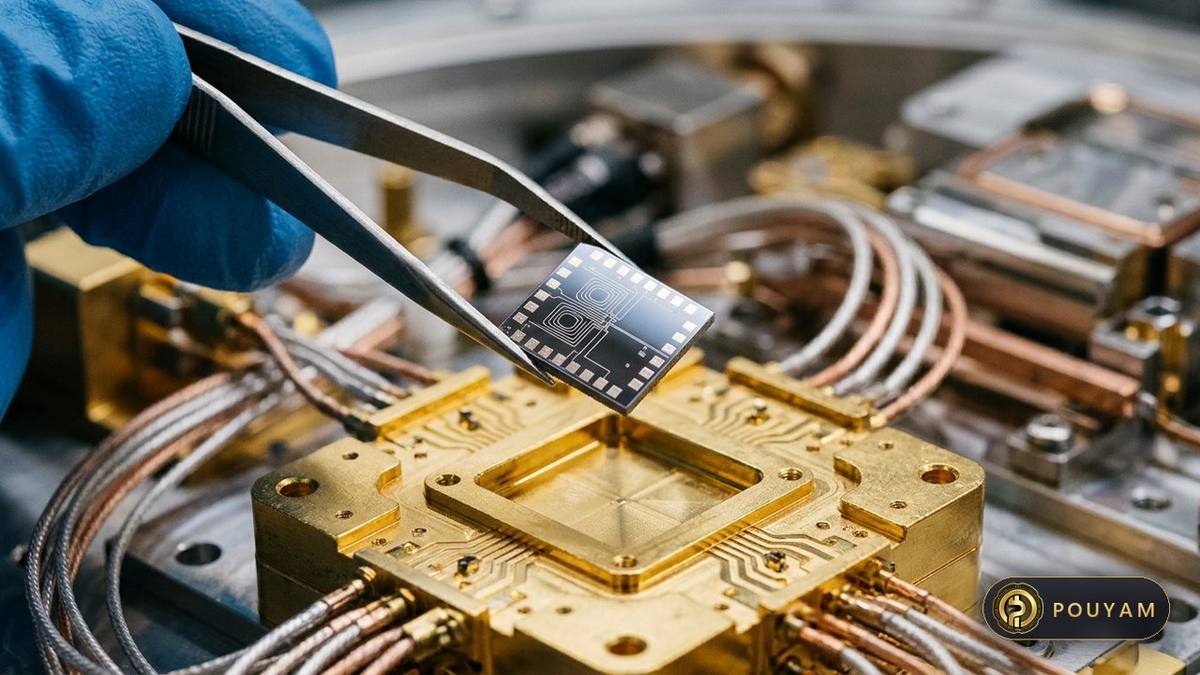
On 9 December 2024 Google announced Willow, a 105-qubit chip. As Google grew its encoded grid of qubits from 3x3 to 5x5 to 7x7, it cut the error rate in half at each step, an exponential reduction the field calls “below threshold” [2]. It matters because the result showed that using more qubits reduced errors rather than adding to them, and that the arrays of qubits outlived the individual physical qubits; Google called it the most convincing prototype of a scalable logical qubit built to date [2].
Large machines would need many physical qubits per logical qubit. IBM's roadmap, for example, describes a future system called Starling running 200 logical qubits [4], while Willow itself has 105 qubits in total [2].
What can quantum computers do, and what can they not do?
Quantum computers are not general-purpose replacements for laptops, phones or data-centre servers. IBM says that for most kinds of tasks, classical computers are expected to remain the best solution, and that quantum computing is not ideal for every, or even most, problems [1]. IBM instead describes a future in which classical supercomputers use quantum circuits to help solve problems [1].
The problems that look promising share a structure that quantum mechanics handles naturally. IBM highlights simulating physical systems such as molecules and materials, which is why chemistry and materials science attract interest [1]. The best-known algorithm is older: in 1994 Peter Shor showed how a quantum computer could factor large integers, which IBM notes could potentially break the most advanced cryptography systems of the time [1].
How should you read speed-up headlines?
Google said Willow finished a random circuit sampling task in under five minutes that it estimates would take the Frontier supercomputer 10 septillion years, but Google also says this benchmark has no known practical commercial use [2]. In October 2025 Google reported that its Quantum Echoes algorithm ran 13,000 times faster on Willow than the best classical algorithm on one of the world's fastest supercomputers, and called this “the first-ever verifiable quantum advantage”, verifiable because the result can be repeated and cross-checked on another quantum computer of similar quality [3]. Its molecular application, run with UC Berkeley on molecules of 15 and 28 atoms, was a proof-of-principle experiment [3]. Each claim compares one task against one classical approach; neither is a general speed-up.
Will quantum computers break today's encryption?
Not today, but the risk is taken seriously. A machine large and reliable enough to attack current public-key cryptography is called a cryptographically relevant quantum computer (CRQC) [6]. The UK's National Cyber Security Centre (NCSC) says most traditional public-key algorithms, including RSA and discrete-logarithm schemes such as ECDH, ECDSA and EdDSA, will be vulnerable to such a machine [6]. Symmetric cryptography is different: the NCSC says it is not significantly affected and that algorithms such as AES with keys of at least 128 bits can continue to be used [6].
How big would such a machine be?
In a May 2025 preprint (not a peer-reviewed paper), the researcher Craig Gidney estimated that a 2048-bit RSA key could be factored in less than a week by a quantum computer with fewer than a million noisy qubits, down from his 2019 estimate (with Ekerå) of 20 million noisy qubits running for eight hours [8]. The estimate assumes a 0.1% gate error rate, a 1-microsecond error-correction cycle and a 10-microsecond control reaction time [8]. For scale, Willow has 105 qubits [2]. The estimate lowers the bar but does not mean such a machine exists.
Why act before the machine exists?
The NCSC warns that an attacker could collect and store encrypted data today and decrypt it in the future [6]. That is why NIST released its first three finalised post-quantum standards on 13 August 2024 and encouraged administrators to begin transitioning as soon as possible; NIST notes that some experts predict a code-breaking quantum device could appear within a decade [5]. The NCSC's timeline asks organisations to finish discovery and planning by 2028, complete their highest-priority migrations by 2031, and complete migration of all systems by 2035 [7].

How far along is quantum computing in 2026?
The table below lists confirmed milestones separately from company roadmaps. Roadmaps are plans and may slip.
IBM announced on 10 June 2025 that it plans to build Starling, a large-scale fault-tolerant quantum computer, by 2029 at a new data centre in Poughkeepsie, New York, designed to run 100 million quantum operations on 200 logical qubits; a successor, Blue Jay, is described as capable of 1 billion operations over 2,000 logical qubits [4]. Google says its next goal after Quantum Echoes is a long-lived logical qubit, the third milestone on its roadmap [3].
IBM's own explainer, updated in April 2026, still presents quantum advantage over all known classical methods as a goal: it says IBM expects to realise the first quantum advantages by late 2026, provided the quantum and high-performance computing communities work together [1].
Which quantum computing claims should you treat with caution?
The field moves fast, and press releases can run ahead of peer-reviewed evidence. A clear example is Microsoft's 2025 press release on Majorana 1, a chip it said held eight topological qubits [9]. The accompanying Nature paper stopped short of claiming a topological qubit, and in the peer-review file Nature's editorial team wrote that the results do not represent evidence for the presence of Majorana zero modes in the devices [9]. A physicist quoted by the American Physical Society's Physics magazine said the paper contained no proof of topological qubits while the press release spoke differently [9].
Some questions help when reading any announcement:
- Is the task useful? Benchmarks such as random circuit sampling demonstrate hardware but have no known practical commercial use [2].
- What is it compared with? A speed-up against the best classical algorithm on one supercomputer [3] is narrower than beating all known classical methods, IBM's definition of advantage [1].
- Physical or logical qubits? A qubit count says little unless errors are corrected; scaling depends on error rates falling as systems grow [2].
- Peer-reviewed or press release? Check whether the paper supports the headline [9].
What are the benefits and limits of quantum computing?
Potential benefits
- Modelling molecules, materials and chemical reactions, with possible uses in drug discovery and semiconductor research [1].
- New measurement tools; in Google's Quantum Echoes experiment, results matched traditional nuclear magnetic resonance (NMR) and revealed information NMR does not usually provide [3].
- Solving certain problems far faster than classical machines once large, error-corrected systems exist [1][4].
Limits and risks
- Claims differ on whether advantage has arrived: Google described Quantum Echoes as a verifiable quantum advantage [3], while IBM's explainer, updated April 2026, still describes an advantage over all known classical methods as expected by late 2026 [1].
- Qubits are fragile, and decoherence and errors remain the main obstacles [1][2].
- A future large machine would threaten widely used public-key encryption [6], which is why migration to new standards has begun [5][7].
- Hype risk: announcements can overstate what the evidence shows [9].
What happens next?
Three dates are worth watching. First, whether the first independently confirmed quantum advantages appear by the end of 2026, as IBM expects [1]. Second, IBM's target of a fault-tolerant Starling system by 2029 [4], alongside Google's push for a long-lived logical qubit [3]. Third, the security migration deadlines: the NCSC's 2028, 2031 and 2035 milestones [7] and continued adoption of NIST's standards [5].
For a beginner the balanced view is this: quantum computing is real physics and real engineering with steady, measurable progress [2], but useful large-scale machines have not arrived, and ordinary computers will keep doing almost everything people use computers for [1].
| Common belief | What the evidence says |
|---|---|
| Quantum computers will replace ordinary computers | Classical computers are expected to stay best for most tasks [1] |
| They try every answer at once | Measurement gives one result; interference amplifies right answers [1] |
| Quantum supremacy means useful results | Random circuit sampling has no known practical commercial use [2] |
| Quantum advantage is already proven | Disputed by definition: Google claims a verifiable advantage on one task [3]; IBM still expects the first advantages over all known classical methods by late 2026 [1] |
| Encryption is already broken | A 2025 estimate needs under 1 million noisy qubits for RSA-2048 [8]; Willow has 105 [2] |
| All encryption is at risk | Public-key schemes are; AES with 128-bit or longer keys can continue [6] |
Common mistakes
Thinking a quantum computer is just a much faster PC
Fix: IBM says classical computers are expected to remain the best solution for most tasks; quantum machines target specific problem types [1].
Reading a speed-up headline as a general advantage
Fix: Check the task and the comparison. Willow's benchmark has no known practical use [2], and Quantum Echoes was compared with one classical algorithm [3].
Comparing qubit counts without asking about errors
Fix: What matters for scale is whether errors fall as systems grow, as Willow showed below threshold [2], and how many logical qubits a system offers [4].
Assuming encryption is either already broken or safe forever
Fix: Neither. A CRQC does not exist yet, but stored data could be decrypted later [6]; organisations should plan migration to NIST's standards [5][7].
Trusting press releases over papers
Fix: Microsoft's Majorana 1 press release claimed more than its Nature paper did, and the journal's editors added a cautionary note [9]. Look for the peer-reviewed evidence.
Frequently asked questions
What is a qubit in simple terms?
A qubit is the quantum version of a bit. Unlike a bit, it can hold a weighted combination of 0 and 1 until it is measured, and qubits can be entangled so their states are correlated [1].
Can I buy a quantum computer or use one at home?
Quantum computers are still experimental research systems [1]; for example, Willow has 105 qubits [2] and IBM's planned fault-tolerant Starling machine is due by 2029 at a data centre [4]. They are not consumer devices.
Will quantum computers break Bitcoin or my bank's encryption?
Not with today's machines. Public-key methods used widely today would be vulnerable to a future CRQC [6], and a 2025 estimate says RSA-2048 would need under a million noisy qubits [8]. NIST's 2024 standards are designed as replacements [5]. This is general information, not security or financial advice.
What is the difference between quantum utility and quantum advantage?
IBM uses utility for reliable results on problems beyond brute-force classical simulation, first shown in 2023, and advantage for a solution better, faster or cheaper than all known classical methods, which it expects by late 2026 [1].
Glossary
- Qubit
- The basic unit of quantum information, able to hold a combination of 0 and 1 [1].
- Superposition
- A qubit's ability to represent a weighted combination of states until measured [1].
- Entanglement
- A link between qubits that makes their states correlated [1].
- Decoherence
- Loss of quantum behaviour caused by measurement or the environment [1].
- Logical qubit
- A more reliable qubit built from many physical qubits using error correction; IBM's Starling targets 200 of them [4].
- CRQC
- Cryptographically relevant quantum computer: one able to break today's public-key algorithms [6].
- Post-quantum cryptography (PQC)
- Algorithms designed to stay secure against quantum attacks, standardised by NIST in FIPS 203, 204 and 205 [5].
Sources
- What is quantum computing? IBM Think (updated 2 April 2026) · 2025-06-10
- Meet Willow, our state-of-the-art quantum chip Google (The Keyword blog) · 2024-12-09
- The Quantum Echoes algorithm breakthrough Google (The Keyword blog) · 2025-10-22
- IBM Sets the Course to Build World's First Large-Scale, Fault-Tolerant Quantum Computer at New IBM Quantum Data Center IBM Newsroom · 2025-06-10
- NIST Releases First 3 Finalized Post-Quantum Encryption Standards National Institute of Standards and Technology (NIST) · 2024-08-13
- Next steps in preparing for post-quantum cryptography UK National Cyber Security Centre (NCSC) · 2024-08-14
- Timelines for migration to post-quantum cryptography UK National Cyber Security Centre (NCSC) · 2025-03-20
- How to factor 2048 bit RSA integers with less than a million noisy qubits arXiv preprint (Craig Gidney) · 2025-05-21
- Experts Weigh in on Microsoft's Topological Qubit Claim Physics (American Physical Society) · 2025-03-10

Comments
Top comments