In short
Genie 4 is Google DeepMind's world model, announced on 27 October 2026, that simulates interactive worlds in real time, generating audio and dialogue alongside visuals and responding to keyboard controls and text prompts. It is a research preview for trusted testers, with Google AI Ultra subscribers among the first intended consumer users. [1][2]
Key takeaways
- Google DeepMind announced Genie 4 on 27 October 2026 as a real-time interactive world model that it calls its first to generate audio natively.
- TechCrunch reports Genie 4 can hold a consistent scene for up to two minutes, double Genie 3's limit, while DeepMind's own post gives no figure in the sections reviewed.
- Genie 4 is a research preview for trusted testers; DeepMind plans to release it to consumers and developers starting with Google AI Ultra subscribers and API partners, and no price or general-availability date was found as of 3 November 2026.
- TechCrunch reports the Genie 4 team acknowledges that details and objects can drift in longer runs and that accurate audio and legible in-world text are unsolved.
- Stanford HAI says no existing benchmark gives policymakers an adequate basis to judge a world model for safety-critical use.
- Rivals take different routes: World Labs' Marble builds persistent 3D worlds, and Yann LeCun's AMI Labs raised $1.03 billion for JEPA-based models.
On this page 14 sections
- What is Genie 4?
- What is a world model in AI?
- How does Genie 4 work?
- What is new in Genie 4 compared with Genie 3?
- Can you use Genie 4 today, and what does it cost?
- What can world models like Genie 4 be used for?
- What are the promises and limits of Genie 4?
- Is a world model the same as a large language model?
- Who else is building world models?
- What is still uncertain about Genie 4?
- Common mistakes
- Frequently asked questions
- Glossary
- Sources
What is Genie 4?
Genie 4 is a world model from Google DeepMind, announced on 27 October 2026, designed for real-time interactive simulation. A user moves through a generated world with standard keyboard controls [1] and changes it with text prompts while it runs. [1][2]
Genie is DeepMind's family of models that generate interactive environments. Genie 3, announced on 5 August 2025, was a general-purpose world model whose worlds could be navigated in real time. [3] Google later put Genie 3 into Project Genie, a Google Labs web app launched on 29 January 2026. [4]
The headline change in Genie 4 is sound. DeepMind describes the model as natively multimodal: music, ambient noise and interactive dialogue are generated at the same time as the world. [1][2] DeepMind calls it its first real-time world model to generate audio natively. Every world carries the ambient sound of its setting, and characters can hold dialogue that adapts to user input and to events in the world. [1]
What does 'world model' mean in Google's wording?
Google's Project Genie announcement says a world model simulates the dynamics of an environment, predicting how it evolves and how actions affect it. Google contrasts this with explorable experiences built on static 3D snapshots, because Genie generates the path ahead in real time as you move. [4]
Who can use it?
Genie 4 is a research preview for trusted testers, and DeepMind describes it as an early, experimental model. [1][2] The access section below covers what is known about wider availability.
What is a world model in AI?
A world model is an AI system that builds a working representation of an environment so it can predict how that environment changes in response to action. That is the definition in a Stanford HAI policy brief dated 27 July 2026. [5] DeepMind's wording is close: world models use their understanding of the world to simulate aspects of it, so agents can predict how an environment will evolve and how their actions will affect it. [3] TechCrunch reported DeepMind's framing of world models as a stepping stone toward artificial general intelligence (AGI). [6]
Where does the idea come from?
Quanta Magazine traces it to psychologist Kenneth Craik's 1943 monograph, which described the mind carrying a 'small-scale model' of reality. Quanta reports that Yann LeCun, Demis Hassabis and Yoshua Bengio all consider world models essential for smarter, safer AI. [7]
Why do labs want them?
The appeal is that an agent can rehearse and plan inside a simulation instead of the real world. Stanford HAI's brief points to uses such as infrastructure planning, crisis response and manufacturing tests. [5] DeepMind tested its SIMA agent, a generalist agent for 3D virtual settings, in Genie 3 worlds. [6]
Is there agreement on what counts as one?
No. Quanta reports that 'no one can agree on the details': what is represented, how faithfully, whether it is learned or built in, and how you would detect it. [7] Stanford HAI says the scarcest input for world models is action-labelled interaction data, such as robot trajectories and fleet logs, which cannot be scraped from the web. [5]
How does Genie 4 work?
DeepMind's announcement and press coverage describe the main moving parts, set out below.
What controls the world?
Users steer with standard keyboard controls for navigation and camera. [1] Text prompts change the scene as it runs, for example changing the weather, moving the camera, or adding a person or object. [1][2]
What role do Gemini models play?
Genie 4 is built on capabilities from the Gemini family. DeepMind says Gemini Omni anchors the simulation in real-world appearance and behaviour, and other Gemini models provide the reasoning that keeps the simulation coherent. [1] In the loop, Gemini 3.8 Flash acts as a guiding agent: it watches the generated scene, breaks goals into steps and checks incoming frames to verify that each step succeeded. [1]
TechCrunch describes this design as a hybrid world model. In the words of Google research director Tejas Kulkarni, quoted by TechCrunch, hybrid world models have Gemini writing code and text while Genie simulates reality at different levels of abstraction. [2] Kulkarni told reporters that hybrid world models will become more common. [2]
Where did the design come from?
The original Genie paper (arXiv, 23 February 2024, Bruce et al., Google DeepMind) described a generative interactive environment trained without action labels from unlabelled Internet videos. At 11 billion parameters it was described as a foundation world model, made of a video tokenizer, an autoregressive dynamics model and a latent action model. [8]
Genie 2, announced in December 2024, turned a single image prompt into playable 3D environments that stayed consistent for up to a minute, with most examples lasting 10-20 seconds. [9] Genie 3 followed in August 2025, with real-time worlds from a text prompt at 24 frames per second and 720p resolution. [3][6]

What is new in Genie 4 compared with Genie 3?
DeepMind's own post supports three changes, and TechCrunch reports a fourth. [1][2]
- Sound and speech. TechCrunch reports that Genie 4 adds audio over Genie 3. DeepMind says it generates ambient sound, music and dialogue alongside the world. [1][2]
- Gemini in the loop. A Gemini model plans and checks the scene as it runs. [1]
- Text steering while running. Prompts can change weather, camera or objects during a session. [1][2]
- Length. TechCrunch reports Genie 4 can hold a consistent scene for up to two minutes, double Genie 3's limit. This figure comes from TechCrunch, not from DeepMind. [2]
Why do the session-length numbers differ?
They come from different sources and different products. DeepMind described Genie 3 as holding consistency for 'a few minutes', with visual memory reaching back about one minute. [3] Project Genie, the consumer prototype, capped generations at 60 seconds. [4] DeepMind's Genie 4 post gives no figure in the sections reviewed. [1] TechCrunch's 'double' comparison is hard to reconcile with DeepMind's 'few minutes' for Genie 3 from the text alone, so treat two minutes as TechCrunch's reported figure rather than a DeepMind specification. [2][3]
The table below sets the Genie lineage side by side, using each source's own wording.
Can you use Genie 4 today, and what does it cost?
As of 3 November 2026, Genie 4 is a research preview for trusted testers. DeepMind says it is gathering feedback before it releases the model to consumers and developers, starting with Google AI Ultra subscribers in Project Genie and early access partners of the Gemini API and Google AI Studio. A waitlist is open. [1] TechCrunch says the wider rollout is expected in the coming weeks. [2]
No price or general-availability date appeared in the sources reviewed. Check Google's official pages for current terms.
What did Project Genie look like at launch?
Project Genie launched on 29 January 2026 as an experimental prototype web app in Google Labs, powered by Genie 3, Nano Banana Pro and Gemini. [4] 9to5Google reported the same launch date and the Genie 3 and Nano Banana Pro components. [10] It was open to Google AI Ultra subscribers in the U.S. aged 18+, 'expanding to more territories in due course'. [10] Google's own announcement notes it was not available to Google AI Ultra for Business users. [4]
Its three core capabilities were world sketching with text and images, world exploration, and world remixing. Generations were limited to 60 seconds, and Genie 3's promptable world events were not included in the prototype. [4]
Is Genie 4 available in Iran?
None of the sources reviewed addresses Iran, so nothing Iran-specific can be stated as fact. The sourced baseline is that Project Genie began as a U.S.-only offer for Ultra subscribers, and DeepMind names Ultra subscribers among the first intended consumer users of Genie 4. [1][4][10] Readers in Iran should check Google's official availability and payment pages, and should not rely on third-party claims about access.
What can world models like Genie 4 be used for?
Uses fall into creative work, agent and robot training, and planning.
What are testers doing with Genie 4?
DeepMind says trusted testers across creative industries, journalism, education, gaming and engineering are trying Genie 4, for example for pre-visualisation and ideation and for turning archival photographs into simulations. [1] TechCrunch's coverage mentions film prototyping, ideation and storyboarding. [2]
How do world models help train agents and robots?
The idea is to give an agent a place to act and fail cheaply. DeepMind tested a version of its SIMA agent in Genie 3 worlds. In a press briefing reported by TechCrunch, DeepMind research scientist Jack Parker-Holder said the model 'just receives the actions from the agent', which then sees the world simulated around it. [6]
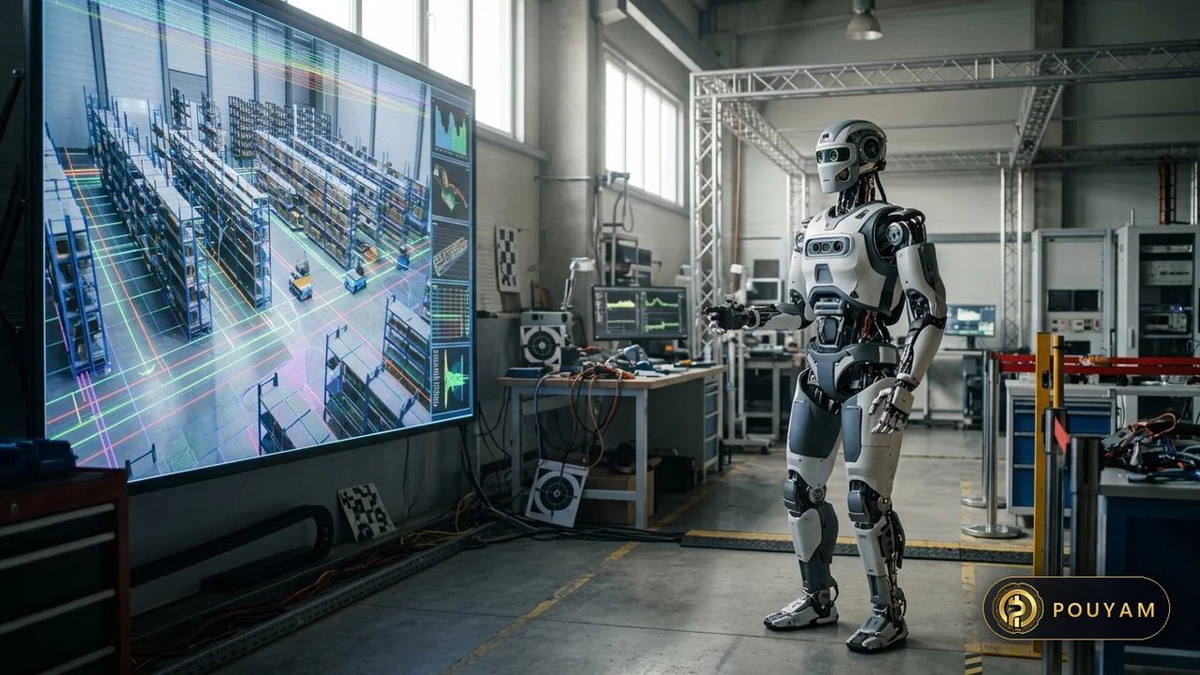
For Genie 4, TechCrunch describes an experiment in which Gemini 4 Argon, working with Gemini Robotics, broke a task into steps that Genie 4 simulated in real time. [2] DeepMind's post says the demonstration simulated Apptronik's Apollo humanoid robot playing checkers. [1] This shows planning inside a simulation, not a robot performing the task in the physical world.
What do policy researchers expect?
Stanford HAI lists infrastructure planning, crisis response and manufacturing tests as examples, and notes that robot trajectories and fleet logs, which are hard to obtain, are the scarcest training input. [5]
What are the promises and limits of Genie 4?
What does it offer?
- Interactive worlds with sound and adaptive dialogue generated in one system. [1]
- Text steering during a session, a feature testers can use for ideation and quick scenario changes. [1][2]
- A planning-and-checking loop in which a Gemini model verifies that each step succeeded. [1]
What are the limits?
TechCrunch reports that the Genie 4 team acknowledged details and objects can drift the longer a simulation runs, and that the team has not worked out how to ensure accurate audio and legible in-world text. [2] For Genie 3, TechCrunch reported a limited range of actions and difficulty modelling multiple agents interacting. [6]
What are the governance concerns?
Stanford HAI says no existing benchmark gives policymakers an adequate basis to judge a world model for safety-critical deployment. It also calls world models dual-use technology with national-security implications. [5]
Both DeepMind and TechCrunch describe a preview limited to trusted testers. [1][2] From that it is reasonable to infer that no independent evaluation of Genie 4 exists yet, though neither source says so directly.
Is a world model the same as a large language model?
No, though the two overlap. Stanford HAI defines a world model by what it is meant to do: predict how an environment changes in response to action. [5] Quanta's reporting contrasts that with large language models (LLMs), which may learn disconnected shortcuts instead. [7]
Do LLMs already contain world models?
Some researchers read emergent abilities, such as playing Othello, as signs of internal world models. [7] Quanta reports that researchers from Harvard and MIT trained a language model that gave near-perfect directions in Manhattan without learning a coherent street map. When 1% of streets were randomly blocked, its performance cratered. Quanta describes results like this as suggesting that LLMs learn 'bags of heuristics'. [7]
Which path leads to better world models?
Quanta says Google DeepMind and OpenAI are betting that enough multimodal data, such as video and 3D simulation, will make a world model emerge inside a neural network. Meta's Yann LeCun thinks a new, non-generative architecture is needed. [7] LeCun's approach, JEPA, learns abstract representations of real-world data and makes predictions in representation space, ignoring unpredictable details. That contrasts with generative models that render pixels. [11]
Genie 4 sits on the generative path, and TechCrunch reports the team acknowledges that details and objects can drift. [2] Kulkarni describes the hybrid approach as Gemini writing code and text while Genie simulates reality at different levels of abstraction. [2]
Who else is building world models?
Several companies pursue world models by different routes. The table below summarises what the sources report.
AMI Labs
Yann LeCun's AMI Labs raised $1.03 billion at a $3.5 billion pre-money valuation, announced on 9 March 2026, to build world models based on JEPA, which LeCun proposed in 2022. [12][11] Its CEO, Alexandre LeBrun, predicted that 'world models' will be the next buzzword and that every company will call itself a world model to raise funding. He also said it could take years to go from theory to commercial applications. [12]
World Labs
World Labs, co-founded by Fei-Fei Li, made Marble generally available on 12 November 2025. Marble creates persistent, downloadable 3D worlds from text, images or short video, rather than generating frames on the fly the way Genie does. [13][14] The 9 March 2026 TechCrunch article on AMI Labs reported that World Labs had raised $1 billion the previous month. [12]
Runway and market moves
TechCrunch says the Genie 4 release came a couple of months after Runway released its second world model, GWM Worlds 2, which includes audio generation. It also reports that World Labs is being acquired by AMD, that Amazon is in talks to buy Decart, and that Rivian acquired Third Dimension. [2] These are TechCrunch's reports, and the sources reviewed do not confirm them independently.

What is still uncertain about Genie 4?
Much remains unsettled, and the likely next steps are mostly access and evaluation.
- Access. DeepMind plans to release Genie 4 to consumers and developers after gathering feedback, TechCrunch says 'in the coming weeks', and no price or general-availability date has been published in the sources reviewed. [1][2]
- Independent evidence. The preview is limited to trusted testers, so claims about quality come from DeepMind and press coverage. [1][2]
- Benchmarks. Stanford HAI says no existing benchmark gives policymakers an adequate basis to judge world models for safety-critical use. [5]
- Definitions and architecture. The field disagrees about what counts as a world model and whether pixel generation or abstract prediction is the better route. [7][11]
- Hype. AMI's own CEO expects the term to be heavily overused for fundraising. [12]
What to watch next
The first signs will be the Google AI Ultra rollout in Project Genie and early access through the Gemini API and Google AI Studio. [1][2] The team acknowledges drift, audio and in-world text problems. [2] In this guide's view, independent testing against those problems is what will show whether hybrid world models hold up beyond short sessions. Google's Tejas Kulkarni predicts hybrids will become more common, but that remains a prediction rather than a settled result. [2]
| Model | Announced | What the sources say |
|---|---|---|
| Genie (original paper) | 23 February 2024 | Generative interactive environment trained without action labels from unlabelled Internet videos; 11B parameters. [8] |
| Genie 2 | December 2024 | Turns a single image prompt into playable 3D worlds; consistent for up to a minute, most examples 10-20 seconds. [9] |
| Genie 3 | 5 August 2025 | Real-time worlds from text at 24 frames per second and 720p; consistency held for a few minutes; described by TechCrunch as a research preview. [3][6] |
| Project Genie (Genie 3 inside) | 29 January 2026 | Experimental Google Labs web app for U.S. Google AI Ultra subscribers aged 18+; generations limited to 60 seconds. [4][10] |
| Genie 4 | 27 October 2026 | Native audio and dialogue, Gemini models in the loop; TechCrunch reports up to two minutes of consistency; research preview for trusted testers. [1][2] |
| Developer | Approach | Reported detail |
|---|---|---|
| Google DeepMind (Genie 4) | Generates frames, sound and dialogue in real time, with Gemini models planning and checking | Announced 27 October 2026; research preview. [1] |
| World Labs (Marble) | Persistent, downloadable 3D worlds from text, images or short video | Generally available 12 November 2025. [13][14] |
| AMI Labs | JEPA: predicts in abstract representation space rather than rendering pixels | Raised $1.03B, announced 9 March 2026. [12][11] |
| Runway (GWM Worlds 2) | Second world model, which includes audio generation | Released a couple of months before Genie 4, per TechCrunch. [2] |
Common mistakes
Assuming Genie 4 is already a public product you can subscribe to and use.
Fix: Check the date and status. Genie 4 is a research preview for trusted testers. DeepMind says it is gathering feedback before releasing it to consumers and developers, starting with Google AI Ultra subscribers and early access partners. A waitlist is open, but no price or general-availability date appeared in the sources reviewed as of 3 November 2026.
Repeating that Genie 4 is the first world model with audio.
Fix: Write 'DeepMind's first real-time world model with native audio'. TechCrunch notes that Runway's GWM Worlds 2, released a couple of months earlier, also generates audio.
Merging session-length numbers from different products and sources into one claim.
Fix: Quote each figure with its source. TechCrunch reports up to two minutes for Genie 4, DeepMind described Genie 3 as consistent for 'a few minutes', and Project Genie capped generations at 60 seconds.
Treating a world model and a large language model as the same thing.
Fix: Treat a world model as a system meant to predict how an environment changes when actions occur. Quanta reports experiments, such as a Manhattan-navigation test, suggesting language models may learn only disconnected heuristics.
Assuming a convincing generated world obeys real physics and can be trusted for engineering or safety decisions.
Fix: Read the model as a simulator of appearance and behaviour. TechCrunch reports that the Genie 4 team acknowledges details and objects can drift over longer runs. Stanford HAI says no existing benchmark supports judging world models for safety-critical use.
Taking demo videos and company claims as independently verified results.
Fix: Separate DeepMind's claims from independent evaluation. The sources reviewed describe a trusted-tester-only preview, so outside verification is probably still missing.
Frequently asked questions
What is Genie 4?
Genie 4 is Google DeepMind's world model, announced on 27 October 2026. It simulates interactive worlds in real time, generates ambient sound and adaptive character dialogue along with the visuals, and accepts keyboard controls and text prompts that change the scene while it runs. It is currently a research preview for trusted testers. [1][2]
Is Genie 4 available to the public?
Not yet in general. DeepMind calls Genie 4 a research preview for trusted testers. It says it is gathering feedback before releasing to consumers and developers, starting with Google AI Ultra subscribers in Project Genie and early access partners of the Gemini API and Google AI Studio. A waitlist is open. TechCrunch expects a wider rollout in the coming weeks. [1][2]
How much does Genie 4 cost?
No price or general-availability date appeared in the sources reviewed as of 3 November 2026. DeepMind names Google AI Ultra subscribers among the first intended consumer users. Project Genie, the earlier web app powered by Genie 3, launched for Ultra subscribers, so Ultra looks like the likely route. Check Google's official pages for current terms. [1][4]
How is Genie 4 different from Genie 3?
TechCrunch reports that Genie 4 adds audio over Genie 3. DeepMind describes ambient sound, music and dialogue that adapts to events, and builds Gemini models into the loop for planning and checking. TechCrunch also reports a consistent scene for up to two minutes, double Genie 3's limit, a figure DeepMind's post does not give in the sections reviewed. [1][2]
Is a world model the same as a large language model?
No. Quanta reports experiments suggesting language models may learn 'bags of heuristics' rather than coherent world models. Stanford HAI defines a world model as a system that predicts how an environment changes in response to action. TechCrunch quotes Google's Tejas Kulkarni describing hybrid world models in which Gemini writes code and text while Genie simulates reality. [7][5][2]
What is Project Genie?
Project Genie is an experimental prototype web app in Google Labs, launched on 29 January 2026 and powered by Genie 3, Nano Banana Pro and Gemini. [4] It opened to Google AI Ultra subscribers in the U.S. aged 18 or over [10] and let them sketch, explore and remix worlds, with generations limited to 60 seconds. [4]
How long can Genie 4 keep a world consistent?
TechCrunch reports up to two minutes, which it says doubles Genie 3's limit. DeepMind's Genie 4 post gives no figure in the sections reviewed, and it described Genie 3 as consistent for a few minutes. TechCrunch also says the Genie 4 team acknowledged that details and objects can drift the longer a simulation runs. [1][2][3]
Who else is building world models?
Apart from Google DeepMind, World Labs, co-founded by Fei-Fei Li, made its Marble model generally available in November 2025. Yann LeCun's AMI Labs raised $1.03 billion in March 2026 for JEPA-based models. TechCrunch also reports Runway's GWM Worlds 2. Each takes a different technical route to modelling the world. [2][12][13]
Glossary
- World model
- A world model is an AI system that builds a working representation of an environment so it can predict how that environment changes in response to action.
- Genie
- Genie is Google DeepMind's family of models that generate interactive environments, from the 2024 research paper to Genie 4 in October 2026.
- Project Genie
- Project Genie is a Google Labs prototype web app, launched on 29 January 2026, that let Google AI Ultra subscribers in the U.S. create and explore worlds powered by Genie 3.
- Latent action model
- A latent action model is the part of the original Genie that learns what actions did between video frames, without action labels.
- Autoregressive model
- An autoregressive model generates output step by step, with each new step depending on the ones before it.
- Hybrid world model
- A hybrid world model, as Google's Tejas Kulkarni describes it, pairs a language model such as Gemini that writes code and text with a simulator such as Genie that simulates reality at different levels of abstraction.
- JEPA
- JEPA, or Joint Embedding Predictive Architecture, is an approach proposed by Yann LeCun in 2022 that predicts in an abstract representation space instead of rendering pixels.
- Research preview
- A research preview is an early release to a limited group, such as trusted testers, so the developer can gather feedback before a wider launch.
Sources
- Genie 4: A new generation of world simulation Google DeepMind · 2026-10-27
- Google's Genie 4 world model adds audio, more realistic worlds, and real-time steering TechCrunch · 2026-10-27
- Genie 3: A new frontier for world models Google DeepMind · 2025-08-05
- Project Genie: Experimenting with infinite, interactive worlds Google (The Keyword) · 2026-01-29
- The World Model and Spatial Intelligence Era: Governing AI Beyond Language Stanford Institute for Human-Centered AI (HAI) · 2026-07-27
- DeepMind thinks its new Genie 3 world model presents a stepping stone toward AGI TechCrunch · 2025-08-05
- 'World Models,' an Old Idea in AI, Mount a Comeback Quanta Magazine (Simons Foundation) · 2025-09-02
- Genie: Generative Interactive Environments (arXiv:2402.15391) arXiv (Google DeepMind authors: Bruce et al.) · 2024-02-23
- Genie 2: A large-scale foundation world model Google DeepMind · 2024-12-04
- Google rolling out 'Project Genie' to generate playable worlds 9to5Google · 2026-01-29
- Yann LeCun's AMI Secures $1B Seed to Develop AI World Models HPCwire (AIwire) · 2026-03-11
- Yann LeCun's AMI Labs raises $1.03B to build world models TechCrunch · 2026-03-09
- Marble: A Multimodal World Model World Labs · 2025-11-12
- Fei-Fei Li's World Labs unveils its world-generating AI model Fast Company