
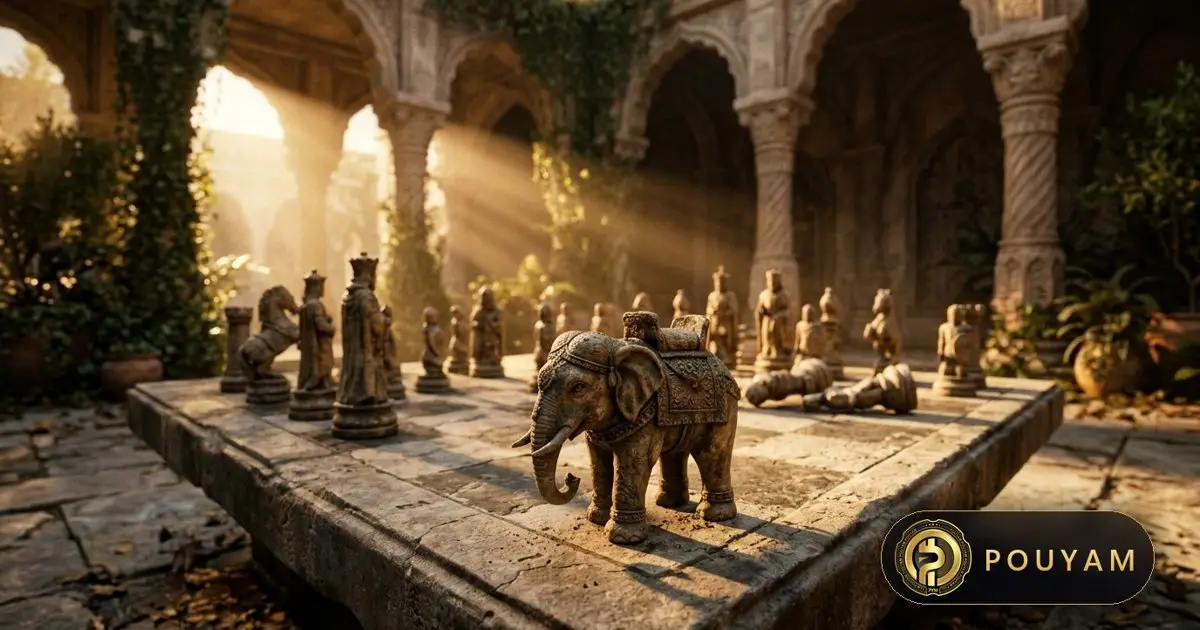
In short
Chess appears to have reached Iran from India around the late Sasanian era, but the exact arrival is uncertain. The court challenge involving Bozorgmehr is a literary tradition. Language, museum objects and later manuscript paintings support different parts of the history and should not be treated as one eyewitness record. [1][2]
Key takeaways
On this page 12 sections
- How did chess reach Iran from India?
- What do chaturanga, chatrang and shatranj tell us?
- What is the story of the Indian envoy and Bozorgmehr?
- What do the Sasanian objects show?
- What does the Nishapur set tell us about later Iranian chess?
- Can a Shahnama painting show the original arrival of chess?
- Was ancient Iranian chess the same as the modern game?
- What is the clearest way to tell this history?
- Common mistakes
- Frequently asked questions
- Glossary
- Sources
How did chess reach Iran from India?
The evidence points toward an Indian background and transmission to Iran around the late Sasanian era, but it does not establish a precise arrival date or a single verified envoy. The Middle Persian name chatrang and the literary traditions are important clues. The famous court challenge belongs to the story of that transmission, not a securely dated event record. [1]
As of November 4, 2026, the broad historical explanation is clearer than the exact circumstances of the game's arrival. Iran's place in chess history does not depend on proving that every scene in the Bozorgmehr legend happened exactly as narrated.
Maryam Ekhtiar's museum essay describes chess as apparently entering Iran through India and notes that the historicity of the court story has been questioned. It also shows how the story continued in Persian manuscript culture. The history therefore includes both the movement of a game and the ways people later imagined that movement. [2]
To understand the evidence, keep names, objects and stories beside one another. A borrowed word can suggest a connection, an artifact can show a form, and a narrative can explain cultural meaning. They answer related questions without necessarily supplying the same kind of proof.
What do chaturanga, chatrang and shatranj tell us?
The terms connect the Indian and Iranian history of the game. Utas examines its name, arrangement of pieces and early Persian traditions as evidence for development from Indian board games. He also stresses uncertainty about the earliest history, so the language evidence should not be converted into an exact year of invention. [1]
Think of a name as one trace of a moving practice. When a game is adopted, its name can change in pronunciation and writing while players also adapt the way they describe its pieces. A linguistic connection is valuable without being a complete itinerary of every person who carried the game.
Ekhtiar connects Persian chess terminology with the Sanskrit name and discusses the Persian roots visible in modern chess language. Her discussion is useful for recognizing that the game's vocabulary, like its objects, carries evidence of contact. It is not a claim that every modern rule was already present when a word was borrowed. [2]
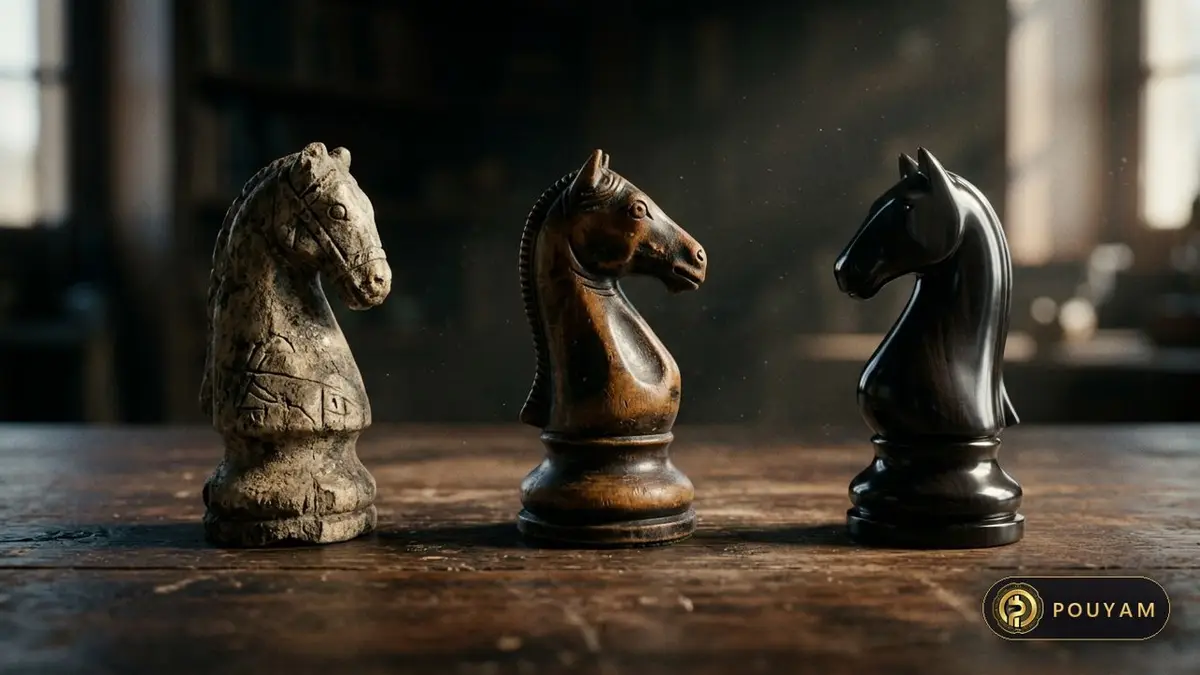
When reading different spellings, check the language and transliteration system. Chatrang and shatranj should not be treated as unrelated games merely because an English article writes them differently. At the same time, shared names should not erase changes in rules and local practice.
What is the story of the Indian envoy and Bozorgmehr?
The narrative turns the unfamiliar game into a challenge between courts. An Indian ruler sends it to Iran, and the Iranian adviser solves the puzzle of how it works. The Met's manuscript description explains how the Shahnama version connects that success with tribute and the prestige of the Iranian ruler. [4]
Read the scene as a contest of understanding. Its drama comes from an object whose meaning must be discovered, rather than from a simple account of someone teaching a neighbour to play. That is an interpretation of the plot, not a claim that such a diplomatic test is independently verified.
The episode also associates chess with courtly education. Ekhtiar discusses chess and backgammon becoming princely pastimes and appearing in training manuals. The tale helps explain why mastery of a board game could stand for intelligence and cultivated judgment. [2]
The distinction is easy to preserve in ordinary language: the story says the adviser solved the challenge. Avoid replacing that with a claim that historians know the exact occasion on which chess first crossed into Iran. The broader transmission and the memorable scene do not have to carry the same level of certainty.
What do the Sasanian objects show?
A stone elephant in the Met is catalogued as possibly a chessman and dated approximately to the sixth or seventh century CE. Its geographic attribution is Iran or Mesopotamia. The museum uses cautious language about both the object's role and its dating; a summary should preserve those qualifications. [5]
The object is useful because it makes an early piece imaginable as something physical, with a base, a body and details that can be compared with other art. Yet visual resemblance cannot supply every missing fact about use. A possible chess piece is not the same as a complete excavated game with written instructions.
The Met relates its proposed date to comparison with Sasanian elephant imagery and explains why it might belong to a chess set. That is a reasoned attribution, not a certainty produced by the modern title. The phrase possibly a chessman is part of the information, not an inconvenience to remove. [5]
Imagine how the interpretation would change if the same object were found with a complete matching set and board. Context could strengthen a game identification. Without that context, the responsible account explains the proposal and leaves room for alternatives.
What does the Nishapur set tell us about later Iranian chess?
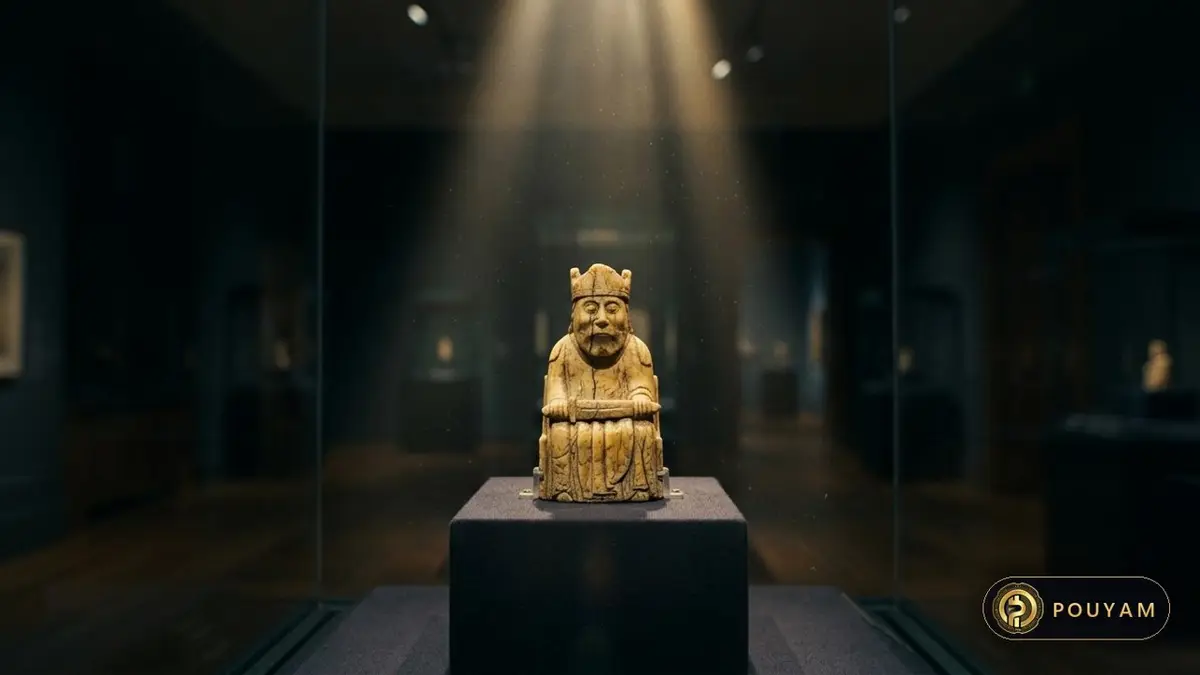
The Met's nearly complete set is dated to the twelfth century and attributed to Nishapur in Iran. Its pieces are molded and glazed stonepaste. They are highly abstract: a throne shape represents the king, a smaller throne the vizier, and other simplified forms represent the remaining roles. [3]
This is a different kind of evidence from an isolated possible chessman. A group of related forms allows the pieces to be understood together as a game set. The catalogue's place attribution still matters, however: attributed to Nishapur should not quietly become a claim about a documented excavation location.
The museum identifies tusk-like projections on the elephant, a head-like knob on the horse and a wedge-topped shape for the chariot. Comparing these forms with a familiar modern set makes continuity and difference visible at once. Recognition of a corresponding role does not mean the historical piece moved exactly like its modern counterpart. [3]
Try describing the set by function before appearance: ruler, adviser, mounted force, elephant, chariot and foot soldier. This is a useful way to notice what an abstract design communicates. It also avoids assuming that a piece must look like a modern carved figure to have been understood by its players.
Can a Shahnama painting show the original arrival of chess?
It can show how the story was pictured later. The Met dates its First Small Shahnama folio of Bozorgmehr mastering chess to approximately 1300–1330 and attributes its production to Iran or Iraq. The catalogue notes clothing associated with the artist's later world rather than presenting the scene as a contemporary Sasanian image. [4]
That time gap changes the question. The painting is evidence of the story's visual life in a later manuscript. It is not an eyewitness picture of the supposed first game at Khosrow's court. The date of the artwork and the period depicted should therefore appear separately in any caption.
Look at how the scene arranges the people around the board. Ask what the composition invites the reader to notice about wisdom, authority and an outsider's challenge. These are questions of interpretation; they do not require claiming that every costume or gesture reproduces the original event.
A later image is not less valuable because it is later. It can reveal how an old story remained worth illustrating and how artists gave it a form their audience could understand. Keep that contribution distinct from the separate search for early evidence of the game itself.
Was ancient Iranian chess the same as the modern game?
No unchanged ruleset should be assumed. The Met's account of paper games places the development of modern chess in southern Europe during the late Middle Ages, from versions of chaturanga. That later development belongs in the history alongside the earlier Indian and Iranian stages. [6]
Separate the board's visual familiarity from its rules. A recognizable king, adviser or horse does not tell you every permitted move, starting condition or way of ending a game. To reconstruct historical play, you need a rules source for the particular version you intend to describe.
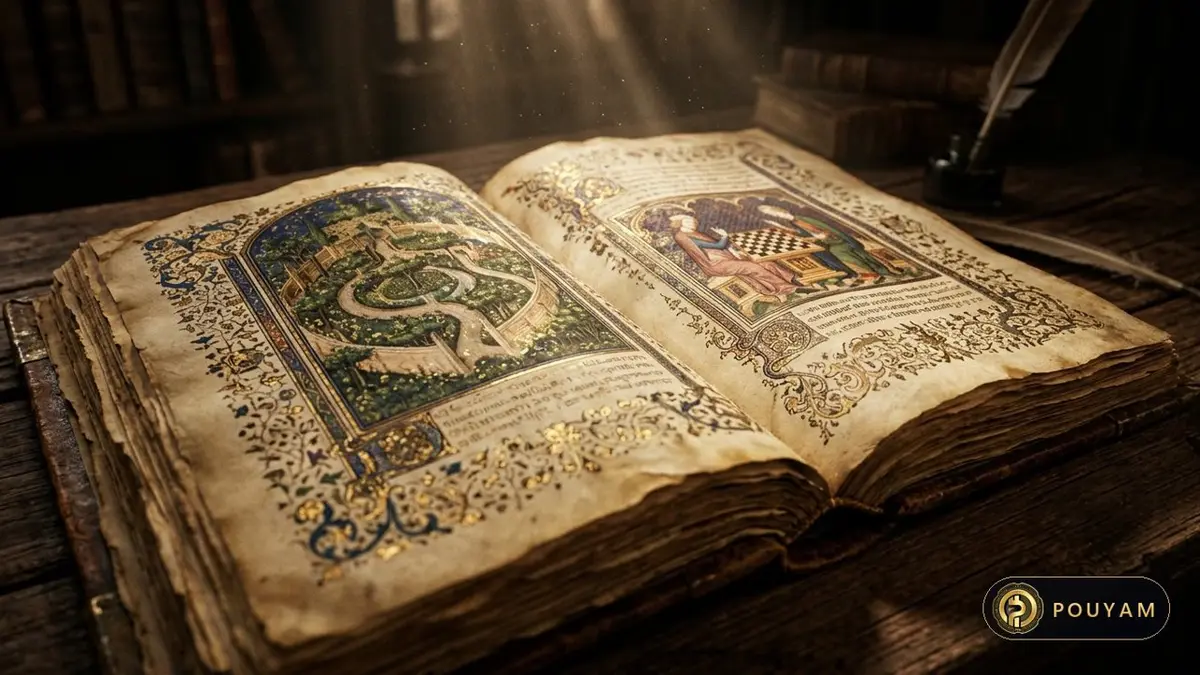
The same museum essay discusses a medieval European chess book that used the ranks of pieces to reflect on society. This provides a useful comparison with Iranian court stories: a game could be both an activity and a way of thinking about a larger social order. The comparison is interpretive, not proof that the books share one author or purpose. [6]
For present-day play, use the current rules of the game or competition you have joined. For historical interest, label a reconstruction and name the source behind it. You can enjoy both activities without treating a modern app as an exact simulation of a Sasanian court.
What is the clearest way to tell this history?
Use a broad route with explicit uncertainty: Indian antecedents, an early Iranian reception, later literary and material evidence, and subsequent changes as the game spread. Utas warns that the Middle Persian texts do not fix a certain introduction date and treats the court narrative as legendary. Preserve that caution when turning scholarship into a short explanation. [1]
Keep each dated object tied to its own claim. The possible Sasanian elephant, the set attributed to Nishapur and the later Shahnama painting do different work. Their dates should not be merged into a single alleged birth date for chess. [3][4][5]
If you want to explore further, compare a museum object record with a scholarly history. Note where one uses probable, possible or attributed. Those words tell you how strongly the identification is supported. Removing them can make an article sound cleaner while making its claims less accurate.
Pouyam's chess game offers a place to play the modern game. Its history is richer than a competition over one inventor: names, teaching, artistic forms and stories travelled and changed. Iran's contribution can be explained through that evidence while the exact first arrival remains an open historical question.
| Source or object | What is stated | Limit |
|---|---|---|
| Iranica history | Indian background and uncertain early transmission | No precise arrival date established |
| Elephant figure | Approximately sixth–seventh century CE; possibly a chessman | Identification is not certain |
| Nishapur-attributed set | Twelfth century; abstract stonepaste pieces | Later evidence, not the first Iranian game |
| First Small Shahnama folio | Approximately 1300–1330; Iran or Iraq | Later illustration of the court story |
Common mistakes
Giving a precise arrival year without evidence
Fix: Retain the scholarly uncertainty.
Calling the envoy story an eyewitness record
Fix: Identify it as literary tradition.
Removing possibly from an object label
Fix: Preserve the museum’s qualified identification.
Assuming familiar pieces imply identical rules
Fix: Use evidence for the historical version being discussed.
Frequently asked questions
Was chess brought to Iran from India?
That is the broad explanation supported by the cited historical and museum accounts, with uncertainty about exact origins and timing. [1][2]
Did Bozorgmehr invent chess in the court story?
The story presents him as solving the Indian chess challenge; it does not make him the inventor of that game. [4]
Is the elephant definitely a chess piece?
No. The museum explicitly labels it possibly a chessman. [5]
Do the Shahnama paintings date from the Sasanian court?
The folio discussed here is dated approximately 1300–1330, long after the setting of the story. [4]
Glossary
- Chaturanga
- An Indian name associated with the antecedents of chess.
- Chatrang
- The Middle Persian name used for chess in the cited textual tradition.
- Shatranj
- A later form of the game’s name used in Persian and Arabic contexts.
- Attribution
- A reasoned identification of an object’s origin, date or maker that may retain uncertainty.
Sources
- Chess i. The history of chess in Persia Bo Utas / Encyclopaedia Iranica · 1991-12-15
- Shah Mat! (Checkmate!) Maryam Ekhtiar / The Metropolitan Museum of Art · 2012-04-04
- Chess Set: twelfth century, attributed to Nishapur The Metropolitan Museum of Art
- Buzurgmihr Masters the Game of Chess: Folio from the First Small Shahnama The Metropolitan Museum of Art
- Figure of an elephant, possibly a chessman The Metropolitan Museum of Art
- Paper Pastimes: Puzzles, Games, and Other Creative Outlets from the Collection of Drawings and Prints The Metropolitan Museum of Art · 2020-07-23

Comments
Top comments