




The Future of AI Agents: How Autonomous Software Is Changing the Internet
 +50
+50 Artificial intelligence has already transformed how we search, write, code, and communicate. Yet today's AI assistants are only the beginning. The next major shift isn't simply better chatbots—it...
Artificial intelligence has already transformed how we search, write, code, and communicate. Yet today's AI assistants are only the beginning. The next major shift isn't simply better chatbots—it's AI agents capable of planning, making decisions, collaborating with other systems, and completing complex tasks with minimal human input.
Many technology leaders believe AI agents will become as significant as smartphones or cloud computing. Instead of asking software to perform one action at a time, people will delegate entire workflows to intelligent systems that operate independently.
This evolution represents one of the biggest changes in software since the rise of the internet.
What Is an AI Agent?
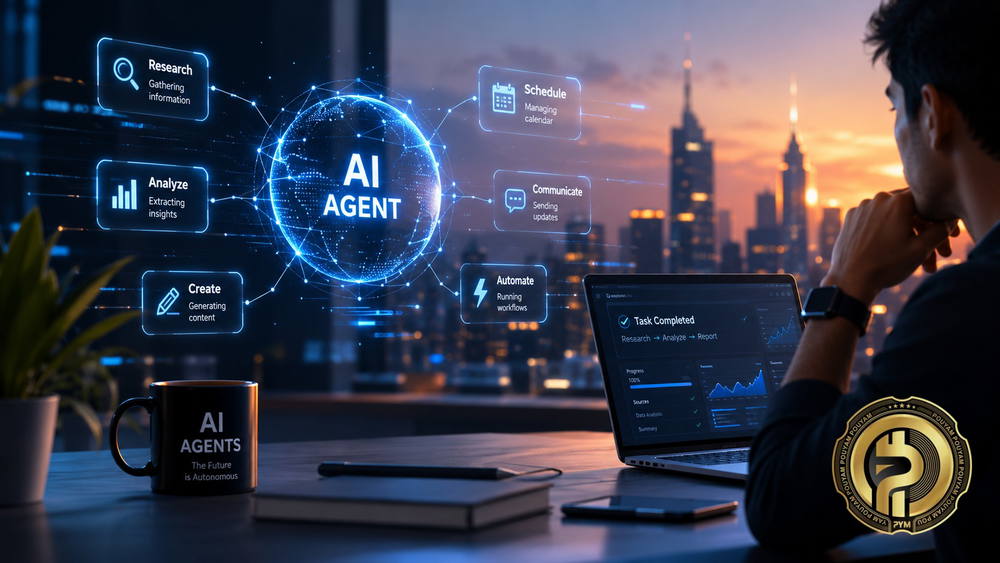
An AI agent is software that can understand goals, reason through problems, use tools, remember previous interactions, and execute multiple steps without continuous user guidance.
Unlike traditional applications, AI agents don't simply respond to commands—they actively pursue objectives.
For example, instead of asking:
"Summarize this document."
A user might ask:
"Research the best cloud provider for our startup, compare pricing, write a report, and prepare a presentation."
An advanced AI agent can perform each task automatically while adapting to new information along the way.
Why AI Agents Matter
Modern software requires users to jump between dozens of applications:
Email
Calendar
Documents
CRM
Chat
Search engines
Analytics
Design tools
AI agents act as an intelligent layer connecting these services together.
Rather than manually switching between platforms, users simply describe the desired outcome.
The agent determines:
which applications to use,
what information to retrieve,
how to organize it,
and when the task is complete.
This dramatically reduces repetitive work.
Industries Being Transformed
Software Development
Developers already use AI to generate code, identify bugs, explain complex systems, and automate testing.
Future AI agents may manage entire development workflows:
planning features
writing code
running CI/CD pipelines
creating documentation
monitoring production
Human engineers remain responsible for architecture and decision-making, while agents handle repetitive implementation.
Healthcare
Medical AI agents could assist physicians by reviewing patient histories, identifying potential risks, organizing medical records, and recommending evidence-based treatments.
Importantly, these systems are designed to support professionals—not replace them.
Finance
Financial institutions are exploring AI agents that monitor fraud, analyze market conditions, automate compliance reporting, and improve customer support.
These systems can process enormous volumes of data far faster than manual analysis.
Customer Support
Businesses increasingly deploy AI agents capable of resolving customer issues without human intervention.
Unlike traditional chatbots, modern agents can:
verify accounts
access databases
update subscriptions
process refunds
escalate complex issues
This creates faster response times while reducing operational costs.
The Challenges Ahead
Despite rapid progress, AI agents still face important limitations.
Reliability
Large language models occasionally generate incorrect information.
For autonomous systems, even small mistakes can produce significant consequences.
Reliable verification remains essential.
Security
AI agents often require access to sensitive information, including emails, financial accounts, documents, and company systems.
Strong authentication, encryption, and permission management will become increasingly important.
Privacy
Organizations must ensure that confidential information remains protected.
Responsible AI development requires transparent data handling and clear user control.
Regulation
Governments worldwide are developing frameworks for AI safety, accountability, and transparency.
Future regulations will likely influence how autonomous agents interact with businesses and consumers.
What This Means for Businesses
Companies that adopt AI strategically can improve efficiency across nearly every department.
Potential applications include:
automated marketing
sales research
customer support
software development
financial reporting
project management
knowledge management
However, successful adoption depends on thoughtful implementation rather than replacing human expertise.
Organizations that combine skilled employees with intelligent automation are likely to achieve the greatest competitive advantage.
The Next Five Years
The internet is shifting from search-driven experiences toward goal-driven experiences.
Instead of searching for information, users will increasingly ask AI systems to accomplish objectives on their behalf.
This transition could redefine productivity software, enterprise applications, digital commerce, and online services.
Just as smartphones changed how people interacted with technology, AI agents may fundamentally change how software itself operates.
Final Thoughts
AI agents represent more than another improvement in artificial intelligence—they signal a new model of computing where software becomes an active collaborator rather than a passive tool.
While challenges surrounding security, privacy, and reliability remain, the pace of innovation suggests autonomous software will become increasingly common across every industry.
Businesses, developers, and everyday users who understand this shift today will be better prepared for the next generation of digital experiences.
Comments
Top comments